2. History
Before Stump Pass
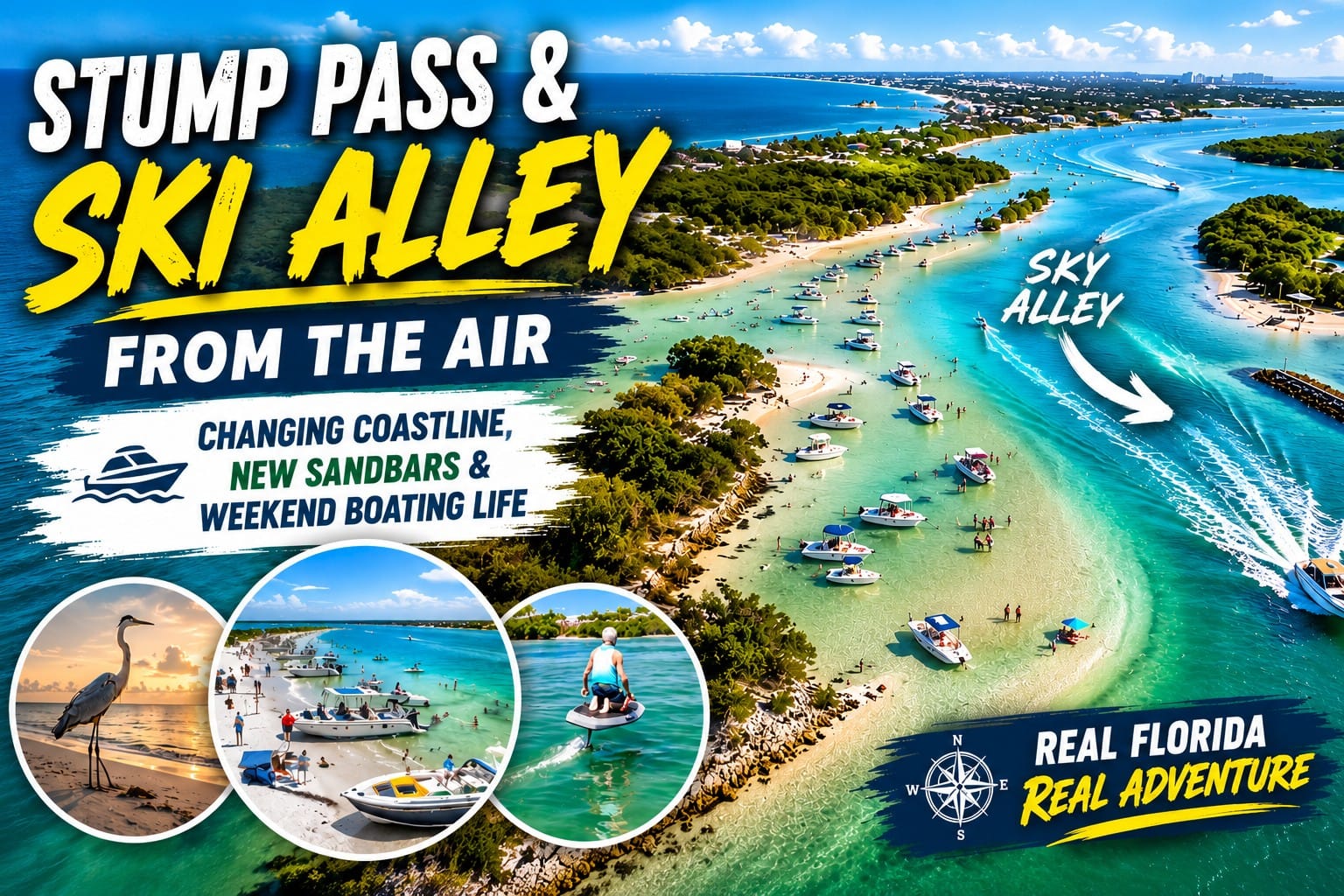
Watch on YouTube: Soar above Ski Alley and Stump Pass with Captain Pavel as this aerial adventure reveals Lemon Bay, Manasota Key, the winding tidal channel, and the dynamic barrier island landscape. Discover why Ski Alley is one of Southwest Florida's favorite protected boating routes and how Stump Pass connects Lemon Bay with the Gulf of America.
The history of Stump Pass is unlike that of most places along Florida's Gulf Coast. Rather than being defined by human settlement or major commercial shipping, its story is one of constant natural change. Wind, waves, tides, hurricanes, and shifting sand have shaped this inlet for thousands of years, and they continue to reshape it today.
Long before the modern inlet existed, the barrier islands separating the Gulf of America from Lemon Bay were continually changing. Natural tidal openings formed, migrated, and eventually closed as storms and coastal currents redistributed enormous quantities of sand. Native Calusa people traveled these waters in dugout canoes centuries before European explorers arrived, navigating through whatever tidal inlets existed at the time.
The exact locations of those ancient passes are unknown because the coastline has changed dramatically over the centuries.
The Original Stump Pass
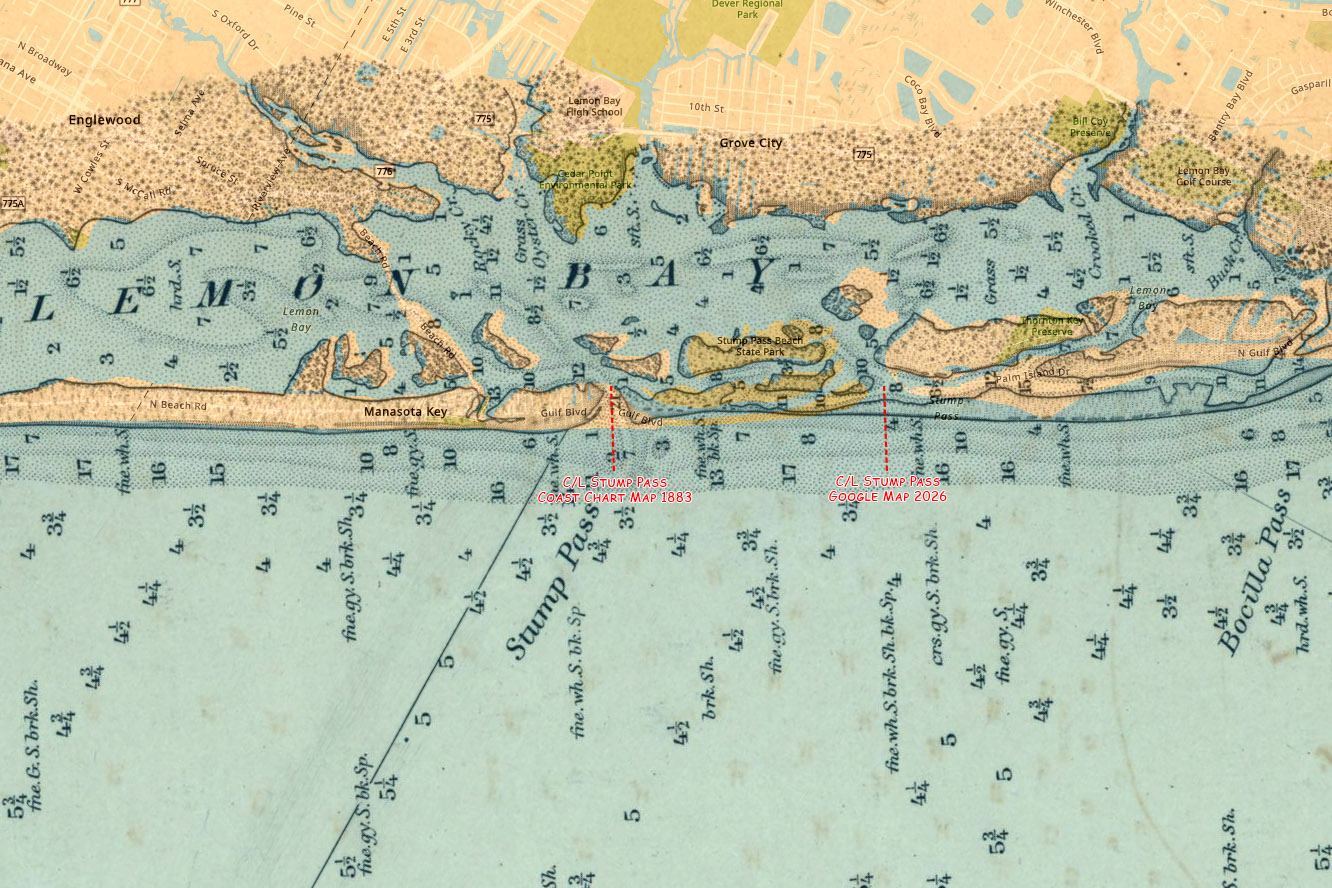
This 1883 U.S. Coast and Geodetic Survey chart, precisely overlaid on a Google map, reveals how dramatically the Stump Pass area has changed over more than 140 years. Click the image to explore the interactive ArcGIS map and compare the historic shoreline, former inlet location, barrier islands, and coastal evolution with today's Southwest Florida landscape.
The Stump Pass familiar to today's boaters is not the original Stump Pass.
Historic U.S. Coast Survey maps from 1883 and 1895 show an inlet known as Stump Pass located approximately 1.3 miles (2 kilometers) north of the present-day inlet. This earlier pass connected Lemon Bay with the Gulf and was used primarily by local fishermen, small sailing vessels, and workboats traveling between the protected waters of Lemon Bay and the open Gulf.
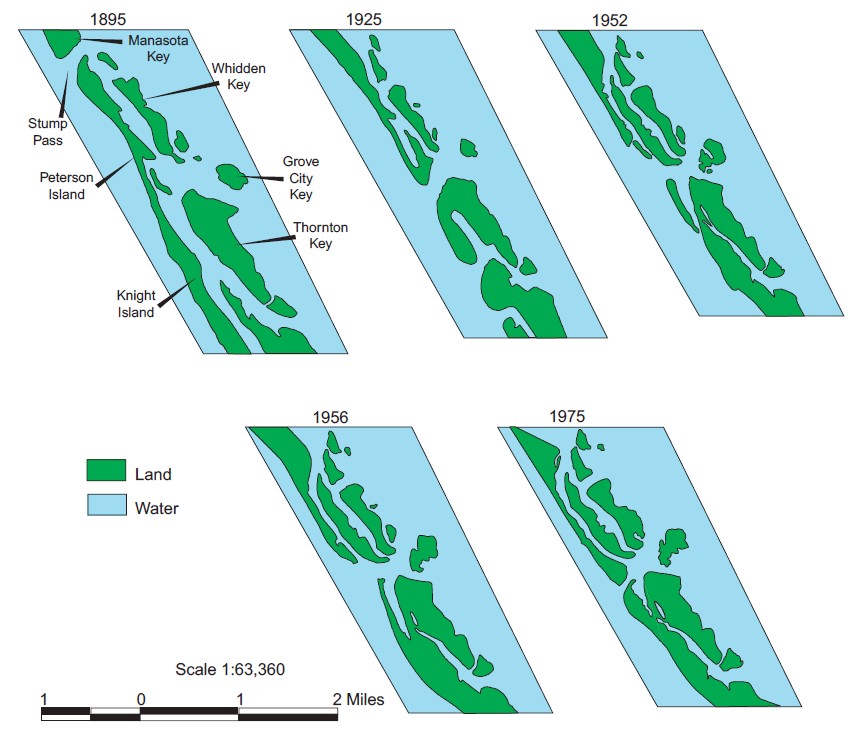
Historic maps from 1895, 1944, and 1975 reveal how Manasota Key has changed over time as hurricanes, shifting inlets, tides, and longshore currents continuously reshaped this dynamic barrier island. Click the image to open the authoritative Historical Geography of Southwest Florida Waterways: Anna Maria Sound to Lemon Bay PDF.
The origin of the name "Stump Pass" has never been officially documented. Local historians generally believe the inlet was named after tree stumps that once protruded from the shoreline or shallow waters, serving as recognizable landmarks for early mariners. While this explanation is widely accepted, no surviving historical record confirms it with certainty.
Birth of the Modern Stump Pass
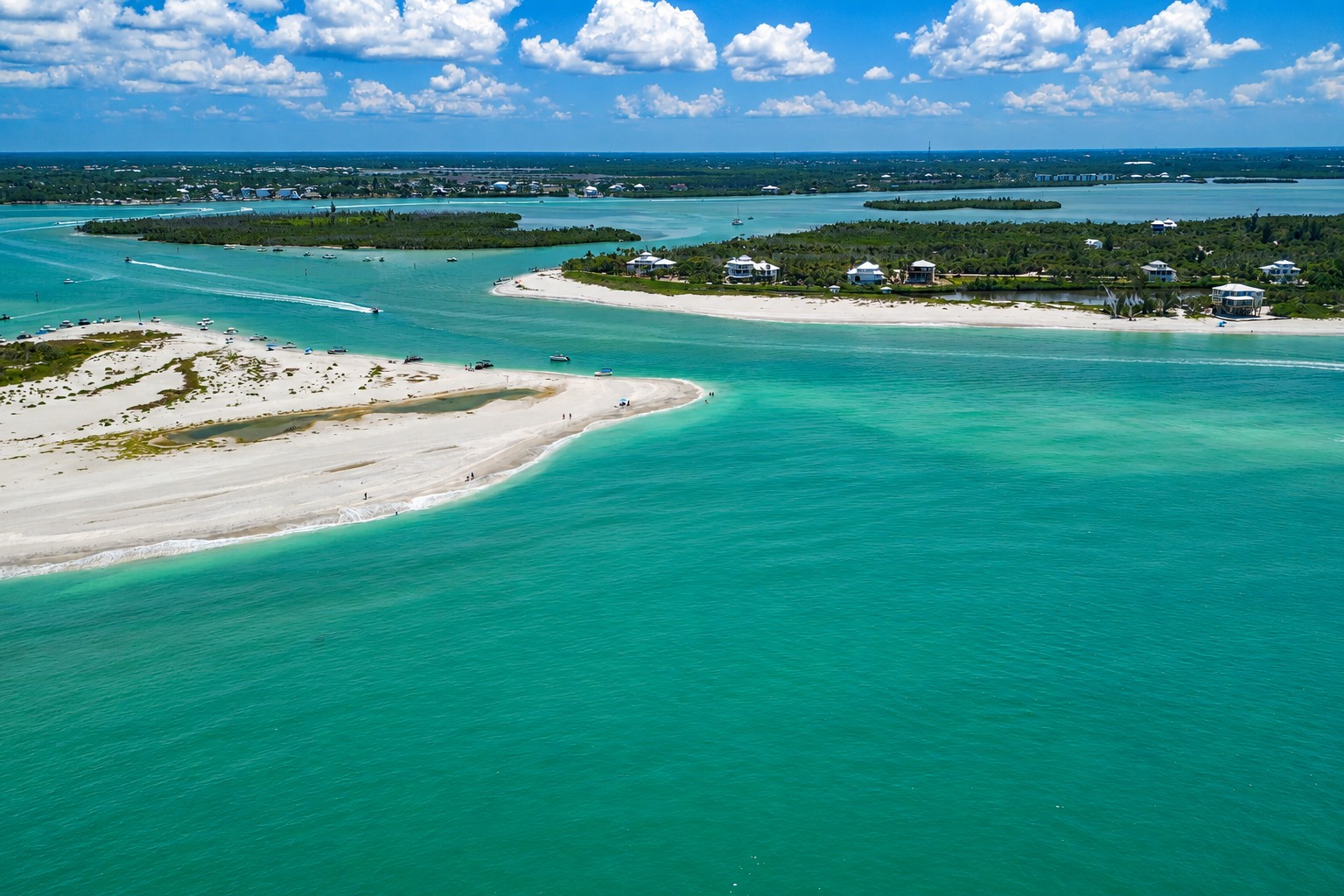
This aerial photograph captures the evolving Stump Pass sandbar at the southern tip of Manasota Key in May 2026.
Everything changed during the 1910 hurricane.
The powerful storm closed the older northern inlet while simultaneously opening a new tidal inlet at the location of today's Stump Pass. From that moment, the modern inlet became the primary connection between Lemon Bay and the Gulf of America.
This dramatic event reminds us that barrier island inlets are not permanent features. They migrate naturally as storms, tides, and waves reshape the coastline.
A Working Inlet for Local Mariners
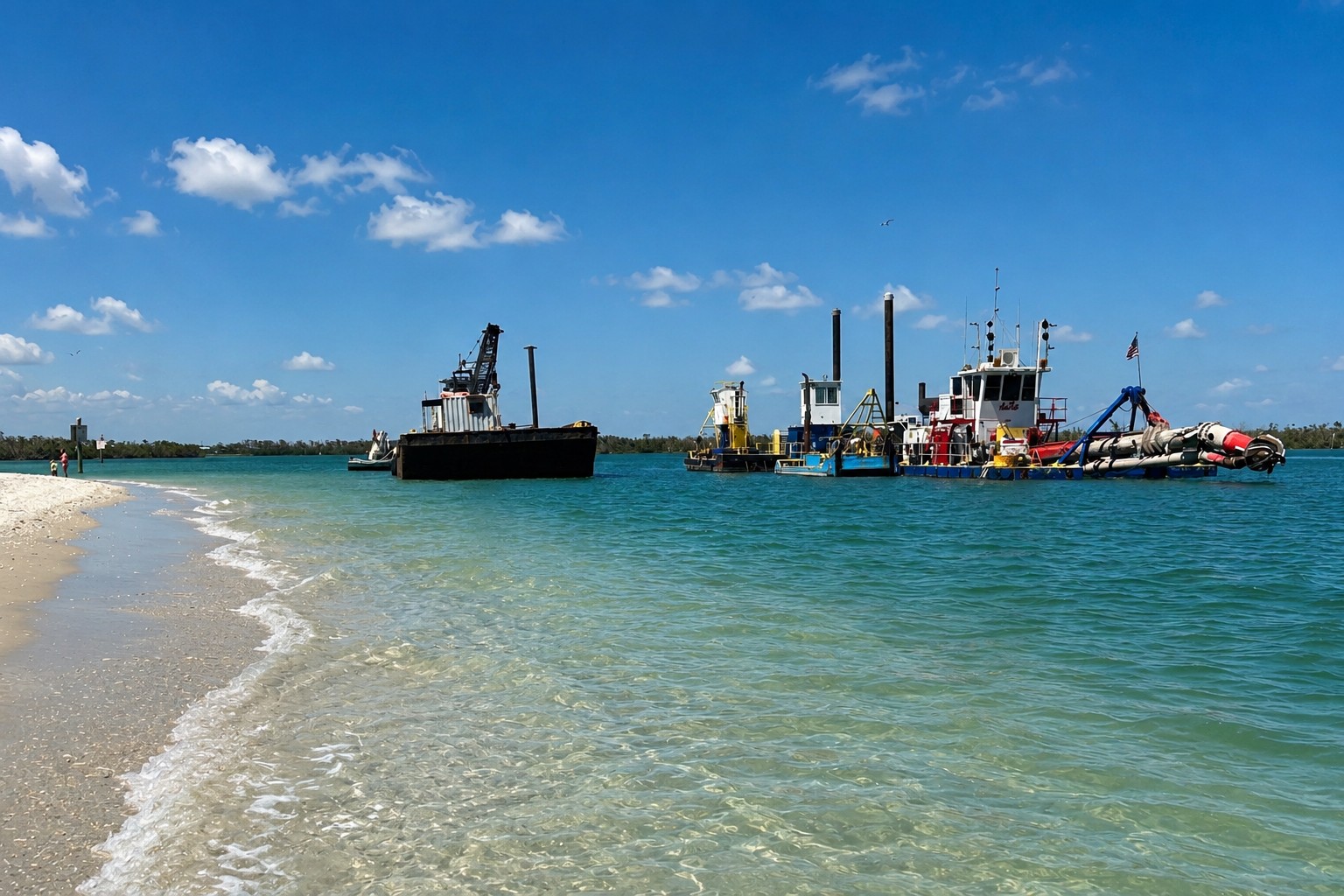
A dredge works to restore the navigation channel at Stump Pass during maintenance operations in 2025.
Unlike nearby Boca Grande Pass, Stump Pass never became a deep-water shipping channel.
Large commercial vessels, phosphate ships, and ocean-going steamships entered Charlotte Harbor through Boca Grande Pass, whose naturally deep waters could accommodate much larger vessels.
Stump Pass, by contrast, served local fishermen, small sailing boats, work skiffs, recreational boaters, and later modern fishing boats and pleasure craft. Its constantly changing depth and shifting sandbars made it unsuitable for large commercial navigation.
Today, the inlet remains popular with center-console boats, bay boats, flats boats, kayakers, paddleboarders, and other shallow-draft vessels.
A Living Inlet
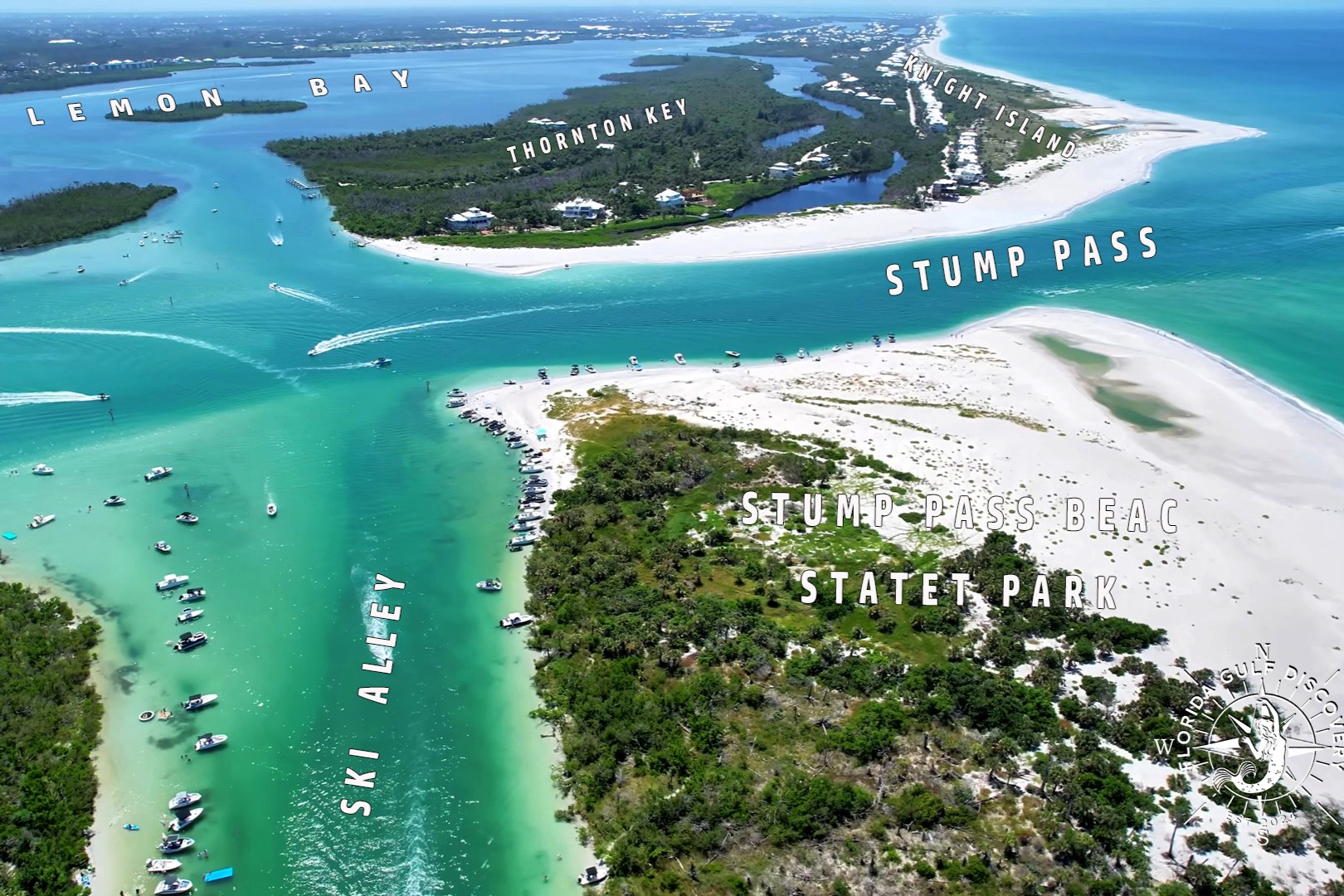
This aerial map highlights the relationship between Ski Alley, Stump Pass, and Lemon Bay at the southern end of Manasota Key.
One of the most remarkable characteristics of Stump Pass is that it never stops changing.
Powerful tidal currents continually transport sand into and out of the inlet. Gulf waves redistribute sediment along the beaches, while tropical storms and hurricanes can reshape the entire entrance within hours. As sandbars migrate, navigation channels shift, and new shoals develop, the appearance of Stump Pass changes from year to year.
This natural cycle has occurred for centuries and continues today.
Hurricane Milton and Recent Changes
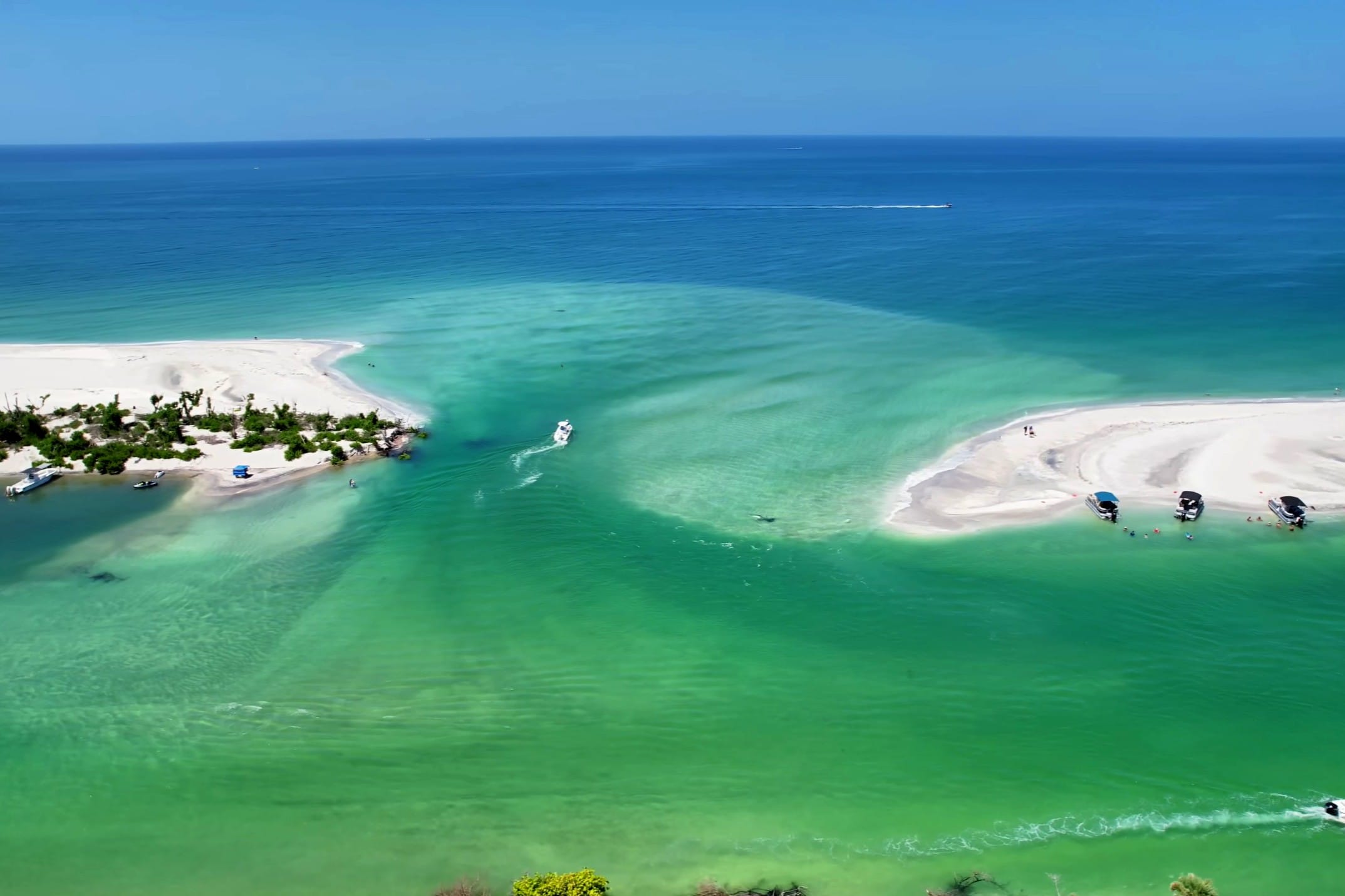
Watch on YouTube: Explore Milton Pass and Ski Alley from above with Captain Pavel. This drone flight showcases the temporary inlet that opened after Hurricane Milton, the protected waters of Lemon Bay, and the scenic waterways surrounding Manasota Key near Englewood. See how storms can reshape Southwest Florida's barrier islands and create dramatic changes to the coastline.
Hurricane Milton in October 2024 dramatically altered Stump Pass once again.
Before the hurricane, the main navigation channel generally ranged from 8–10 feet in depth. After the storm, large volumes of sand shifted into the inlet, reducing depths in places to approximately 3–4 feet.
To restore safe navigation, dredging operations were completed during 2025, deepening the marked channel to approximately 8–12 feet by the end of the summer.
Nature, however, quickly resumed its work. By 2026, sand had once again begun migrating through the inlet. Areas outside the marked fairway—particularly along the northern side of the channel—had shoaled to around 3 feet, while a noticeable new sandbar began developing along the southern shoreline adjacent to Little Gasparilla Island.
These changes demonstrate that Stump Pass remains one of Southwest Florida's most dynamic tidal inlets. The story of the pass is still being written, and every hurricane, strong cold front, and changing season leaves its mark on this ever-evolving coastal landscape.
3. Tidal Currents
How the Tide Works
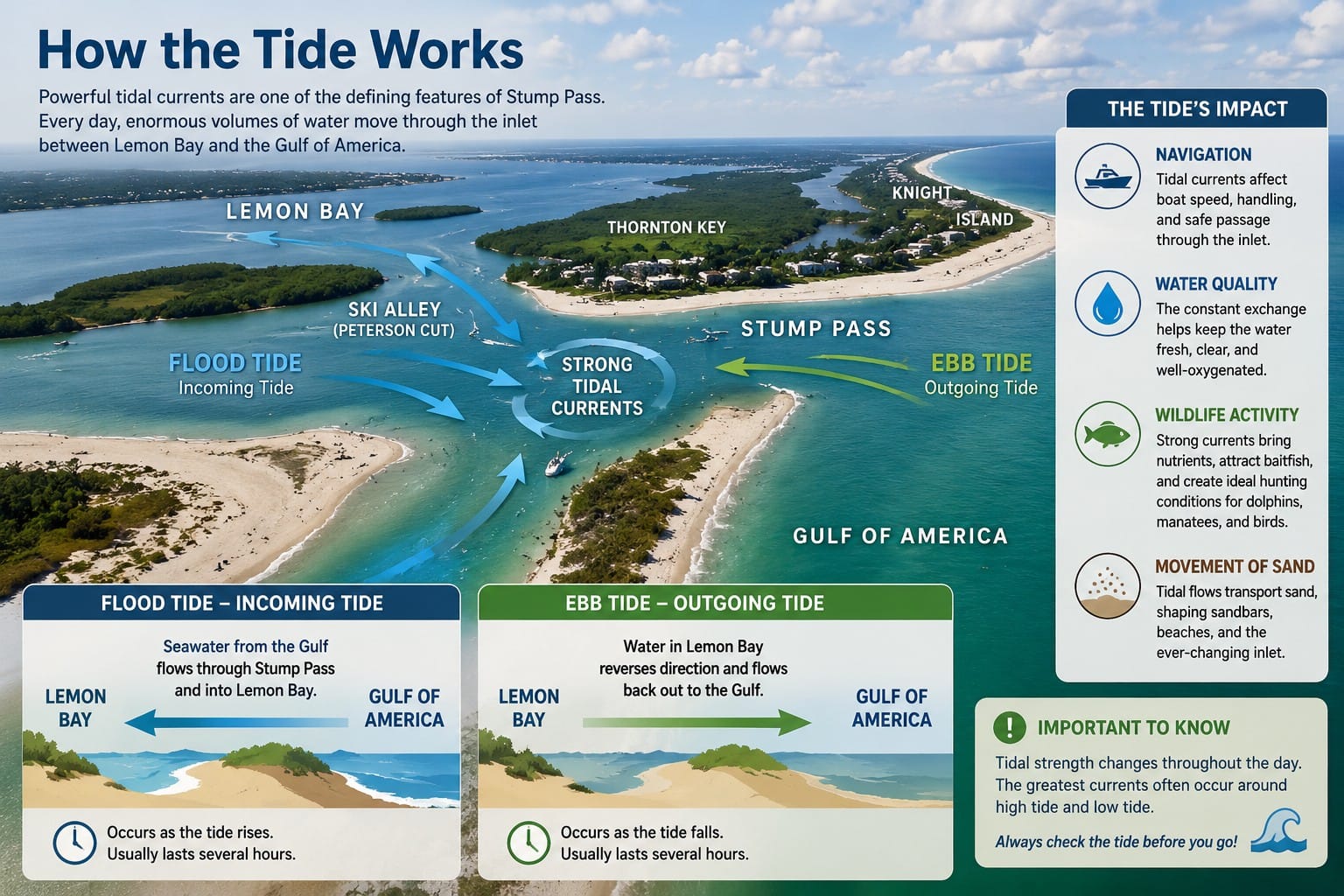
This infographic illustrates how the tides drive the constant exchange of water between Lemon Bay and the Gulf of America through Stump Pass. As the tide rises, seawater flows into Lemon Bay during the flood tide; several hours later, the ebb tide carries water back toward the Gulf. These powerful tidal currents shape the inlet, transport sand, improve water quality, influence navigation, and create ideal feeding conditions for dolphins, fish, and other wildlife that make Stump Pass one of Southwest Florida's most dynamic coastal ecosystems.
Powerful tidal currents are one of the defining features of Stump Pass. Every day, enormous volumes of water move through the inlet between Lemon Bay and the Gulf of America.
As the tide rises, seawater flows through Stump Pass and into Lemon Bay. Several hours later, as the tide falls, the water reverses direction and moves back toward the Gulf. This continuous exchange creates two primary tidal flows: the incoming flood current and the outgoing ebb current.
These currents influence nearly every part of the surrounding coastal environment, from navigation and water quality to wildlife activity and the movement of sand.
Why the Currents Are Strong
The strength of the currents is determined partly by what coastal scientists call the tidal prism—the total volume of water that enters and leaves Lemon Bay during each tidal cycle.
Because Stump Pass is the primary natural tidal connection between Lemon Bay and the Gulf of America, a large volume of water must move through a relatively narrow inlet. As the water is forced through this confined passage, the current becomes faster and stronger than it is across the wider waters of the bay.
The strongest flow is often found near the narrowest section of the inlet and around the main navigation channel. Current speed can vary considerably depending on the stage of the tide, wind direction, recent weather, and the changing shape of the channel.
How Tides Reshape the Inlet
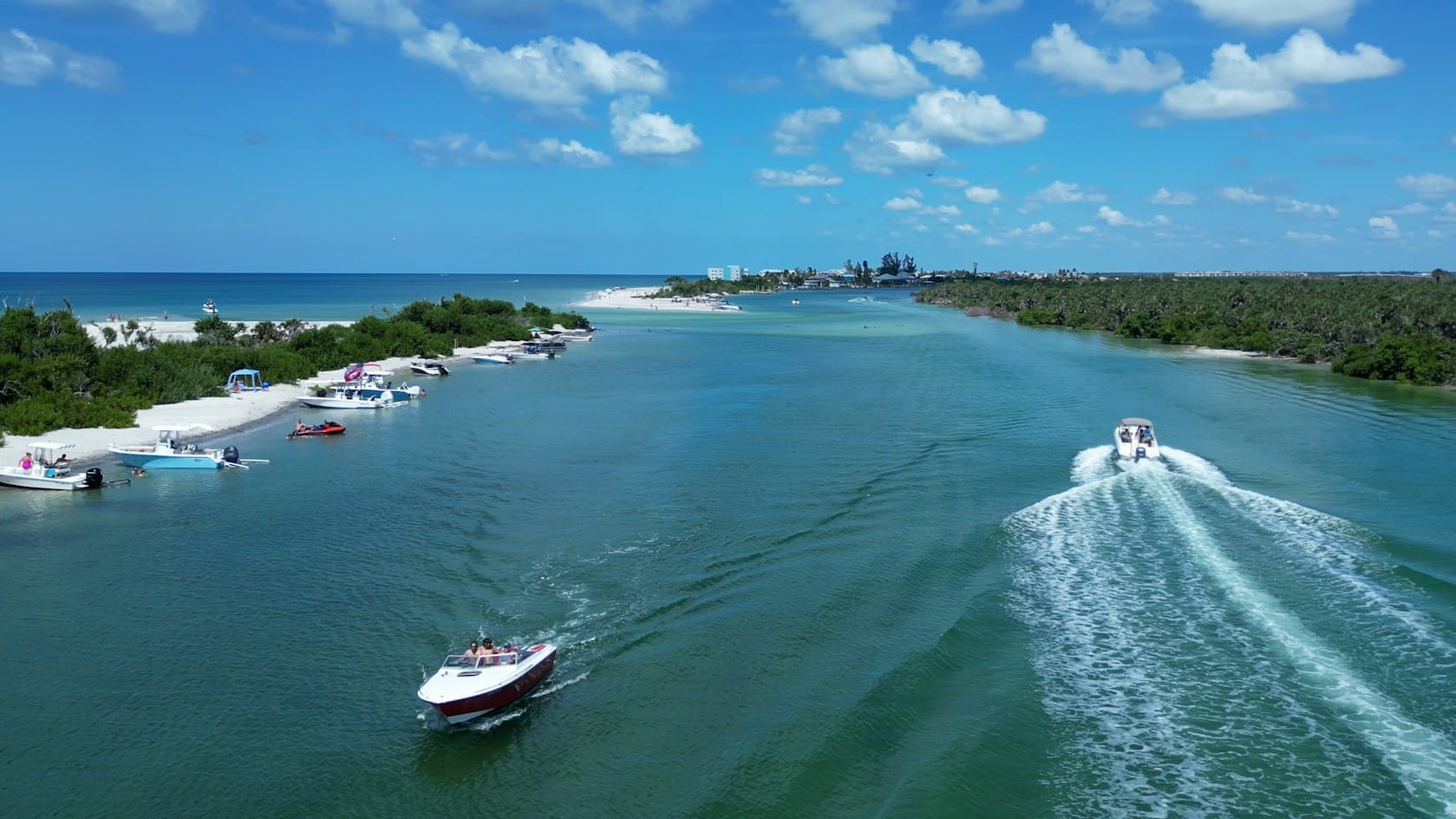
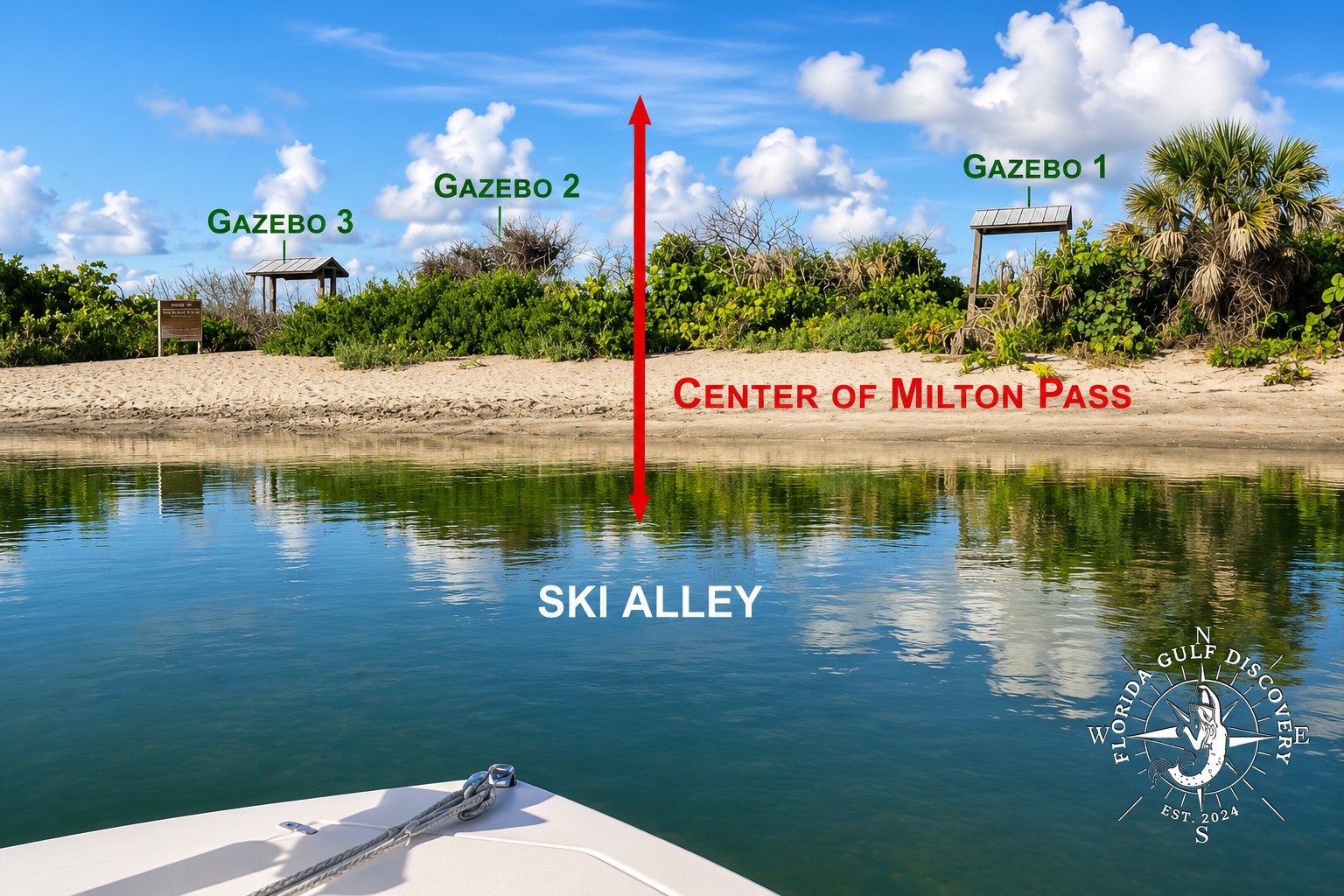
A boat navigates the calm waters of Milton Pass and Ski Alley, a scenic waterway connecting Lemon Bay with the Gulf of America near Stump Pass Beach State Park. Formed by Hurricane Milton in October 2024, Milton Pass temporarily altered the coastline and created a new tidal inlet before natural longshore currents gradually began filling it with sand. The sheltered waters around Ski Alley remain one of Southwest Florida's most popular locations for boating, paddleboarding, kayaking, wildlife viewing, and exploring the ever-changing barrier island landscape.
The currents at Stump Pass never stop moving sand. They transport sediment through the inlet, deepen some channels, fill others, build new sandbars, and gradually erode existing beaches.
During an incoming tide, Gulf water may carry sand and suspended material into the pass. During an outgoing tide, the flow can move sediment back toward the Gulf. Where the current slows, sand settles to the bottom and may gradually form a shoal or sandbar.
This constant movement explains why the navigation channel at Stump Pass changes over time. A route that was deep and clearly defined during one season may become shallower after a hurricane, winter cold front, or prolonged period of strong tidal flow.
Periodic dredging may restore the marked channel, but natural currents immediately begin redistributing the sand again. Stump Pass never remains fixed for long.
Tides and the Coastal Ecosystem
Tidal flow also plays an essential role in the health of Lemon Bay and the surrounding coastal ecosystem. Moving water carries oxygen and nutrients into the estuary while flushing sediment, organic material, and warmer water back toward the Gulf.
This exchange supports healthy seagrass beds and attracts schools of baitfish. Dolphins, snook, tarpon, redfish, seabirds, rays, and many other coastal species gather where moving water concentrates food.
Wildlife activity can therefore change with the tide. Dolphins may use the current to herd baitfish, birds may gather near shallow feeding areas, and larger fish often position themselves along channel edges where prey is carried by the flow.
Weather and Changing Conditions
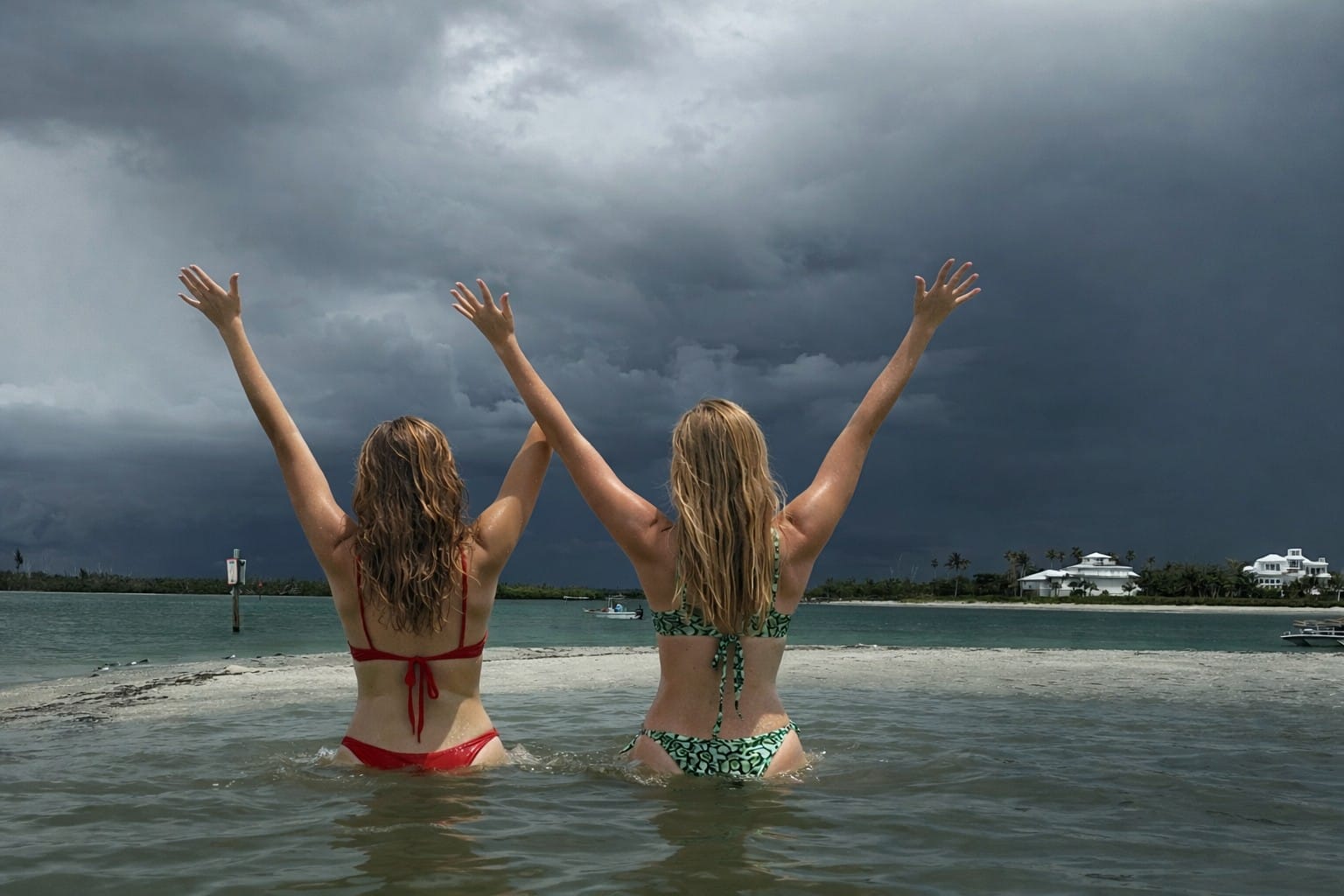
Towering storm clouds gather above the Stump Pass sandbar, where the waters of Lemon Bay meet the Gulf of America at the southern tip of Manasota Key. Summer thunderstorms and tropical systems are among the natural forces that reshape the inlet, moving sand, modifying channels, and continually changing the surrounding beaches. This ever-evolving landscape makes Stump Pass Beach State Park one of Southwest Florida's most dynamic coastal environments for boating, shelling, wildlife viewing, and coastal photography.
Wind and weather can significantly alter normal tidal conditions. Strong easterly or westerly winds may push water into or out of Lemon Bay, increasing or reducing the predicted water level.
Winter cold fronts can produce strong winds and unusually rapid changes in water movement. Tropical storms and hurricanes can have an even greater effect, shifting large quantities of sand and changing the shape, depth, and direction of the inlet within a short period.
After a major storm, familiar channels may no longer follow the same route. New shoals may appear, navigation markers may need to be adjusted, and current patterns can temporarily change until the inlet reaches a new natural balance.
Safe Boating Through Stump Pass
For boaters, understanding the tide is essential. A calm-looking surface can conceal surprisingly strong currents, particularly near the narrowest part of the pass.
Boaters should remain inside the marked navigation channel, watch all aids to navigation, maintain a safe speed, and avoid assuming that previous depths remain unchanged. Extra caution is especially important after hurricanes, strong cold fronts, dredging operations, or other events that may have moved sand.
4. Ski Alley (Peterson Cut)
A Protected Waterway
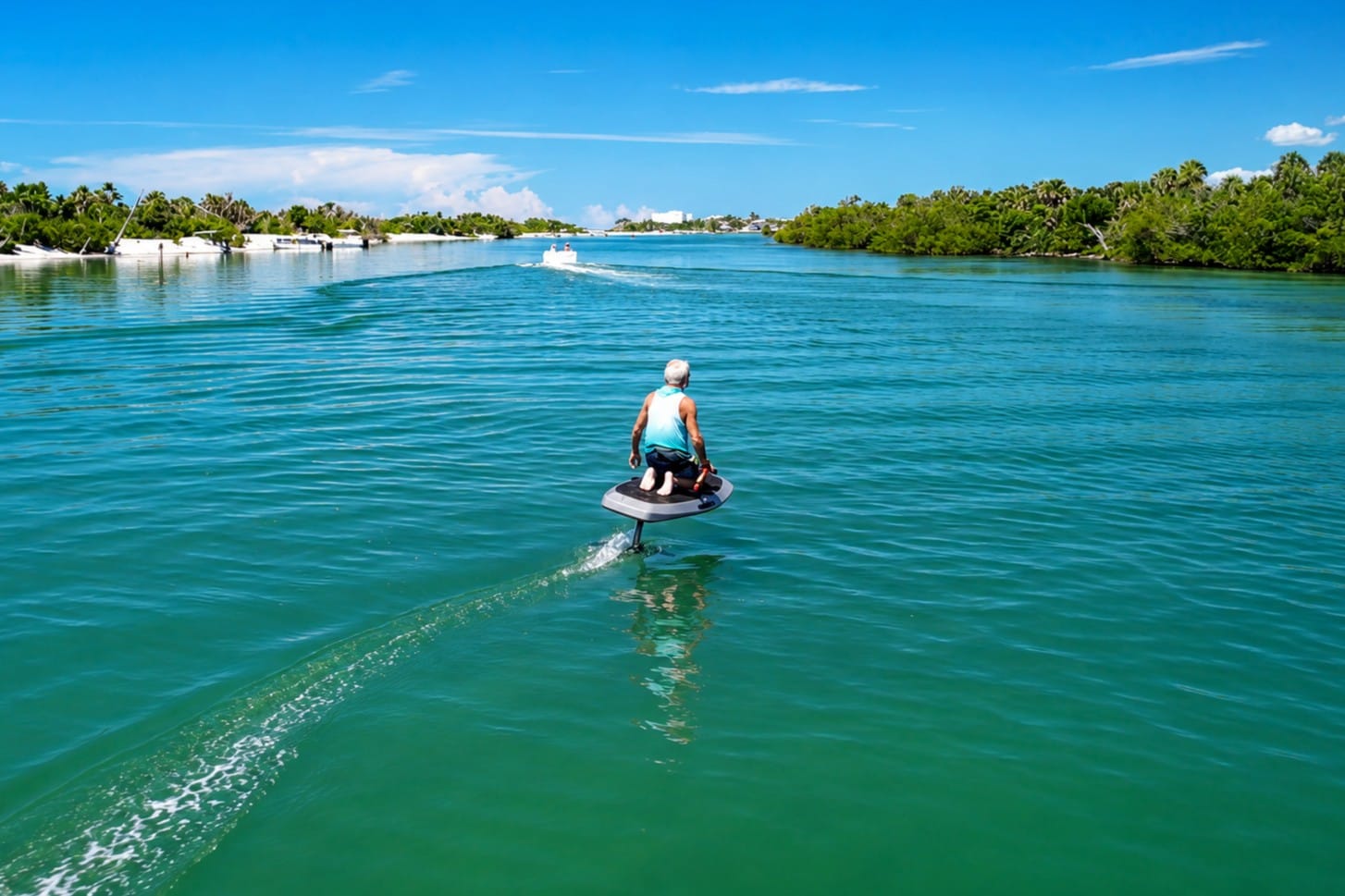
Watch on YouTube: Ride along with Captain Pavel as he e-foils through the calm, protected waters of Ski Alley near Stump Pass. This unique perspective showcases one of Southwest Florida's favorite waterways, where Lemon Bay meets the Gulf of America, offering smooth conditions for boating, paddleboarding, kayaking, and e-foiling while surrounded by spectacular coastal scenery and abundant wildlife. :contentReference[oaicite:0]{index=0}
Just north of Stump Pass lies one of Southwest Florida's best-kept boating secrets—Ski Alley, officially known as Peterson Cut. This narrow, sheltered waterway connects the southern end of Lemon Bay with Stump Pass, creating a calm passage protected by Manasota Key and Little Gasparilla Island.
Unlike the stronger tidal currents found in Stump Pass, Ski Alley is generally quieter and more protected from Gulf waves. The surrounding barrier islands create calmer conditions, making it a favorite destination for boaters, kayakers, paddleboarders, and other recreational water enthusiasts.
Part of the Same Tidal System
Despite its peaceful appearance, Ski Alley remains part of the same tidal system as Stump Pass. As the tide rises and falls, water continually moves through Peterson Cut between Lemon Bay and the Gulf of America. Although the currents here are usually much weaker than those found in the inlet itself, they still influence water quality, marine life, and navigation.
Wildlife Along the Channel
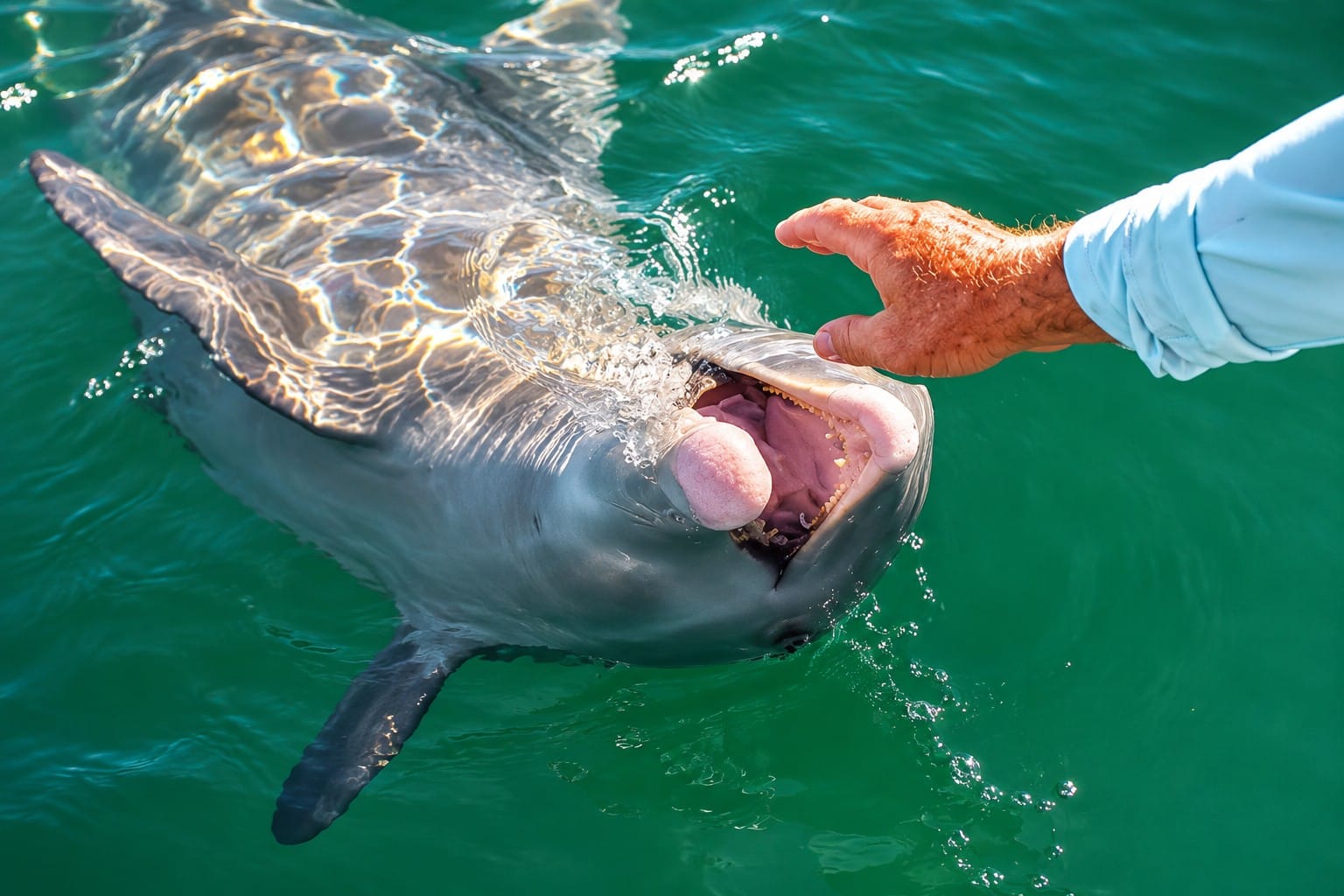
A friendly bottlenose dolphin surfaces in the calm waters of Lemon Bay near Stump Pass Beach State Park, where abundant fish and strong tidal currents create one of Southwest Florida's richest marine habitats. Dolphins are year-round residents of these waters and are frequently seen swimming through Stump Pass or riding the currents between Lemon Bay and the Gulf of America. Whether exploring by boat, kayak, or paddleboard, visitors often enjoy memorable dolphin encounters while observing these intelligent marine mammals from a respectful distance.
The surrounding shallow flats and healthy seagrass beds provide important habitat for a wide variety of coastal species. Dolphins are frequently seen hunting schools of baitfish in the deeper portions of the channel, while manatees often travel through the area during the warmer months.
Ospreys, pelicans, herons, egrets, and many other shorebirds regularly feed along the shoreline, taking advantage of the fish carried by the moving water.
A Favorite for Exploring
For boaters, Ski Alley offers a scenic alternative to the open Gulf. The protected waterway is ideal for leisurely cruising, wildlife viewing, photography, and exploring the natural beauty of southern Lemon Bay.
On calm days, the clear, shallow water often reveals seagrass meadows, stingrays gliding across the bottom, and schools of fish moving through the channel.
The area has also become increasingly popular for paddleboarding and eFoiling. Because the surrounding barrier islands reduce wave action, Ski Alley often provides smooth water while remaining only a short distance from Stump Pass and the Gulf.
Boating Tips
Although the water is generally calm, boaters should remain alert. Much of the surrounding area is shallow, and depths can change as sand is moved by tides and storms. Staying within the marked channel helps protect sensitive seagrass habitats while ensuring safe navigation.
Two Different Worlds
Ski Alley is more than just a shortcut between Lemon Bay and Stump Pass. It is the transition between two very different environments—the calm estuary behind the barrier islands and the powerful tidal inlet leading to the Gulf of America.
Together, they form one of Southwest Florida's most unique and beautiful coastal waterways.
5. Stump Pass Beach State Park
A Protected Barrier Island
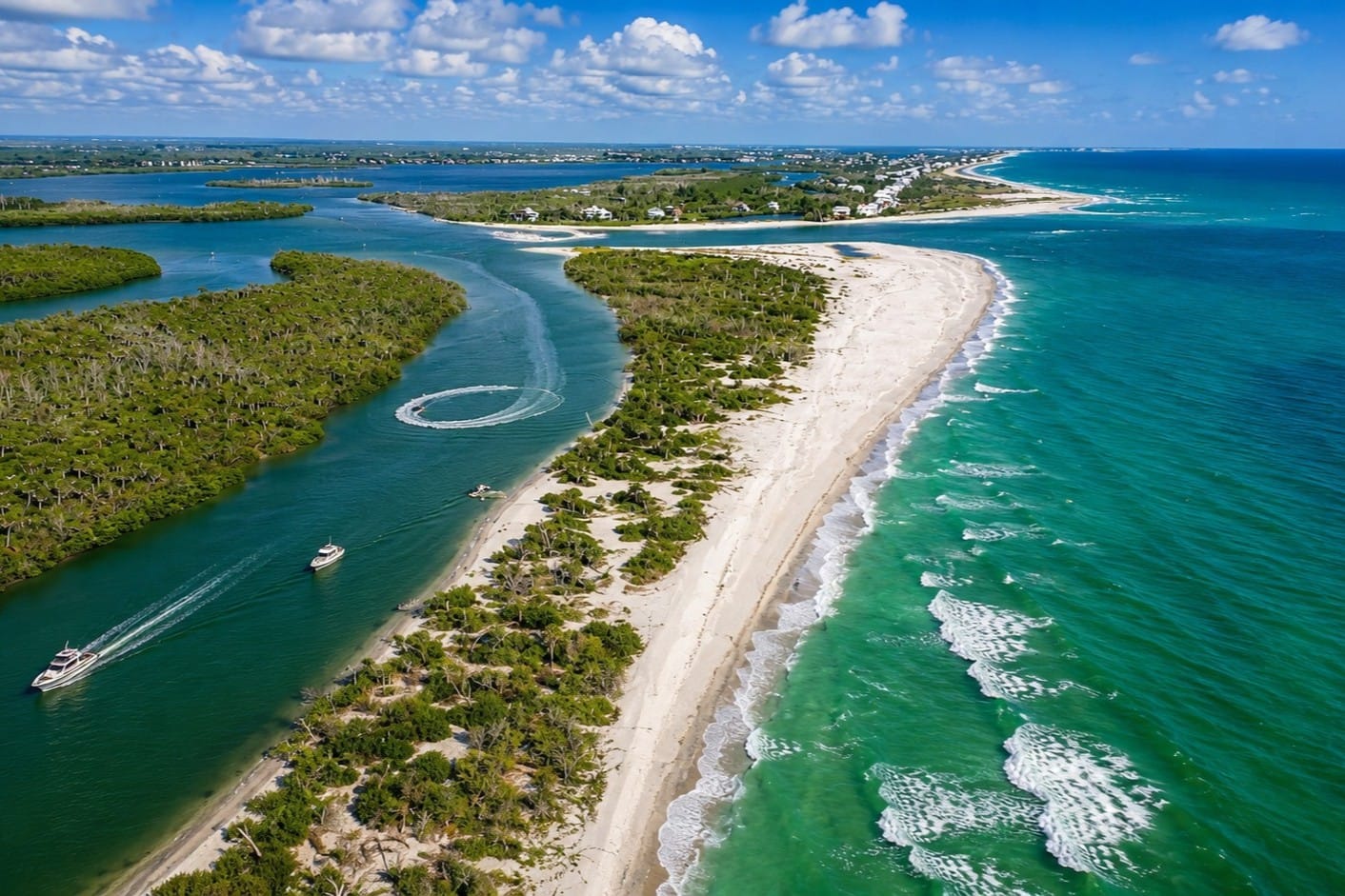
This scenic view showcases the natural beauty of Stump Pass Beach State Park at the southern tip of Manasota Key in Southwest Florida. The park protects pristine Gulf beaches, coastal dunes, mangrove shorelines, and the dynamic inlet connecting Lemon Bay with the Gulf of America. Popular for shelling, wildlife viewing, kayaking, fishing, hiking, and boating, Stump Pass Beach State Park offers visitors one of Florida's finest examples of an undeveloped barrier island ecosystem.
Occupying the southern tip of Manasota Key, Stump Pass Beach State Park protects one of Southwest Florida's last undeveloped stretches of barrier island coastline. Covering approximately 245 acres, the park preserves natural beaches, coastal dunes, maritime hammock, mangrove shoreline, and tidal habitats that support a remarkable diversity of plants and wildlife.
Unlike many of Florida's developed beaches, the park remains largely unchanged by buildings or commercial development. Visitors experience a landscape that closely resembles the natural barrier islands that once stretched along much of Florida's Gulf Coast.
Beautiful Beaches and Excellent Shelling
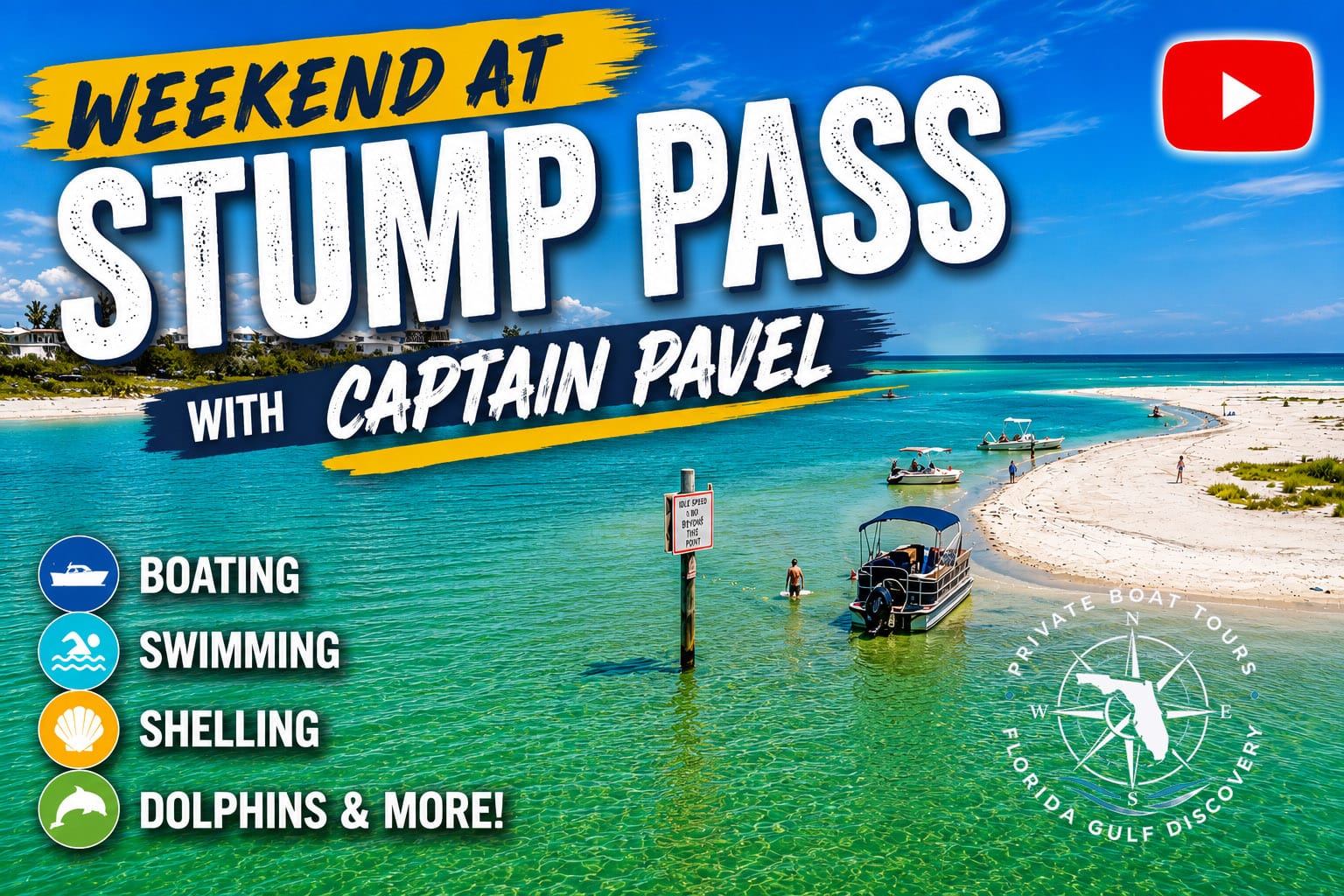
Watch on YouTube: Spend a weekend exploring Stump Pass Beach State Park with Captain Pavel. Cruise through Lemon Bay, discover the famous Ski Alley waterway, enjoy pristine Gulf beaches, and experience why Stump Pass is one of Southwest Florida's favorite destinations for boating, wildlife, shelling, and unforgettable coastal adventures.
The park's wide Gulf beach is known for its excellent shelling, particularly after winter cold fronts and tropical storms. As waves and tidal currents move through nearby Stump Pass, seashells are carried along the shoreline and often accumulate on the beach, making it one of the best shelling locations on southern Manasota Key.
Whether you're searching for lightning whelks, tulip shells, olives, or colorful coquinas, every tide offers the possibility of a new discovery.
Dunes That Protect the Coast
Behind the beach, rolling dunes are stabilized by native vegetation including sea oats, railroad vine, beach elder, and sea grapes. These plants play an essential role in protecting the island from erosion by trapping windblown sand and helping the dunes recover after storms.
The dunes also provide important nesting and resting habitat for shorebirds and other coastal wildlife.
Wildlife Throughout the Park
The protected shoreline serves as an important nesting area for loggerhead sea turtles, which come ashore between May and October to lay their eggs. During nesting season, visitors should avoid disturbing marked nests, fill in holes dug on the beach, and minimize artificial lighting after sunset to help hatchlings safely reach the Gulf.
Birdwatchers frequently encounter ospreys, brown pelicans, snowy egrets, great blue herons, royal terns, black skimmers, and seasonal migratory shorebirds. Dolphins are often visible just offshore, while manatees occasionally pass through nearby Stump Pass and the protected waters of southern Lemon Bay.
Hiking to the End of the Park
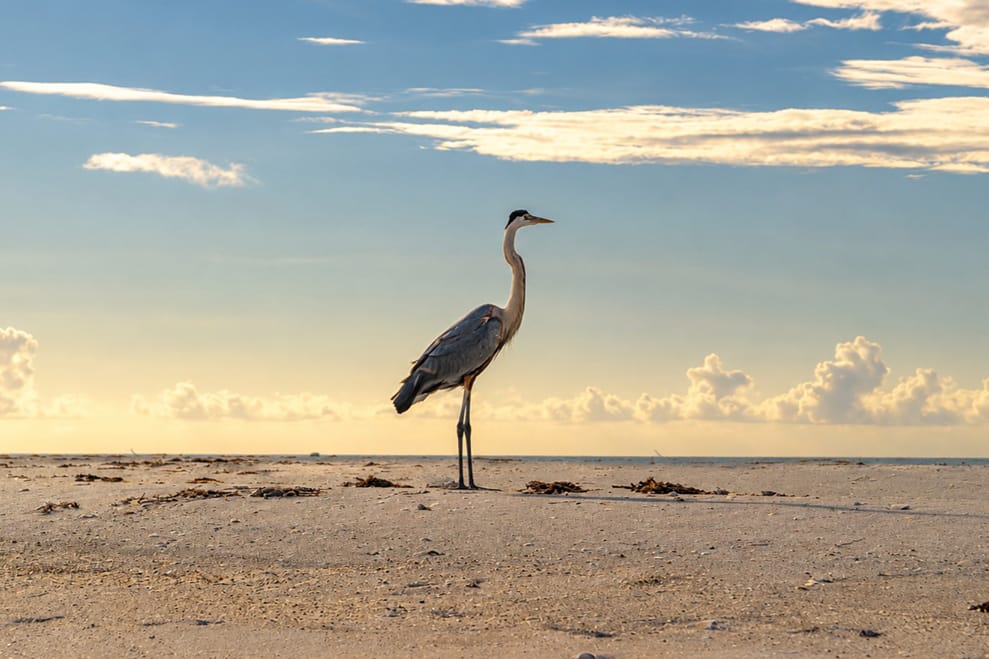
A majestic Great Blue Heron greets the sunrise at Stump Pass Beach State Park, patiently hunting along the shallow shoreline where tidal waters from Lemon Bay meet the Gulf of America. These graceful wading birds are a familiar sight throughout Southwest Florida's estuaries, feeding on fish, crabs, and other small aquatic animals. The park's beaches, mangroves, and tidal flats provide exceptional habitat for herons and many other coastal bird species, making Stump Pass a favorite destination for wildlife photography and birdwatching.
A scenic nature trail winds through coastal vegetation before opening onto the beach, offering opportunities to observe native plants, butterflies, and wildlife along the way.
At the southern end of the park, visitors are rewarded with spectacular views of Stump Pass, where the constantly changing tidal inlet separates Manasota Key from Little Gasparilla Island.
A Coast That Never Stops Changing
Because Stump Pass is a naturally shifting inlet, the shoreline at the southern end of the park changes over time. Storms, tides, and coastal currents continually reshape the beaches, create new sandbars, and alter the position of the water's edge.
Every visit offers a slightly different landscape, reminding visitors that Florida's barrier islands are living coastal environments rather than fixed landforms.
A Place Worth Protecting
Today, Stump Pass Beach State Park remains one of Southwest Florida's finest places to experience an undeveloped Gulf Coast barrier island. Whether you're hiking the nature trail, searching for shells, watching dolphins offshore, or simply enjoying the scenery, you'll experience a coastal landscape that continues to evolve with every passing season.
6. Little Gasparilla Island
A True Barrier Island
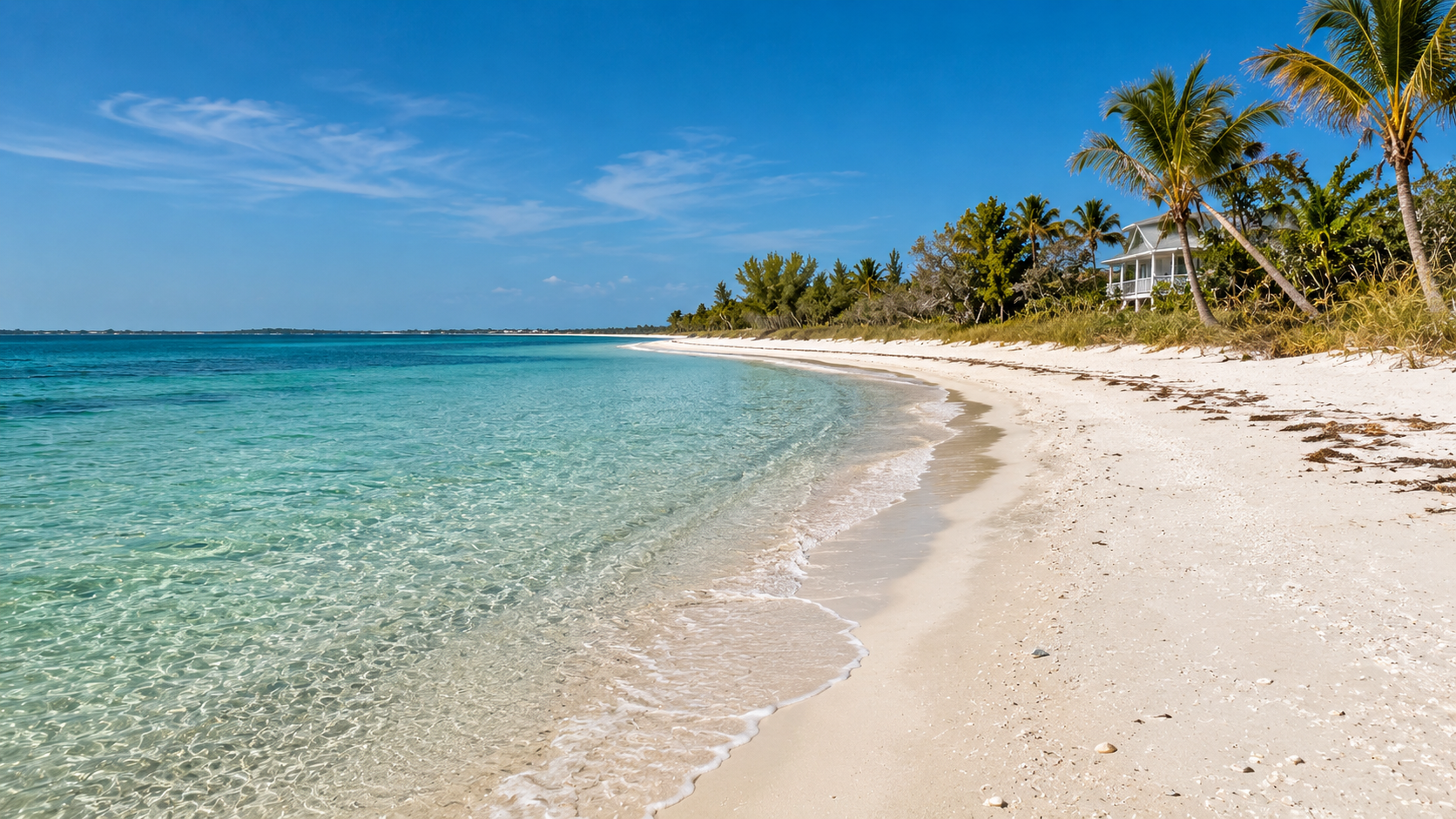
The quiet beaches of Little Gasparilla Island offer a glimpse of Old Florida, where seven miles of unspoiled shoreline stretch along the Gulf of America. Accessible only by boat or water taxi, this bridgeless barrier island is known for excellent shelling, sea turtle nesting, abundant shorebirds, and spectacular Gulf sunsets. Its peaceful beaches and natural coastal habitats make Little Gasparilla Island one of Southwest Florida's finest destinations for beachcombing, boating, and escaping the crowds.
Located on the southern side of Stump Pass, Little Gasparilla Island is one of Southwest Florida's most peaceful barrier islands. Stretching for approximately 7 miles between Stump Pass and Gasparilla Pass, the island separates the Gulf of America from the protected waters of Placida Harbor and Lemon Bay.
Unlike neighboring barrier islands connected by bridges, Little Gasparilla Island is accessible only by boat or private ferry. There are no public roads or automobiles, giving the island a quiet atmosphere that has changed little over the decades.
Most residents travel by golf cart, bicycle, or on foot, preserving the island's relaxed character.
Quiet Beaches and Natural Beauty
The island's Gulf-facing shoreline features broad sandy beaches that are ideal for shelling, beachcombing, wildlife viewing, and peaceful walks.
After winter cold fronts and tropical storms, waves often deposit large numbers of seashells along the shoreline, attracting shell collectors from across Southwest Florida.
Where the Coast Is Always Changing
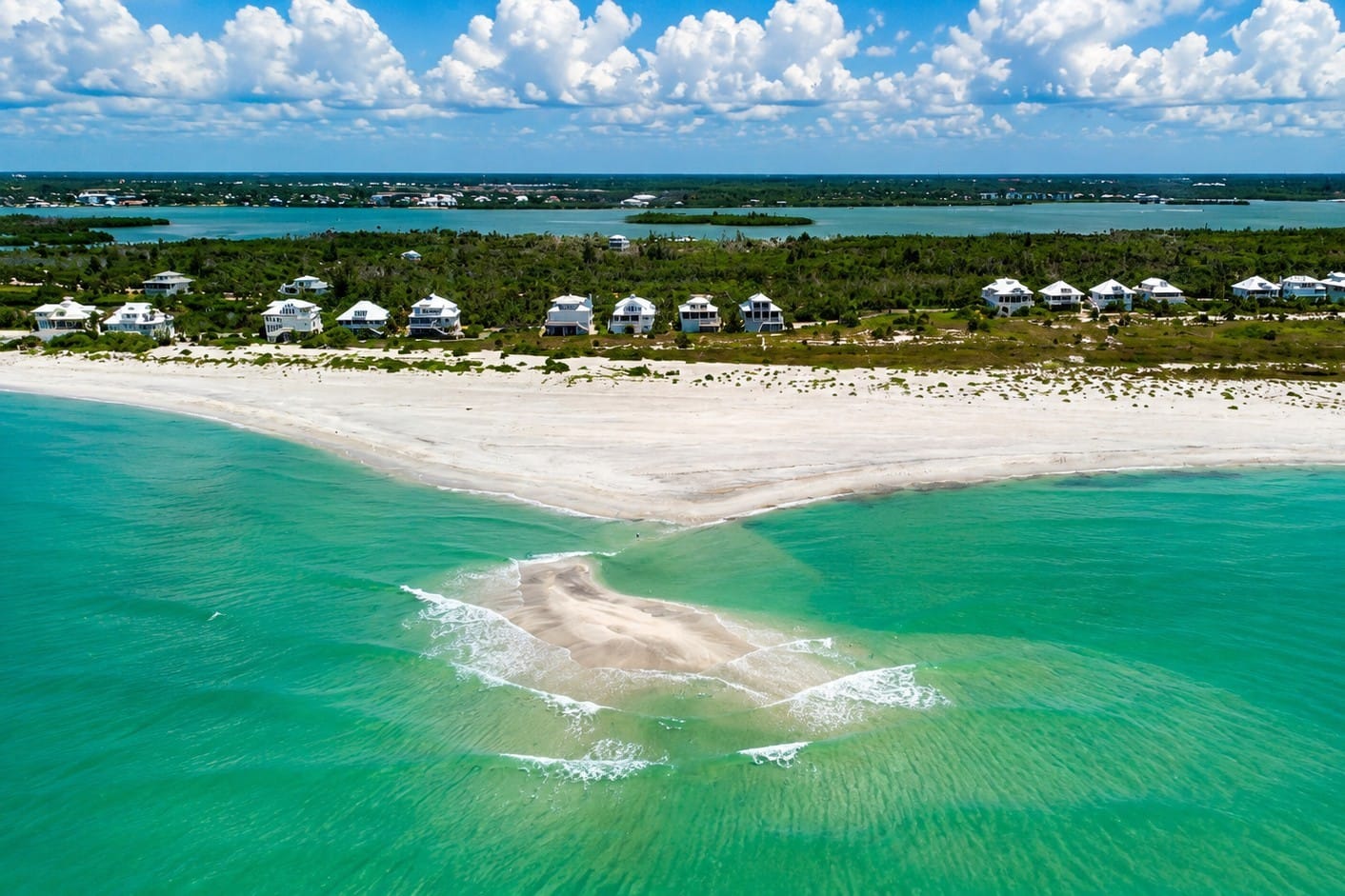
A drone view reveals the broad offshore sandbar that parallels the beach along Little Gasparilla Island, one of Southwest Florida's most pristine barrier islands. These shallow sandbars are constantly shaped by waves, tides, and longshore currents, creating calm, clear water that is ideal for swimming, shelling, paddleboarding, and wildlife viewing. Accessible only by boat or water taxi, Little Gasparilla Island remains a peaceful destination where visitors can enjoy unspoiled beaches, Gulf sunsets, and the timeless character of Florida's Gulf Coast.
The northern end of the island, adjacent to Stump Pass, is one of the most dynamic areas along the Gulf Coast. Strong tidal currents continually move sand through the inlet, creating new sandbars while eroding others.
The shoreline can change noticeably from year to year—and sometimes even from season to season—as storms and tides reshape the landscape.
Behind the beaches, dunes support native vegetation including sea oats, railroad vine, beach elder, and sea grapes. These plants stabilize the island by trapping windblown sand, reducing erosion, and providing important habitat for birds and other wildlife.
Rich Marine Life
The waters surrounding Little Gasparilla Island are rich with marine life. Dolphins are frequently seen traveling through Stump Pass, while manatees visit the protected bays and channels during the warmer months.
Nearby seagrass beds provide nursery habitat for juvenile fish, blue crabs, shrimp, and countless other marine species that support the entire coastal ecosystem.
Protecting the Mainland
Little Gasparilla Island serves an important purpose beyond its natural beauty. As a barrier island, it absorbs the energy of Gulf waves and storm surge before they reach the calmer waters of Lemon Bay and Placida Harbor.
At the same time, the island helps shape the tidal currents flowing through Stump Pass, influencing the movement of water, sand, nutrients, and wildlife throughout the surrounding area.
An Island Worth Exploring
For boaters exploring Southwest Florida, Little Gasparilla Island offers a unique combination of natural beauty and tranquility. Whether you're anchoring offshore, walking the quiet beaches, searching for shells, or watching dolphins cruise through Stump Pass, the island offers an authentic glimpse of Florida's coastal heritage.
Together with Manasota Key on the opposite side of the inlet, Little Gasparilla Island forms the natural gateway to Stump Pass. The two barrier islands are continually shaped by the same tides, storms, and coastal processes that have defined this remarkable landscape for centuries.
7. Wildlife
A Thriving Coastal Ecosystem
Stump Pass is one of the richest wildlife habitats along Southwest Florida's Gulf Coast. The combination of strong tidal currents, shallow seagrass flats, sandy beaches, mangrove shorelines, and nearby estuarine waters creates an ecosystem that supports an extraordinary variety of marine life, birds, and coastal wildlife throughout the year.
The tides are the driving force behind this abundance. As water moves between Lemon Bay and the Gulf of America, it carries oxygen, nutrients, and schools of baitfish through the inlet. Larger predators naturally follow, making Stump Pass one of the best places in the region to observe wildlife in its natural environment.
Wildlife You May Encounter
Visitors commonly see:
- Bottlenose dolphins
- West Indian manatees
- Loggerhead sea turtles
- Ospreys and brown pelicans
- Great blue herons, snowy egrets, and other wading birds
- Royal terns, black skimmers, and migratory shorebirds
- Snook, redfish, tarpon, and spotted seatrout
- Stingrays, horseshoe crabs, blue crabs, and shrimp
Dolphins
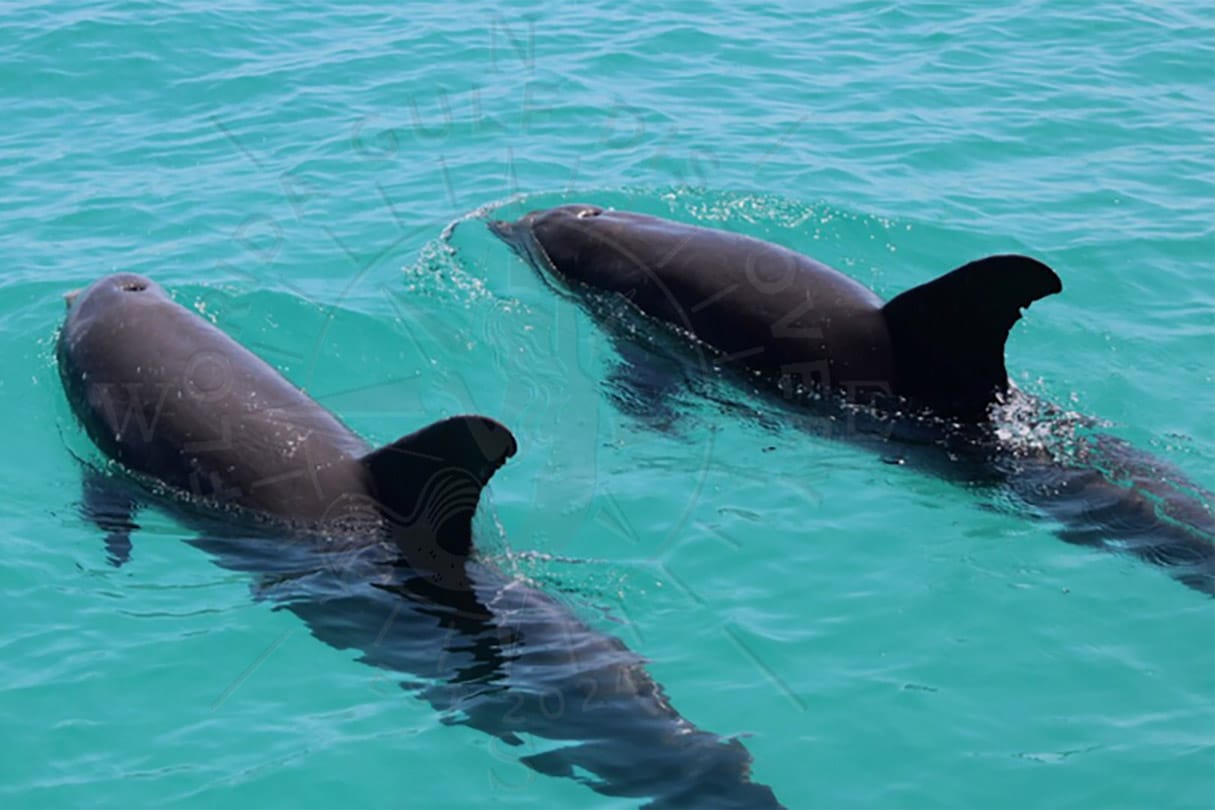
A pair of playful bottlenose dolphins cruises through the clear waters of Stump Pass, where the tidal exchange between Lemon Bay and the Gulf of America creates one of Southwest Florida's richest marine habitats.
Bottlenose dolphins are among the most frequently seen animals at Stump Pass. Small family groups regularly patrol the inlet, often using the strong currents to herd baitfish into shallow water before feeding.
Early morning and late afternoon are often the best times to observe dolphins actively hunting near the navigation channel or swimming along the beaches.
Manatees
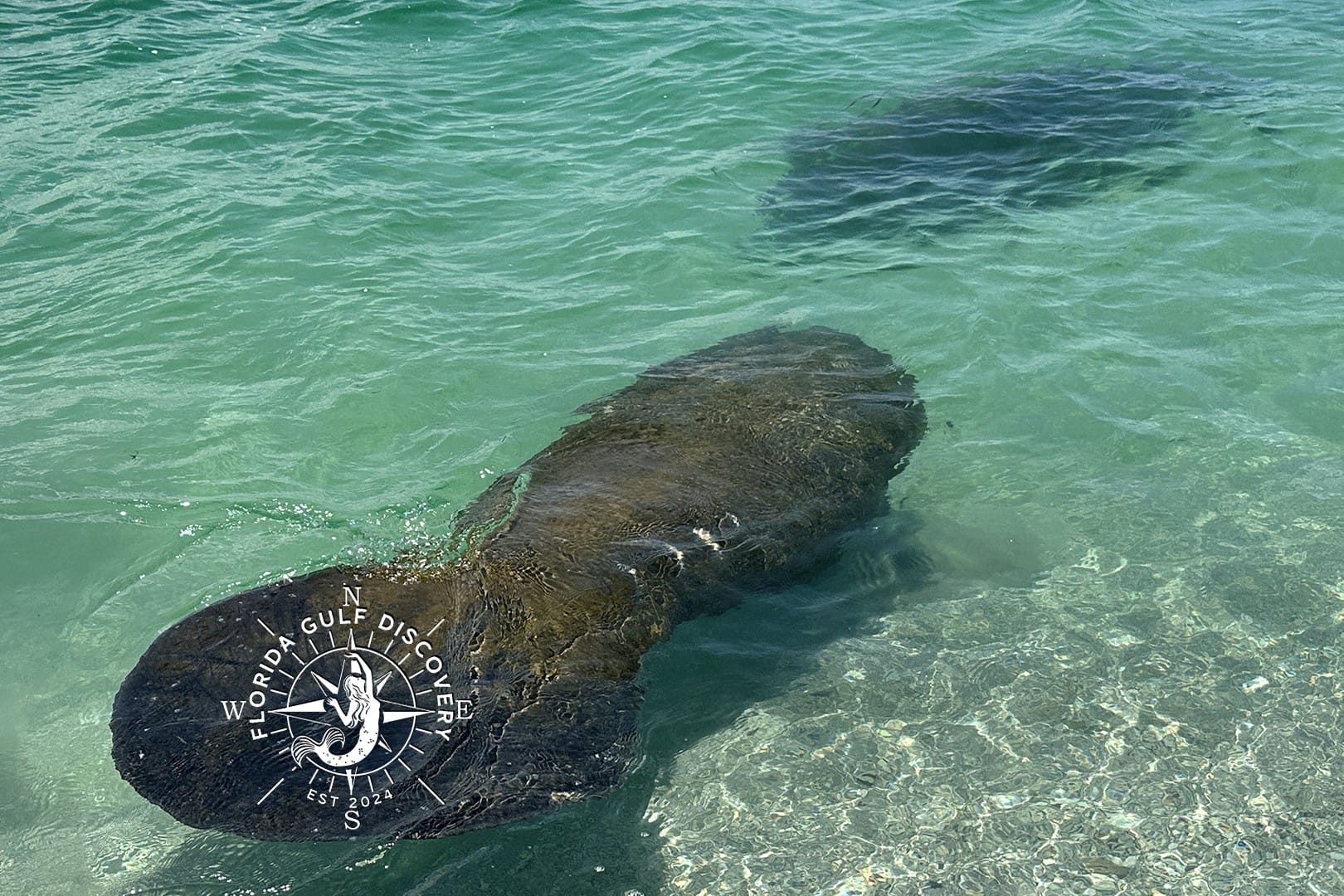
Watch on YouTube: Join Captain Pavel for an unforgettable close encounter with a gentle Florida manatee in the crystal-clear waters of Stump Pass. Discover why Lemon Bay and Stump Pass Beach State Park are among the best places in Southwest Florida to observe manatees, dolphins, and other native wildlife while exploring one of the region's most beautiful coastal waterways by boat.
West Indian manatees are common visitors during the warmer months, especially from spring through early fall. They travel between Lemon Bay, Ski Alley (Peterson Cut), and the protected waters surrounding Little Gasparilla Island while feeding on seagrass or resting in calm areas away from stronger currents.
Boaters should always operate at idle speed when manatees are present and remain alert for their slow-moving silhouettes near the surface.
Coastal Birds
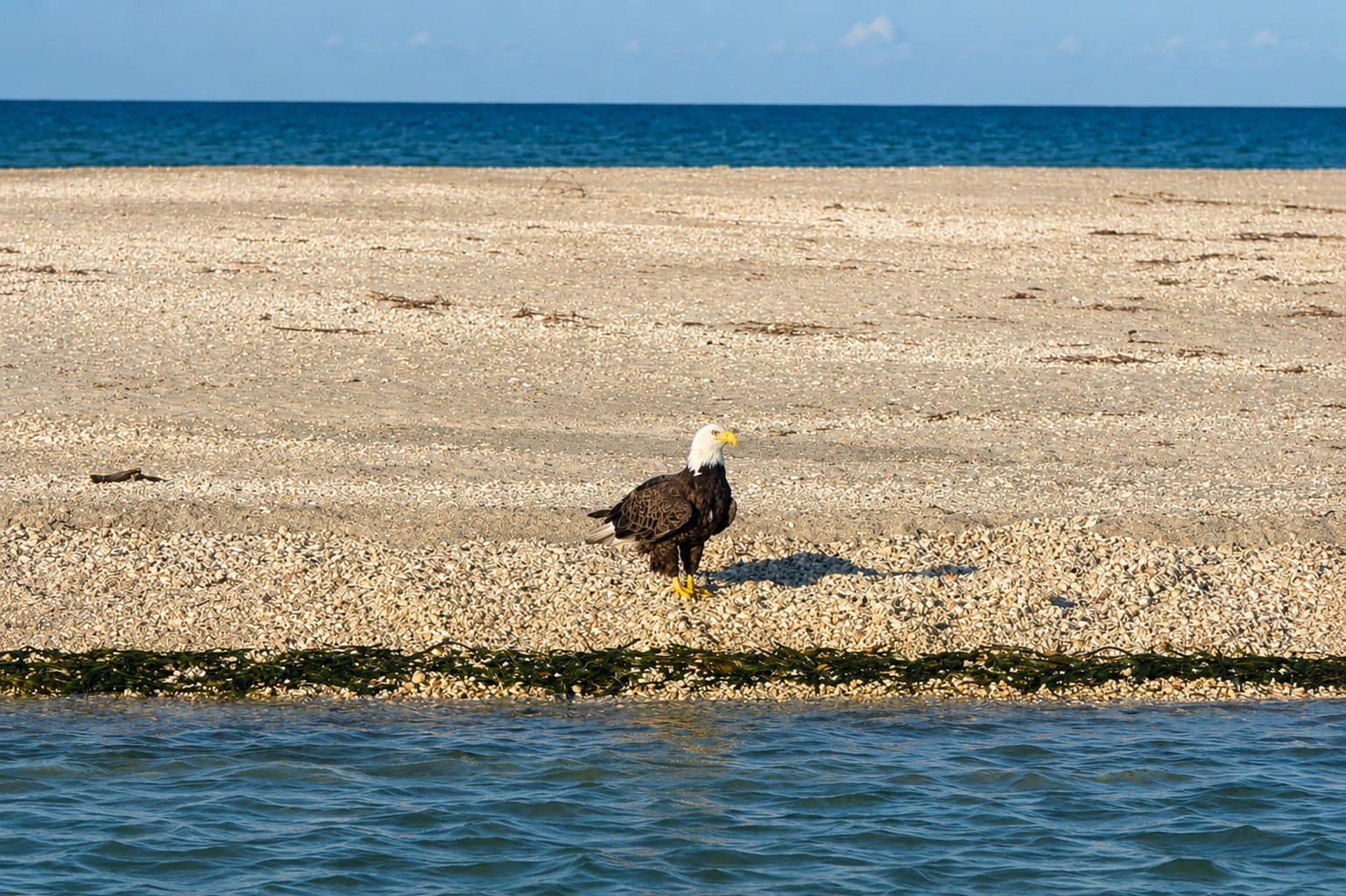
A magnificent Bald Eagle, America's national bird, surveys the waters near Stump Pass Beach State Park on Manasota Key. The productive estuarine waters of Lemon Bay and the nearby Gulf of America provide excellent hunting habitat, where eagles feed primarily on fish while sharing the skies with ospreys, pelicans, and other coastal birds. Sightings of these impressive raptors are a memorable highlight for boaters, kayakers, photographers, and nature enthusiasts exploring Southwest Florida's protected coastal ecosystems.
The beaches, dunes, and tidal flats provide important habitat for a wide variety of coastal birds. Ospreys frequently dive into the water to catch fish, while brown pelicans patrol the shoreline before plunging into schools of baitfish.
Great blue herons, snowy egrets, great egrets, reddish egrets, white ibis, royal terns, black skimmers, and numerous migratory shorebirds can be seen throughout the year.
During nesting season, several protected shorebird species raise their young on the beaches above the high-tide line. Visitors should respect posted nesting areas and keep a safe distance from birds that are resting or feeding.
Sea Turtles
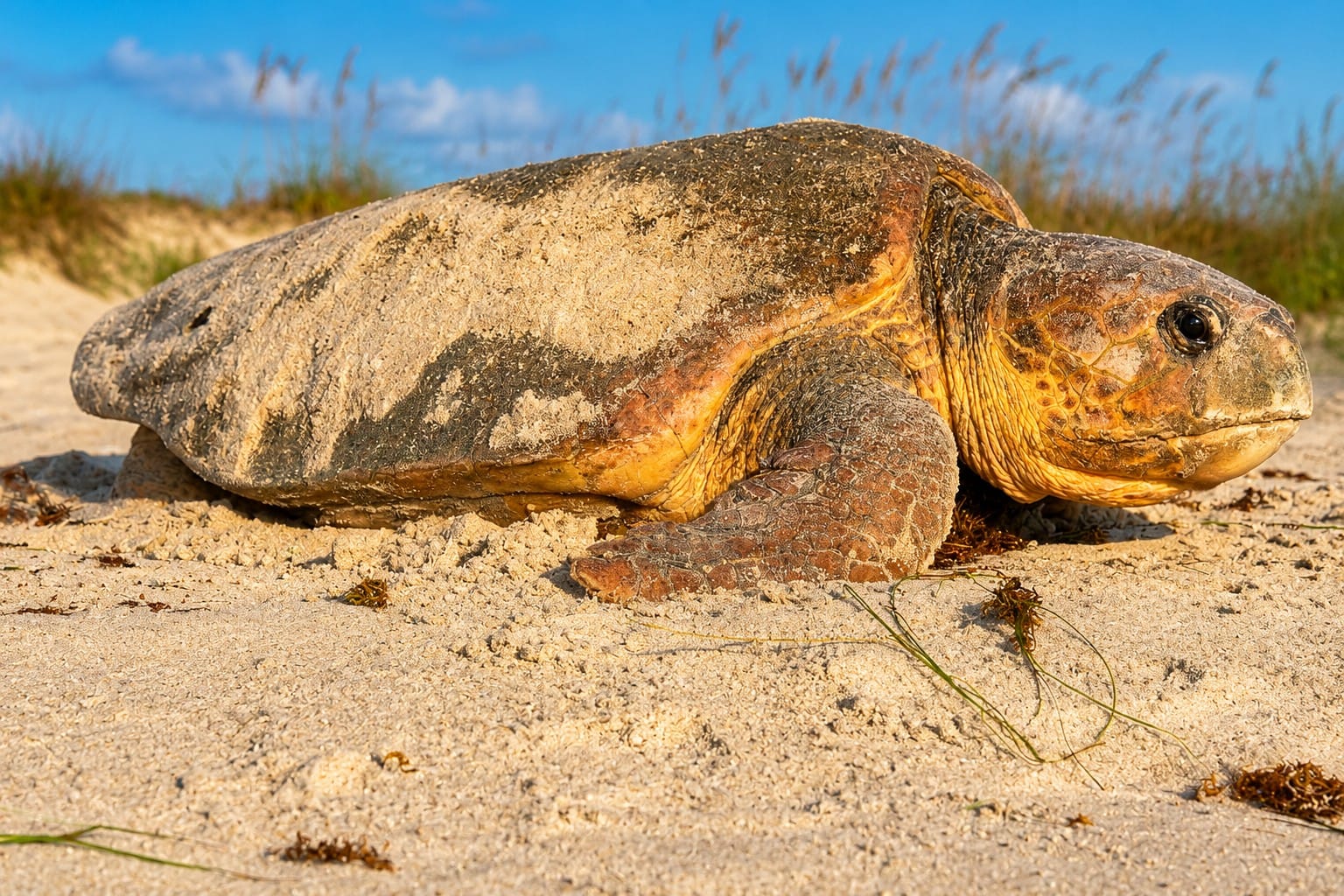
A threatened Loggerhead Sea Turtle (Caretta caretta) makes its way along Blind Pass Beach on Manasota Key, one of Southwest Florida's important nesting beaches. Each year, female loggerheads come ashore at night to lay their eggs above the high-tide line before returning to the Gulf of America. Protecting nesting habitat by keeping beaches dark, filling in holes, and avoiding marked nests helps ensure future generations of these remarkable marine reptiles continue to thrive along Florida's Gulf Coast.
Loggerhead sea turtles return to these beaches each year between May and October to lay their eggs. Females crawl ashore at night to dig nests above the tide line before returning to the Gulf.
Weeks later, hatchlings emerge and instinctively make their way toward the water. Protecting nesting areas, reducing artificial light, and filling holes dug in the sand all help improve their chances of survival.
Fish and Marine Life
The waters surrounding Stump Pass support an impressive variety of fish. Snook, redfish, spotted seatrout, tarpon, mangrove snapper, sheepshead, mullet, ladyfish, and jack crevalle are commonly found throughout the area.
Southern stingrays, cownose rays, horseshoe crabs, blue crabs, shrimp, and countless smaller marine organisms depend on the surrounding seagrass beds and tidal flats.
The changing tides continually deliver food into the inlet, making Stump Pass an important feeding area for both resident and migratory species.
Nature Connected by the Tide
Every species found at Stump Pass is connected by the movement of water. The tides shape the beaches, nourish the seagrass, transport nutrients, and concentrate fish, creating ideal conditions for larger predators.
Whether you're watching dolphins chase baitfish, pelicans diving into the surf, or manatees grazing in nearby seagrass beds, you're witnessing a natural system that has evolved over thousands of years.
For many visitors, the wildlife is what makes Stump Pass unforgettable. Every trip offers the possibility of a new encounter, and no two days on the water are ever exactly the same.
8. Seashells & Shark Teeth
A Treasure Hunt Along the Shore
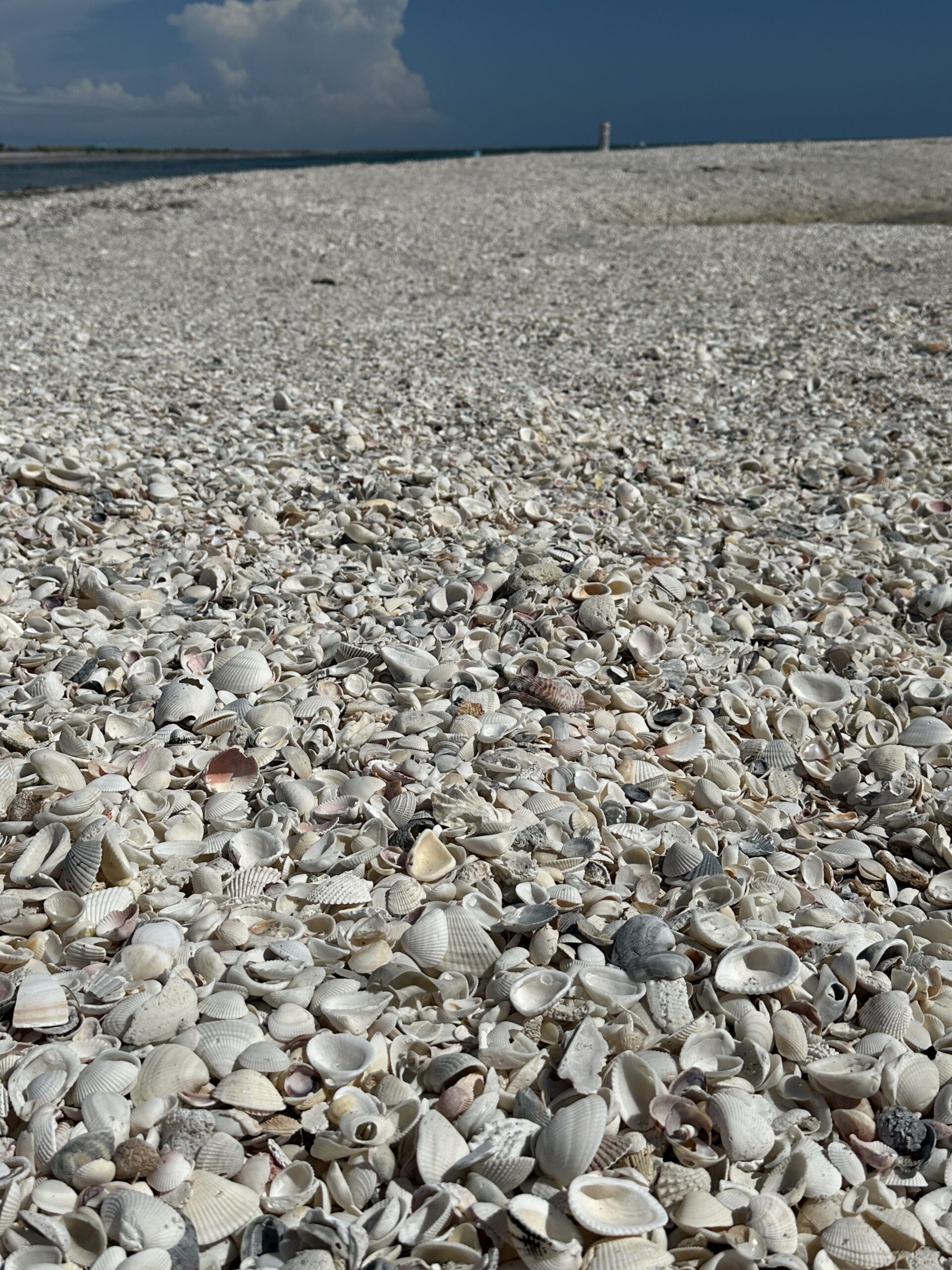
Thousands of colorful seashells blanket Shell Beach at Stump Pass Beach State Park, creating one of the premier shelling destinations in Southwest Florida. Powerful tidal currents flowing between Lemon Bay and the Gulf of America, combined with seasonal winds and storms, continually deposit fresh shells along this ever-changing shoreline. Visitors frequently discover lightning whelks, fighting conchs, olives, scallops, and other Gulf Coast treasures, especially after low tide and winter cold fronts.
Stump Pass is one of the best places in Southwest Florida to search for seashells and, with a little patience, even shark teeth. The area's constantly changing tides, waves, and coastal currents naturally concentrate shells and other marine treasures along the beaches, making every visit a little different.
The strong tidal currents flowing through Stump Pass carry shells from the Gulf of America toward the surrounding shoreline. As waves lose energy along the beaches of southern Manasota Key and northern Little Gasparilla Island, shells settle into the sand, often forming colorful shell lines after high tides or passing storms.
When Is the Best Time to Go?
Winter cold fronts and tropical systems frequently create the best shelling conditions. Strong winds and higher waves stir the Gulf floor, uncovering shells that have been buried beneath the sand before depositing them along the shoreline.
Early morning after a storm or an unusually high tide is often the most rewarding time to explore the beaches.
What You Might Find
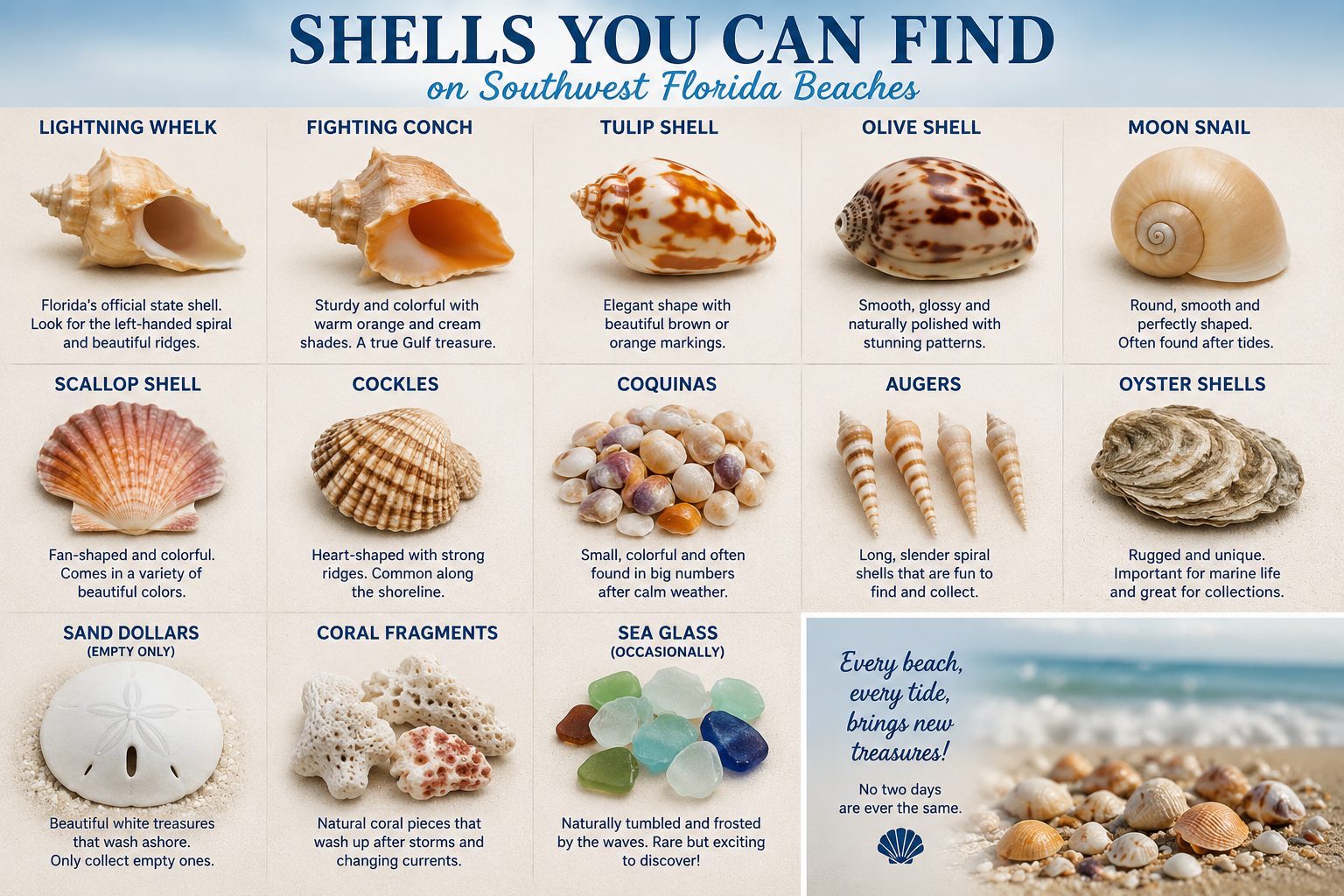
Southwest Florida's barrier island beaches are home to an incredible variety of seashells, making the region one of North America's premier shelling destinations. Common finds include lightning whelks, Florida fighting conchs, banded tulips, lettered olives, scallops, cockles, coquinas, and many other Gulf Coast treasures. The best shelling typically follows low tide, offshore winds, or seasonal storms, when fresh shells are deposited along the beaches of Little Gasparilla Island, Stump Pass, Cayo Costa, and other Southwest Florida barrier islands.
Visitors regularly discover a wide variety of Gulf Coast shells, including:
- Lightning whelks
- Horse conchs
- Fighting conchs
- Tulip shells
- Olives
- Scallops
- Cockles
- Ark shells
- Coquinas
- Moon snails
- Colorful clam shells
Many shells are found intact, while others have been naturally polished by years of movement through the surf.
Searching for Shark Teeth
Although less common than seashells, fossilized shark teeth can also be found around Stump Pass. These ancient fossils are continually released from offshore sediments and carried toward the beaches by waves and currents.
Most shark teeth are small and dark in color, having become mineralized over thousands or even millions of years. Larger specimens occasionally wash ashore after periods of rough weather.
Shell Responsibly
Successful shelling requires patience and respect for nature. Live shells occupied by living animals should always be left where they are found, allowing them to continue their natural life cycle.
Empty shells, however, make wonderful souvenirs and lasting reminders of a day spent exploring Florida's Gulf Coast.
Every Visit Is Different
Join Captain Pavel on a Private Shelling Tour and discover hidden beaches, shell-rich barrier islands, and crystal-clear Gulf waters throughout Southwest Florida. Every tour is customized around the day's tides, weather, and shelling conditions, giving your family or group the best opportunity to find beautiful seashells while enjoying dolphins, coastal wildlife, and secluded beaches accessible only by boat.
The beaches around Stump Pass change constantly. One day the shoreline may appear nearly empty, while the next morning a fresh tide or overnight storm may cover the sand with thousands of shells.
That unpredictability is part of what makes shelling here so enjoyable. Every walk along the beach offers the possibility of discovering something new.
For many visitors, searching for shells and shark teeth becomes more than collecting souvenirs. It is an opportunity to slow down, observe the rhythms of the Gulf, and appreciate the natural processes that continue to shape this remarkable coastal landscape.
9. Beaches & Sandbars
A Coast Shaped by Nature
The beaches and sandbars surrounding Stump Pass are among the most dynamic coastal landscapes in Southwest Florida. Unlike beaches protected by seawalls or maintained through regular beach nourishment, this shoreline is shaped almost entirely by natural forces.
Waves, tides, longshore currents, and tropical storms continually move sand, creating a landscape that is always changing.
Two Beautiful Barrier Island Beaches
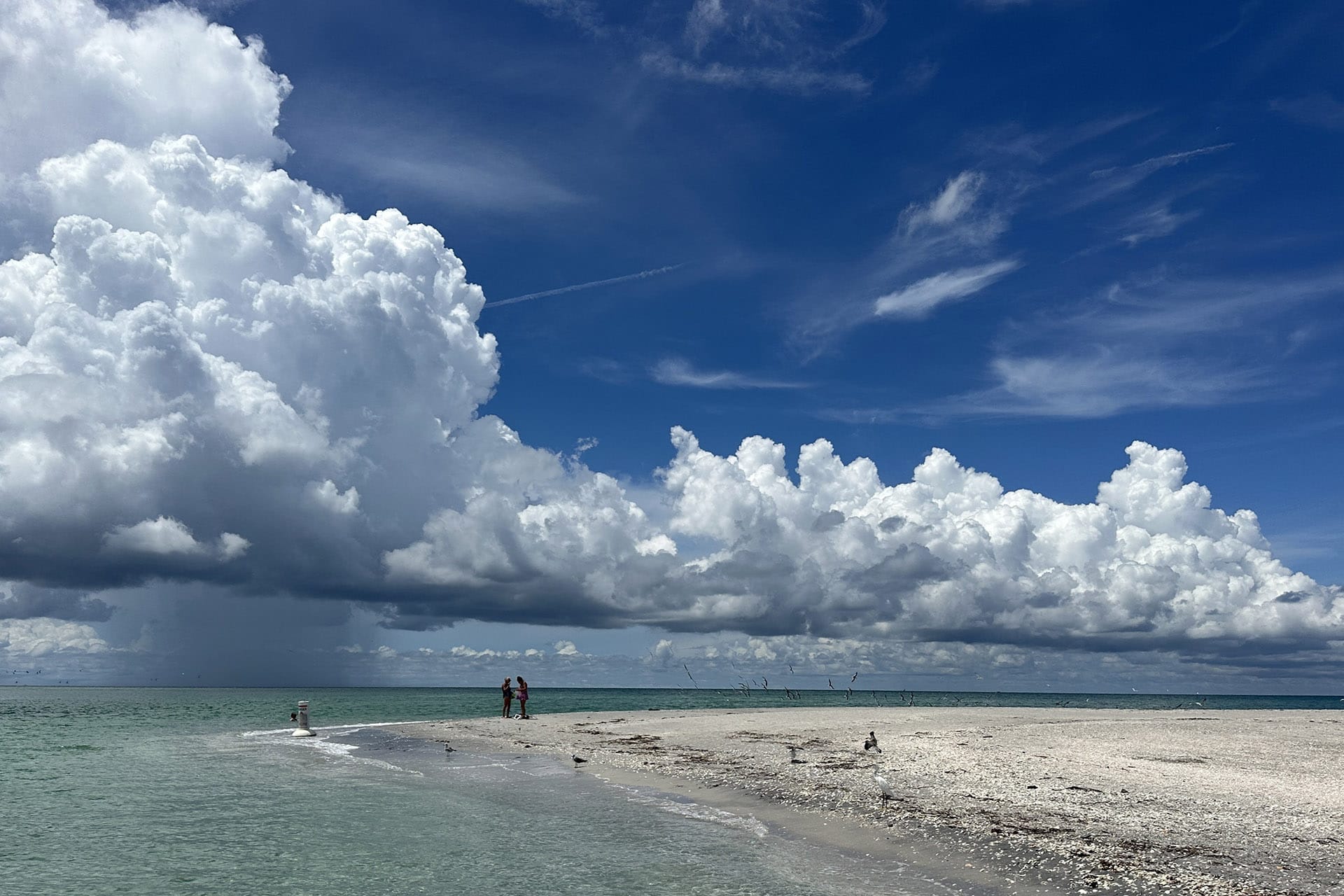
Dark storm clouds gather above the Stump Pass sandbar, highlighting the powerful natural forces that continually reshape the southern tip of Manasota Key. Wind, waves, tides, and tropical storms move vast amounts of sand through the inlet, creating an ever-changing landscape of beaches, sandbars, and navigation channels. This dynamic coastal environment is one of the defining features of Stump Pass Beach State Park, making every visit a unique experience for boaters, photographers, shell collectors, and nature enthusiasts exploring Southwest Florida.
On the northern side of the pass, Stump Pass Beach State Park offers wide stretches of soft white sand backed by natural dunes. Across the inlet, the northern tip of Little Gasparilla Island features equally beautiful, undeveloped beaches where visitors can often enjoy long walks without encountering large crowds.
Together, these two barrier islands create one of Southwest Florida's most scenic coastal environments.
Sandbars That Never Stay the Same
The shape of the shoreline changes throughout the year. During calm summer months, beaches often become wider as gentle waves deposit sand along the coast. Winter cold fronts, strong tides, and tropical storms can quickly reshape the shoreline, removing sand from one area while building new beaches and sandbars in another.
Sandbars are among the most noticeable features of Stump Pass. As tidal currents carry sediment between Lemon Bay and the Gulf of America, sand settles wherever the current slows. Over time, these deposits grow into shallow bars that may remain for months—or disappear after a single major storm.
Hurricane Milton's Impact
Watch on YouTube: See Ski Alley and the coastline exactly as they appeared before Hurricane Milton reshaped this section of Manasota Key. Captain Pavel's aerial footage documents the area in June 2024, before the storm opened the temporary Milton Pass and dramatically altered the shoreline between Lemon Bay and the Gulf of America. It's a rare before-and-after look at how powerful hurricanes can rapidly transform Southwest Florida's barrier islands and tidal inlets. :contentReference[oaicite:0]{index=0}
Recent hurricanes demonstrate just how rapidly the landscape can evolve.
Following Hurricane Milton in 2024, large volumes of sand were redistributed throughout the inlet. Existing sandbars shifted, new shoals developed, and sections of the navigation channel became significantly shallower.
Even after dredging restored the main channel, natural currents continued moving sand, creating new deposits along the northern shoreline of Little Gasparilla Island and other parts of the pass.
More Than Beautiful Beaches
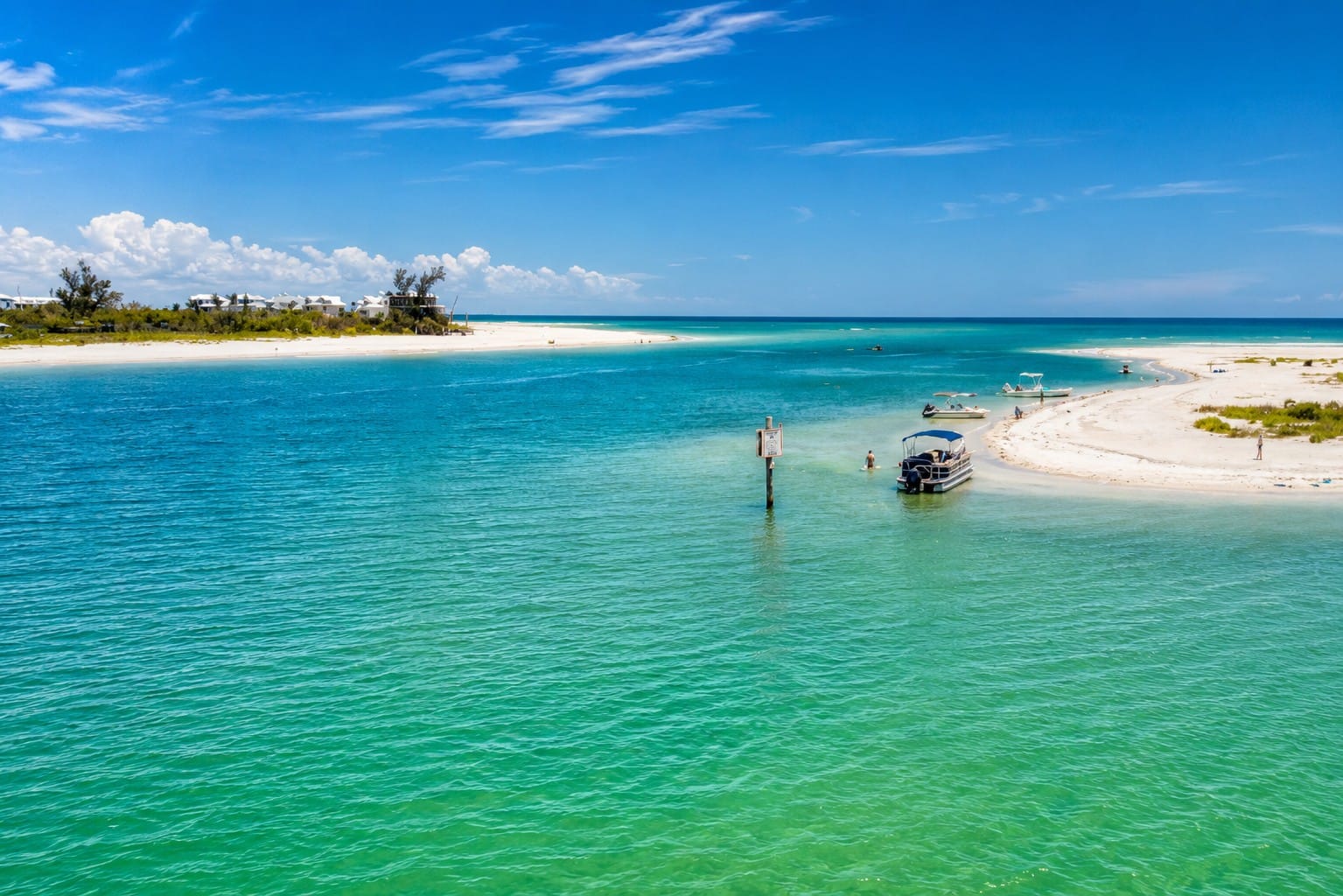
This drone photograph captures a peaceful weekday at Stump Pass in 2025, revealing the winding tidal channel, expansive sandbars, and turquoise waters at the southern end of Manasota Key. The inlet forms the natural connection between Lemon Bay and the Gulf of America, where strong tidal currents continually reshape the surrounding beaches and navigation channel. From above, the ever-changing landscape highlights why Stump Pass is one of Southwest Florida's premier destinations for boating, shelling, wildlife viewing, kayaking, and coastal photography.
These constantly changing beaches provide far more than beautiful scenery. They create nesting habitat for sea turtles, resting areas for shorebirds, and feeding grounds for fish, crabs, and countless other marine species.
The surrounding dunes also protect the barrier islands from storm surge while trapping windblown sand that gradually rebuilds the shoreline after storms.
Boating Around the Sandbars
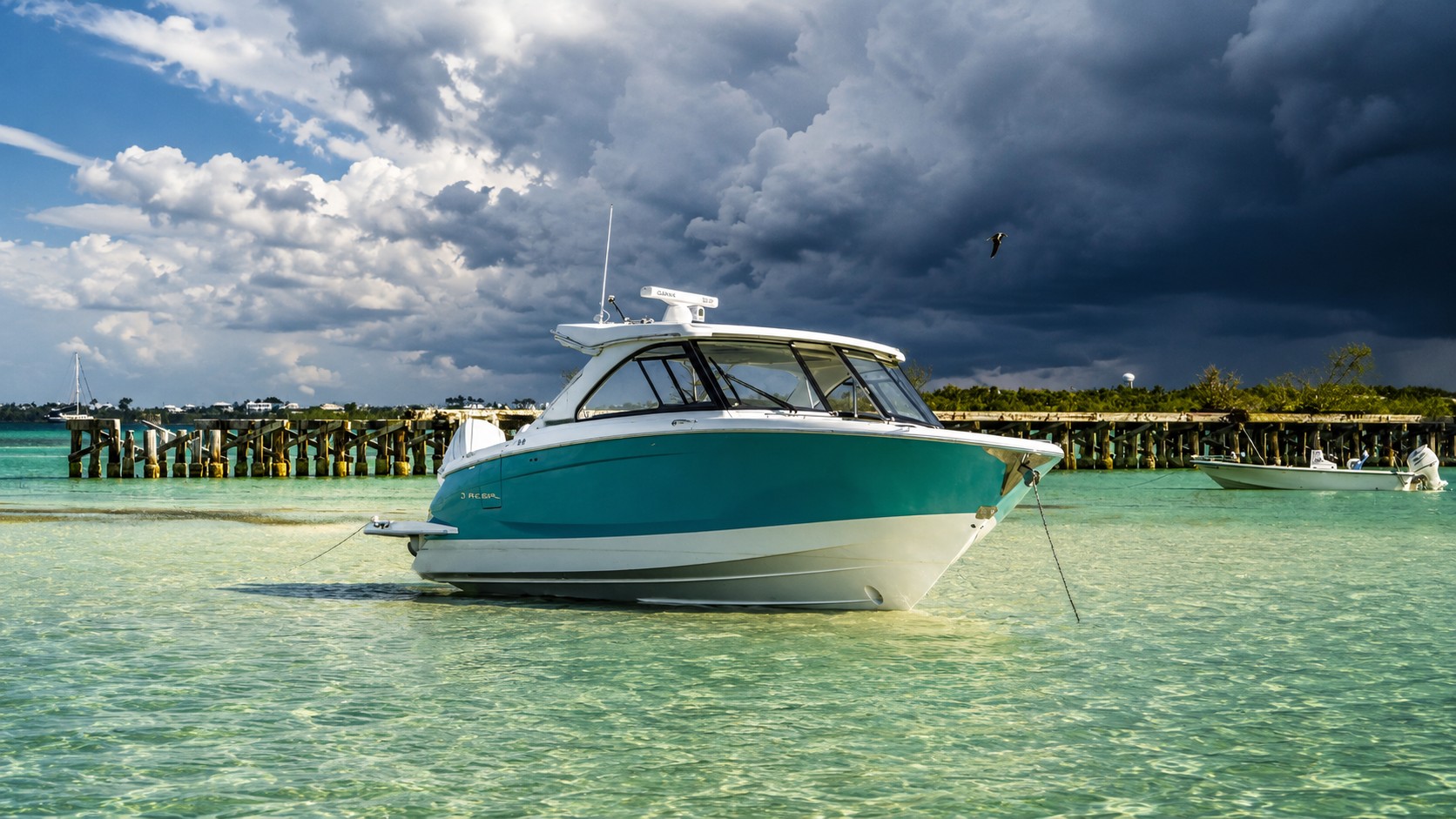
An anchored boat rests at the famous Boca Grande Sandbar, one of Southwest Florida's most popular boating destinations. The size, shape, and water depth around the sandbar change throughout the day as the tides rise and fall, making it important for boaters to monitor tide levels, current direction, and anchor position. Understanding the tides helps ensure a safe visit while enjoying the crystal-clear waters, shallow sand flats, and spectacular scenery near Gasparilla Island and Boca Grande Pass.
For boaters, the changing sandbars are a reminder that local knowledge is invaluable. Water that was safely navigable one season may become shallow the next.
Staying within the marked navigation channel and paying close attention to navigation markers is essential, especially after hurricanes or strong storms that may have reshaped the inlet.
A Landscape in Motion
Whether arriving by boat or exploring on foot, the beaches and sandbars of Stump Pass offer a front-row seat to one of nature's most fascinating processes.
Every tide, every season, and every storm leaves its mark, ensuring that no two visits to Stump Pass are ever exactly alike.
After exploring the history, tides, wildlife, and ever-changing shoreline of Stump Pass, I'd like to leave you with one final thought from my own experiences on the water.
10. Captain Pavel's Note

Make your next celebration unforgettable with a Private Events Boat Charter in Southwest Florida. Whether you're planning a bachelorette party, birthday, anniversary, family reunion, engagement, or other special occasion.
After countless trips through Stump Pass, one thing has become clear to me—no two days here are ever exactly alike.
I've watched hurricanes reshape the inlet, seen channels move, and discovered new sandbars where open water once existed. I've also watched dolphins use the tidal currents to hunt, manatees quietly cruise through Ski Alley, pelicans dive into schools of baitfish, and loggerhead turtles return each summer to nest on these beautiful beaches.
One of my favorite places is the southern end of Stump Pass Beach State Park. After the walk through the dunes, you arrive where Lemon Bay meets the Gulf of America. It's one of those places where you can simply stop, watch the water, and realize you're witnessing a coastline that is constantly changing.
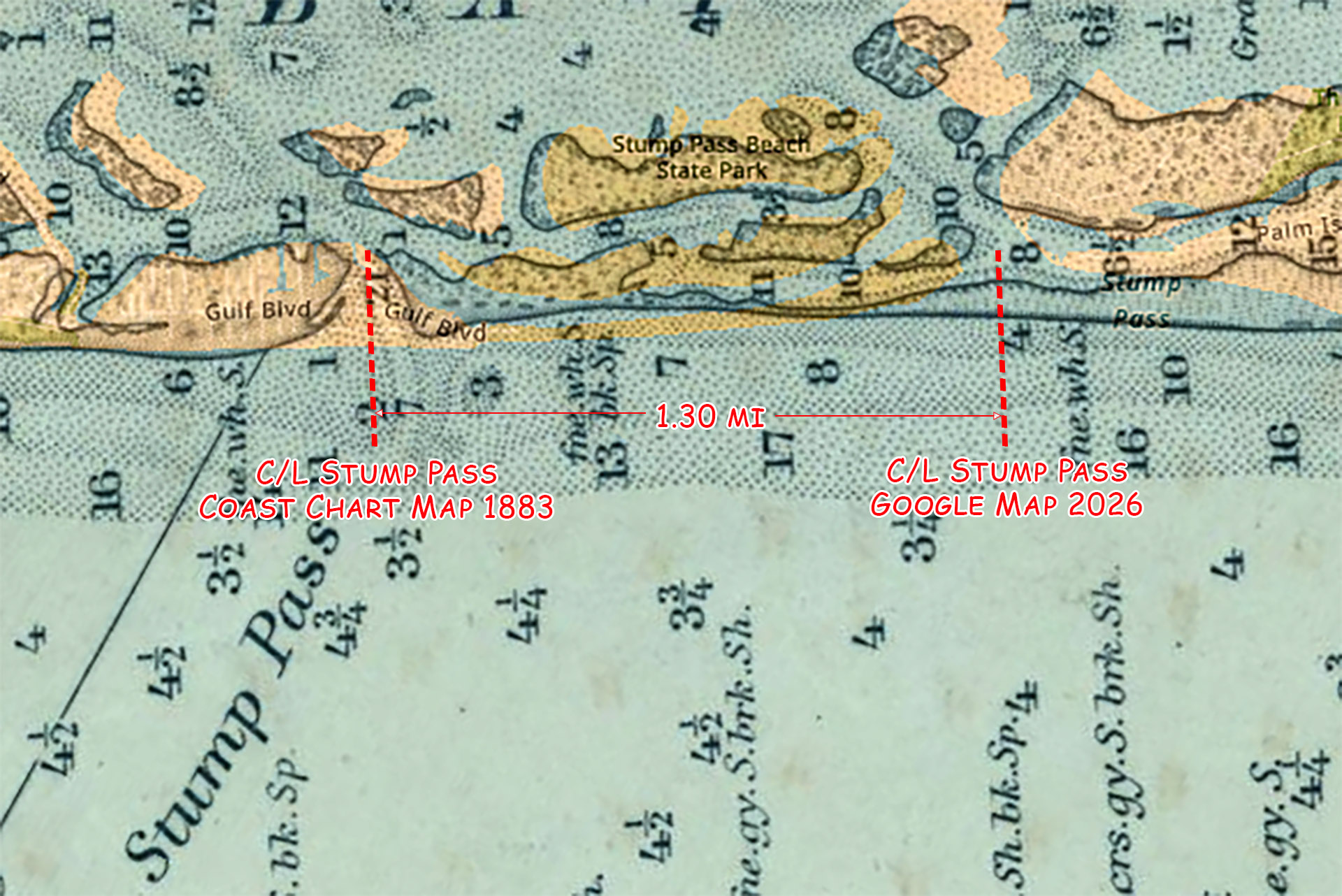
Compare Stump Pass in 1883, 1910, and 2026 to see how Southwest Florida's dynamic coastline has evolved. The historic maps reveal that the original Stump Pass was located approximately 1.3 miles (2 km) north of today's inlet before storms, tides, and longshore currents gradually reshaped the barrier islands. Click the image to view the full-size comparison and explore more than 140 years of coastal change.
I also enjoy cruising along Little Gasparilla Island. With no bridges, no traffic, and miles of quiet shoreline, it offers a glimpse of Florida's Gulf Coast as it existed generations ago. Every trip reminds me how fortunate we are that places like this still exist.
If there's one lesson Stump Pass has taught me, it's that nature is always in charge. The tides move the water, storms reshape the beaches, wildlife follows the seasons, and every day the inlet becomes just a little different from the day before.
That's why I never assume yesterday's channel is today's channel, and why I encourage every boater to respect the tides, follow the navigation markers, and slow down enough to appreciate everything happening around them.
I hope this guide helps you discover not only where to go, but also why Stump Pass remains one of Southwest Florida's most remarkable and ever-changing coastal landscapes. Whether you're arriving by boat, kayak, paddleboard, or on foot, take your time, watch the wildlife, explore responsibly, and enjoy a place that never stops changing.
May your tide be high, your dolphins be playful, and your cooler come home lighter than it left.
See you on the water,
Captain Pavel
Florida Gulf Discovery
