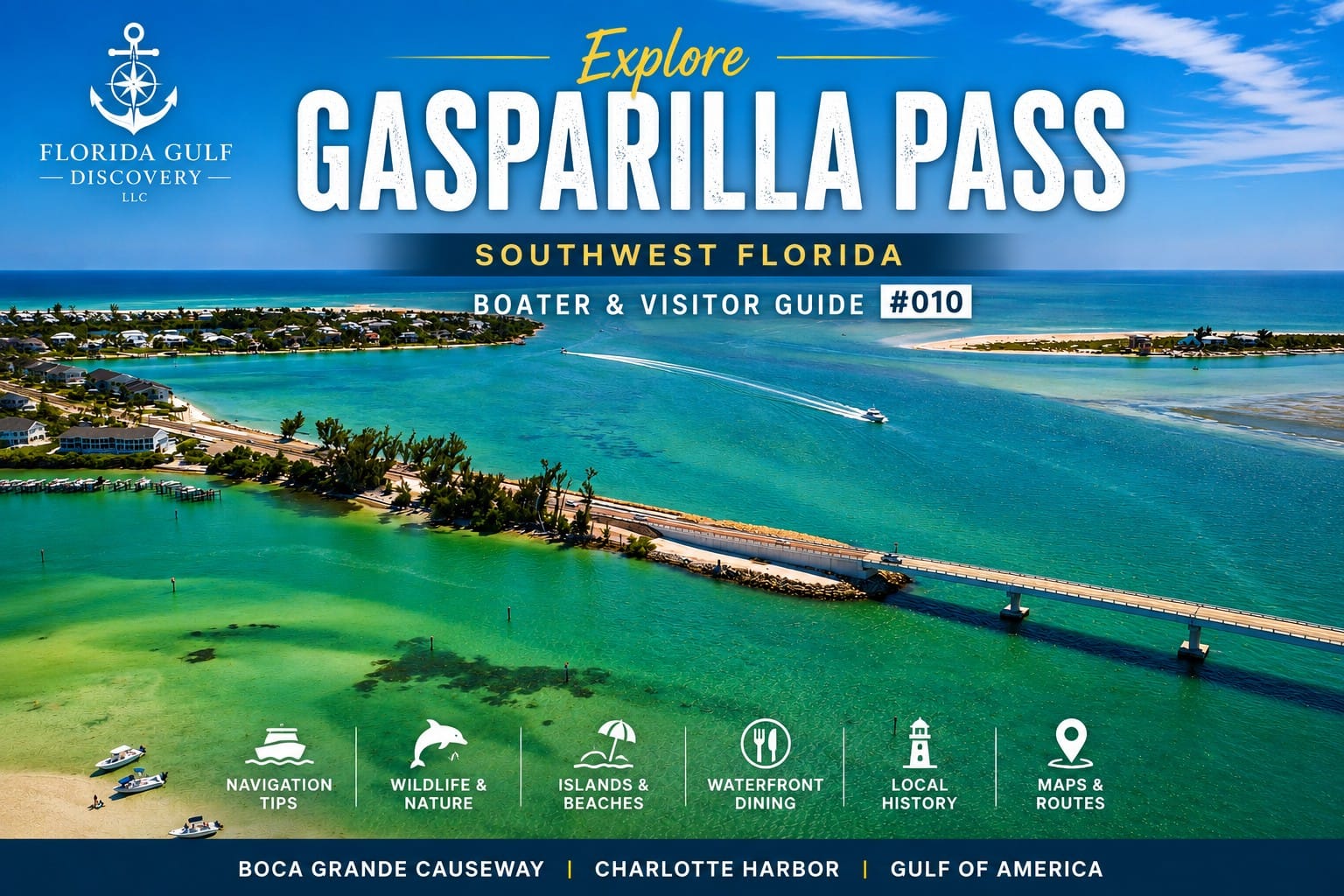
Guide Contents
Explore the history, tides, wildlife, dining, and nearby destinations that make Gasparilla Pass one of Southwest Florida's most fascinating waterways.
Captain Pavel says:
"Gasparilla Pass isn't a place to rush through—it's a place to discover.
Let's explore one chapter at a time."
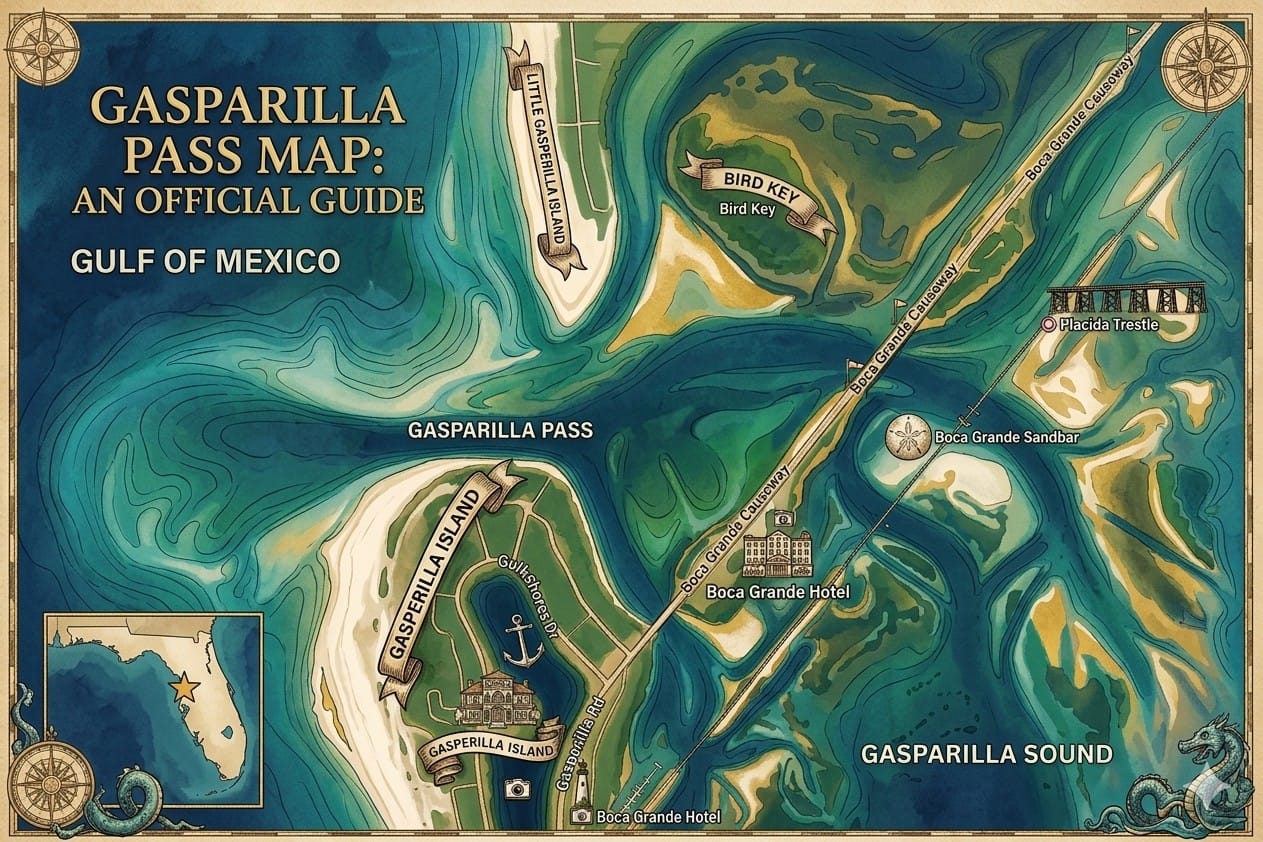
1. Interactive Map
Explore Gasparilla Pass and nearby attractions on the map.
2. Who Was José Gaspar?
Separate historical evidence from Florida's famous pirate legend.
3. How Gasparilla Got Its Name
Discover the documented origins of the Gasparilla name.
4. Quick Facts
Essential boating, navigation, and visitor information.
5. History
Follow the maritime, railroad, and coastal history of the pass.
6. How the Tide Works
Understand the currents that shape boating conditions.
7. Wildlife & Marine Life
Meet the dolphins, manatees, birds, turtles, and marine species.
8. Waterfront Dining
Find popular restaurants accessible by boat.
9. Nearby Destinations
Visit beaches, sandbars, islands, and historic landmarks.
10. Explore with Captain Pavel
Discover Gasparilla Pass aboard a customized private boat tour.
Captain Pavel's Challenge:
"See if you can make it through this guide without adding Gasparilla Pass to your bucket list. I haven't met anyone who succeeded yet."
2. Who Was José Gaspar?
Few names are more closely associated with Southwest Florida than José Gaspar, the legendary pirate better known as Gasparilla. For more than a century, his story has fascinated visitors, inspired festivals, and become part of Florida's rich coastal folklore. But was he a real pirate—or simply a legendary character?
The Legend of Gasparilla
According to tradition, José Gaspar was born in Spain around 1756. Depending on which version of the story you hear, he was described as a Spanish nobleman, naval officer, or court favorite who turned to piracy after falling from royal favor.
The legend says that around 1783, Gaspar fled Spain aboard a captured ship called the Floriblanca and established his headquarters somewhere near Charlotte Harbor. Over the next four decades, he supposedly commanded a fleet of pirate ships that preyed on merchant vessels throughout the Gulf of Mexico and Caribbean.
Stories claim that he buried enormous treasures on islands throughout Southwest Florida, including Gasparilla Island. Male prisoners were reportedly forced to join his crew or were killed, while female captives were said to have been imprisoned on nearby Captiva Island—a story that inspired another enduring local legend about the island's name.
The most dramatic chapter of the legend takes place in 1821, when Gaspar allegedly attacked what appeared to be an ordinary merchant ship. According to the story, the vessel was actually the USS Enterprise, disguised as bait for pirates. Rather than surrender after a fierce battle, Gaspar reportedly wrapped an anchor chain around his waist and leaped into the Gulf of Mexico, choosing death over capture.
It is one of Florida's greatest pirate stories—but there is one problem.
History Tells a Different Story
Despite decades of research, historians have found no reliable evidence that José Gaspar ever existed.
No Spanish military records, naval documents, court records, newspapers, ship logs, or archaeological discoveries confirm the existence of a pirate matching the legend. Likewise, there is no historical evidence for his famous ship, the Floriblanca, his hidden treasure, or the legendary battle with the USS Enterprise.
Today, most historians agree that José Gaspar is best understood as a legendary or fictional pirate, rather than a documented historical figure.
How the Legend Began
The first detailed written account of José Gaspar did not appear during the actual age of piracy. Instead, it surfaced in the early twentieth century, when Boca Grande was developing into a popular winter resort destination.
A promotional brochure produced for the Gasparilla Inn and the Charlotte Harbor & Northern Railway introduced visitors to the colorful story of the pirate Gasparilla. Presented as local history, the tale quickly captured the public's imagination.
The legend gained even greater credibility in 1923, when maritime historian Francis B. C. Bradlee included José Gaspar in his book The Suppression of Piracy in the West Indies. Because the story appeared alongside accounts of documented pirates, many readers assumed Gaspar had been a genuine historical figure.
Over the following decades, the legend spread through books, newspapers, tourism publications, and local storytelling. Each retelling added new details, resulting in numerous versions of Gaspar's life, adventures, hidden treasure, and dramatic death.
A Legend That Lives On
Although historians continue to regard José Gaspar as a legendary figure rather than a documented pirate, his influence on Southwest Florida is undeniable.
In 1904, Tampa adopted the Gasparilla theme for a civic celebration that eventually evolved into today's famous Gasparilla Pirate Festival, one of Florida's largest annual events. The legend has since inspired countless businesses, landmarks, books, festivals, and traditions throughout the region.
Today, José Gaspar remains one of Florida's most recognizable folk heroes. While history may not support the existence of the pirate himself, the legend has become an enduring part of the culture, identity, and imagination of Southwest Florida.
Historians have found no reliable evidence that José Gaspar actually existed. Even more interesting, the name Gasparilla appears on historical maps long before the first written pirate story, suggesting the legendary pirate was named after the place—not the other way around.
3. How Gasparilla Got Its Name
One of the most enduring mysteries of Southwest Florida is how Gasparilla Island and Gasparilla Pass received their name. Many visitors assume they were named after the legendary pirate José Gaspar. Historical evidence, however, tells a different story.
A Name That Predates the Legend
Spanish explorers began charting Florida's Gulf Coast during the sixteenth century, and by the eighteenth century the waters around present-day Charlotte Harbor were well known to Spanish sailors, fishermen, and mapmakers.
One of the earliest documented references appears on maps created by Scottish cartographer George Gauld during the 1770s. His surveys of Florida's Gulf Coast identified the inlet as Boca Gasparilla, meaning "Gasparilla Mouth" or "Entrance of Gasparilla." Around the same time, British naturalist and surveyor Bernard Romans also used the name in his influential maps and publications describing Florida's Gulf Coast.
These maps were produced decades before the first written stories about the pirate José Gaspar appeared in the early twentieth century, providing strong evidence that the geographic name already existed.
In other words, the place gave its name to the pirate legend—not the pirate to the place.
Where Did the Name Come From?
The exact origin of the name Gasparilla remains uncertain. Historians generally agree that it is of Spanish origin, but no surviving historical document identifies the individual or event that inspired it.
One theory suggests the name honored a Spanish sailor, pilot, missionary, or local resident named Gaspar, a common Spanish given name during the colonial period. Another proposes that the name gradually evolved from an older Spanish geographic description as maps were copied and updated over time.
While historians continue to debate its exact origin, they generally agree that the place name existed long before the famous pirate legend developed.
How the Legend Changed the Name
During the late nineteenth and early twentieth centuries, Southwest Florida experienced rapid growth as railroads, hotels, and tourism expanded throughout the region. Around the same time, colorful stories about the legendary pirate José Gaspar began appearing in promotional brochures, newspapers, and books.
Because the pirate's name closely matched the existing place name, many people naturally assumed that Gasparilla Island, Gasparilla Pass, and nearby landmarks had been named after him. Over time, the legend became so widely accepted that it overshadowed the area's earlier documented history.
Where History Meets Legend
Today, the name Gasparilla represents the perfect blend of documented history and enduring folklore. Historical evidence strongly suggests the geographic name existed long before the legend of José Gaspar became part of Florida's cultural heritage.
Although the pirate himself remains a legendary figure, the name Gasparilla has become one of the most recognizable along Florida's Gulf Coast. Whether visitors come for the history, the folklore, or simply the beauty of the surrounding waters, Gasparilla Pass continues to capture the imagination of everyone who explores it.
The earliest known maps using the name Gasparilla date to the 1770s—more than a century before the pirate legend became popular. This is one of the strongest pieces of historical evidence that Gasparilla Island and Gasparilla Pass were not named after José Gaspar.
4. Quick Facts
Planning a visit to Gasparilla Pass? These quick facts provide an overview of its location, navigation, wildlife, and boating conditions to help you make the most of your adventure.
| Feature | Details |
|---|---|
| Location | Between Gasparilla Island and Placida in Charlotte County, Southwest Florida. |
| Waterway Type | Natural tidal pass connecting Charlotte Harbor and Gasparilla Sound with the Gulf of America. |
| Coordinates | Approximately 26.813° N, 82.285° W. |
| Navigation Channel | Federally maintained navigation channel with marked aids to navigation. Stay within the channel, as nearby shoals and sandbars naturally shift over time. |
| Bottom Composition | Primarily sand with scattered shell, seagrass beds, and shallow tidal flats along the edges of the pass. |
| Tidal Range | Typically 2–3 feet (0.6–0.9 m), depending on lunar cycles, weather, and seasonal conditions. |
| Current | Strong tidal currents occur during both incoming and outgoing tides, especially near the Gulf entrance. Currents become significantly stronger during spring tides and after periods of strong winds. |
| Bridge Crossing | Boca Grande Causeway (County Road 771) crosses Gasparilla Pass and provides the only vehicle access to Gasparilla Island. |
| Intracoastal Waterway | Located on the Gulf Intracoastal Waterway (GIWW), connecting Charlotte Harbor with Lemon Bay, Venice, Sarasota Bay, and other Southwest Florida waterways. |
| Nearest Public Boat Ramp | Placida Park Boat Ramp is located just east of the pass. Several private marinas, including Eldred's Marina, also provide boating services and launch facilities for customers. |
| Nearby Communities | Placida, Boca Grande, Cape Haze, Rotonda West, and Englewood. |
| Nearby Islands | Gasparilla Island, Little Gasparilla Island, Don Pedro Island, and Knight Island. |
| Wildlife | Bottlenose dolphins, West Indian manatees, brown pelicans, ospreys, bald eagles, double-crested cormorants, roseate spoonbills (occasionally), rays, seasonal sea turtles, and numerous shorebirds and wading birds. |
| Popular Activities | Boating, sightseeing, wildlife watching, dolphin tours, kayaking, paddleboarding, shelling, waterfront dining, photography, and sunset cruises. |
| Best Time to Visit | October through May offers cooler temperatures, lower humidity, and excellent boating conditions. Summer brings warmer water, abundant wildlife, spectacular sunsets, and frequent afternoon thunderstorms. |
| Fishing | Known for snook, redfish, spotted seatrout, sheepshead, mangrove snapper, and seasonal tarpon in nearby Boca Grande Pass. Always follow current Florida fishing regulations. |
| Navigation Charts | Current NOAA nautical charts and local navigation information are strongly recommended, as channels and shoals may change over time. |
| Managed By | U.S. Coast Guard (navigation aids), U.S. Army Corps of Engineers (federal navigation channel), Florida Fish and Wildlife Conservation Commission (FWC), Charlotte County, and the Florida Department of Environmental Protection (FDEP). |
Gasparilla Pass may appear calm on a sunny day, but the current can change quickly with the tide. Stay within the marked navigation channel, keep an eye on recreational boat traffic, and don't forget to slow down occasionally—you'll often be rewarded with dolphins, pelicans, and some of Southwest Florida's most beautiful coastal scenery.
5. History of Gasparilla Pass
Long before bridges, marinas, or waterfront communities existed, Gasparilla Pass served as one of the natural gateways into the protected waters of Charlotte Harbor and Gasparilla Sound. For thousands of years, Native Americans—most notably the Calusa—traveled these waters in large dugout canoes, using the pass as part of an extensive network of fishing grounds, trading routes, and coastal settlements.
During the 1500s and 1600s, Spanish explorers and mariners sailing along Florida's Gulf Coast almost certainly recognized the sheltered entrance provided by Gasparilla Pass. While the larger and deeper Boca Grande Pass became the primary entrance for ocean-going vessels entering Charlotte Harbor, Gasparilla Pass remained an important route for smaller sailing craft, local fishermen, and later commercial vessels navigating the protected inland waters between Placida, Gasparilla Island, and Boca Grande. :contentReference[oaicite:0]{index=0}
By the late 1800s and early 1900s, commercial fishing had become one of the region's principal industries. Cuban fishing ranchos had already operated throughout Charlotte Harbor for centuries, followed by American commercial fishermen harvesting mullet, snapper, grouper, oysters, and other seafood from the surrounding estuaries. Gasparilla Pass provided a safe shortcut between the Gulf and the protected waters of Gasparilla Sound, allowing working boats to avoid the stronger tidal currents and deep-water traffic of nearby Boca Grande Pass. :contentReference[oaicite:1]{index=1}
The construction of the Boca Grande Causeway in the 1950s transformed travel to Gasparilla Island, but Gasparilla Pass retained its quiet, natural character. Unlike many of Florida's inlets, it was never developed into a major commercial shipping channel. Instead, it evolved into a favorite destination for recreational boaters, kayakers, paddleboarders, birdwatchers, and families exploring Southwest Florida's barrier islands.
Today, Gasparilla Pass remains one of the most scenic and peaceful tidal passes on Florida's Gulf Coast. While nearby Boca Grande Pass is known worldwide for its deep-water navigation and famous tarpon migration, Gasparilla Pass offers a different experience—calm protected waters, abundant wildlife, quiet beaches, and a direct connection to the natural beauty that has defined this coastline for thousands of years.
Major Hurricanes That Changed Gasparilla Pass
Like every natural inlet along Florida's Gulf Coast, Gasparilla Pass has never remained exactly the same. Powerful hurricanes repeatedly reshape the shoreline, move enormous volumes of sand, alter navigation channels, and modify nearby beaches. Although the pass has remained open throughout recorded history, its depth, width, shoals, and sandbars have continually evolved.
- 2004 – Hurricane Charley (Category 4)
Making landfall near nearby Cayo Costa on August 13, 2004, Hurricane Charley dramatically reshaped beaches throughout Charlotte Harbor and the surrounding barrier islands. Gasparilla Pass experienced significant beach erosion, channel changes, and movement of offshore sandbars, although the inlet remained navigable. :contentReference[oaicite:0]{index=0} - 2017 – Hurricane Irma
Irma produced extensive storm surge and overwash across Gasparilla Island and the surrounding barrier islands. Large quantities of sand were transported into Gasparilla Sound, altering shoals and requiring boaters to navigate carefully until natural tidal currents gradually re-established parts of the channel. :contentReference[oaicite:1]{index=1} - 2022 – Hurricane Ian (Category 4)
Ian made landfall just south of Gasparilla Pass near Cayo Costa on September 28, 2022. The storm caused severe erosion along Gasparilla Island, shifted sandbars, damaged dunes, and changed the underwater contours around both Boca Grande Pass and Gasparilla Pass. Recovery efforts focused on restoring beaches while allowing natural inlet processes to continue. :contentReference[oaicite:2]{index=2} - 2024 – Hurricanes Helene and Milton
Back-to-back hurricanes once again reshaped Southwest Florida's coastline. Although nearby Milton Pass opened at Stump Pass over 50 miles to the north, Gasparilla Pass also experienced additional beach erosion, offshore sand movement, and shoreline changes typical of major Gulf Coast storms. These events demonstrated how barrier islands and tidal passes remain dynamic systems that continually respond to powerful hurricanes. :contentReference[oaicite:3]{index=3}
Today, visitors may notice that sandbars, beaches, and navigation channels look slightly different from year to year. This is completely natural. Waves, tides, currents, and hurricanes have been reshaping Gasparilla Pass for thousands of years, and they will continue to shape its landscape long into the future.
6. How the Tide Works
Gasparilla Pass is a natural tidal inlet connecting Charlotte Harbor and Gasparilla Sound with the Gulf of America. Every day, enormous volumes of seawater move through the pass as the tides rise and fall. This continuous exchange of water is essential to the health of the estuary, bringing oxygen-rich Gulf water into Charlotte Harbor while carrying nutrients, sediments, and freshwater back toward the Gulf.
According to the National Oceanic and Atmospheric Administration (NOAA), tides are the regular rise and fall of sea level caused primarily by the gravitational pull of the Moon and the Sun. The horizontal movement of water through an inlet such as Gasparilla Pass is known as a tidal current.
Flood Tide (Incoming Tide)
During a flood tide, water flows from the Gulf of America into Gasparilla Pass, continuing into Gasparilla Sound and Charlotte Harbor. As the water is funneled through the relatively narrow pass, the current accelerates and can become surprisingly strong.
Incoming tides typically bring:
- Clearer, saltier Gulf water into the estuary.
- Improved water circulation and higher dissolved oxygen levels.
- Better underwater visibility for marine life and boaters.
- Cooler water during much of the year.
Ebb Tide (Outgoing Tide)
During an ebb tide, the current reverses direction. Water flows from Charlotte Harbor and Gasparilla Sound back toward the Gulf of America, carrying freshwater from the Peace, Myakka, and Caloosahatchee Rivers, along with suspended sediments and organic material.
Outgoing tides often produce:
- Stronger currents through the pass.
- Visible color changes where estuary water mixes with Gulf water.
- Natural transport of nutrients that support fish, birds, seagrass, and other marine life throughout the Charlotte Harbor estuary.
What Affects the Current?
Although the Moon and Sun create the tides, several local factors determine how strong the current becomes at Gasparilla Pass.
- Tidal Range – Larger differences between high and low tide create stronger currents.
- Spring and Neap Tides – Currents are generally strongest during spring tides, which occur near the new and full moon, and weaker during neap tides around the first and third quarter moon.
- Wind Direction and Speed – Strong onshore or offshore winds can raise or lower local water levels and influence current strength.
- Freshwater Inflow – Seasonal rainfall and river discharge into Charlotte Harbor affect the volume of water flowing through the pass.
- Channel Shape and Depth – The narrow inlet naturally concentrates tidal flow, increasing current velocity.
Why the Tides Matter
The daily movement of water through Gasparilla Pass plays a critical role in maintaining the health of the Charlotte Harbor estuary. Studies by the U.S. Geological Survey (USGS) show that tidal circulation helps flush the estuary, maintain water quality, distribute salinity, transport nutrients, and support productive seagrass beds and marine habitats.
For boaters, understanding the tide is equally important. Strong currents can affect boat handling, especially near the bridge and the Gulf entrance. Water depths over nearby shoals also change with the tide, making it essential to remain within the marked navigation channel and consult current NOAA tide predictions before departing.
Gasparilla Pass is generally calmer than nearby Boca Grande Pass, but it deserves the same respect. Plan your trip around the tide whenever possible, stay within the marked navigation channel, and never anchor in or immediately beside the navigation channel, where strong currents and passing boat traffic can create hazardous conditions. During spring tides, expect noticeably stronger currents, especially near the Gulf entrance.
7. Wildlife & Marine Life
Gasparilla Pass is one of Southwest Florida's richest wildlife habitats, where the waters of Charlotte Harbor, Gasparilla Sound, and the Gulf of America meet. This daily exchange of fresh and saltwater creates a productive estuary that supports an extraordinary diversity of marine life, birds, and coastal wildlife throughout the year.
Whether you're cruising through the pass, kayaking the shoreline, or simply watching from the bridge, every trip offers the chance to encounter some of Florida's most iconic wildlife.
Dolphins
Common bottlenose dolphins are among the most frequently seen animals in Gasparilla Pass. They often travel individually or in small family groups, surf the tidal currents, and feed on mullet, sardines, pinfish, and other baitfish concentrated by the moving water.
Early mornings and the last few hours before sunset are often the best times to observe dolphins actively feeding near the pass.
Manatees
The gentle West Indian manatee is a regular visitor during the warmer months. Manatees move through Gasparilla Pass while traveling between Charlotte Harbor, Gasparilla Sound, and nearby seagrass feeding areas.
Boaters should always operate at safe speeds, watch carefully for manatees near the surface, and follow all posted speed zones.
Birds
Gasparilla Pass is an excellent destination for birdwatching throughout the year. The pass and surrounding mangroves provide feeding, nesting, and resting habitat for numerous coastal species, including:
- Brown Pelicans
- Ospreys
- Bald Eagles
- Great Blue Herons
- Great Egrets
- Snowy Egrets
- Tricolored Herons
- Double-crested Cormorants
- Roseate Spoonbills (occasionally)
- White Ibises
- Black Skimmers (seasonally)
- Royal Terns
- Sandwich Terns
- Laughing Gulls
- Belted Kingfishers
During spring and fall migration, additional shorebirds may stop to rest and feed along nearby beaches and sandbars.
Sea Turtles
From May through October, loggerhead sea turtles nest on the beaches of Gasparilla Island. Less commonly, green sea turtles and leatherback sea turtles also nest along Southwest Florida's Gulf Coast.
If you encounter a nesting turtle or hatchlings, observe from a distance, avoid using bright lights at night, and never disturb nests marked by wildlife officials.
Fish & Marine Life
The constantly moving tides make Gasparilla Pass an important feeding area for many marine species. Common residents include:
- Snook
- Redfish
- Spotted Seatrout
- Mangrove Snapper
- Sheepshead
- Southern Stingrays
- Cownose Rays (seasonally)
- Horseshoe Crabs
- Blue Crabs
- Stone Crabs (seasonal)
- Atlantic Tarpon, especially in nearby Boca Grande Pass during the annual migration.
Healthy seagrass beds surrounding the pass also support shrimp, juvenile fish, scallops, sea stars, sea urchins, and countless other small marine organisms that form the foundation of the Charlotte Harbor estuarine food web.
A Healthy Estuary
Gasparilla Pass is much more than a navigation route—it's a vital gateway between the Gulf of America and the Charlotte Harbor estuary. The daily movement of tides delivers nutrients, maintains salinity, and circulates oxygen-rich water throughout the ecosystem. This natural process supports one of Florida's most productive coastal environments, benefiting wildlife, recreational boating, and future generations alike.
One of my favorite moments is watching dolphins work together during a moving tide. If you slow down, keep a respectful distance, and simply drift for a few minutes, you'll often witness behavior that many boaters speed right past. Around Gasparilla Pass, nature usually rewards those who are patient.
8. Waterfront Dining
One of the best parts of exploring Gasparilla Pass is tying up the boat and enjoying fresh seafood with a waterfront view. Within a short cruise of the pass, you'll find everything from casual tiki bars and marina restaurants to one of Florida's most iconic island dining destinations.
Before heading out, always check current operating hours, dock availability, and reservation requirements, especially during the busy winter season.
The Pink Elephant – Boca Grande
A Boca Grande landmark since 1947, The Pink Elephant is one of Southwest Florida's most celebrated restaurants. Located in the heart of the historic village, it combines elegant Old Florida charm with outstanding coastal cuisine, fresh seafood, premium steaks, and an extensive wine selection.
Why Visit
- Fine dining in historic Boca Grande.
- Fresh local seafood and seasonal specialties.
- Short walk from nearby public docks.
- Reservations recommended during peak season.
Eagle Grille & Miller's Dockside – Boca Grande Marina
Located at Boca Grande Marina, Eagle Grille & Miller's Dockside is a favorite destination for local boaters and visiting cruisers. Dock your boat and enjoy waterfront views while dining on fresh seafood, burgers, sandwiches, salads, and daily specials.
Why Visit
- Boater-friendly marina with dockage.
- Casual waterfront atmosphere.
- Beautiful harbor and sunset views.
- Excellent stop before or after exploring Boca Grande Pass.
The Outlet Restaurant – Boca Grande Causeway
Located beside the Boca Grande Causeway, The Outlet Restaurant has welcomed boaters, anglers, and locals for generations. Its relaxed atmosphere, outdoor seating, tropical drinks, and views overlooking Gasparilla Pass make it one of the area's classic waterfront stops.
Why Visit
- Easy boat access.
- Outdoor waterfront seating.
- Fresh seafood and American favorites.
- Great place to watch boats traveling through the pass.
Smokin Jerry's Tiki Hut – Gasparilla Marina, Placida
Located at Gasparilla Marina, Smokin Jerry's Tiki Hut is a laid-back Old Florida favorite known for its excellent food, tropical drinks, and welcoming atmosphere. It's a popular stop for both local boaters and visitors exploring Gasparilla Pass.
Why Visit
- Relaxed tiki bar atmosphere.
- Excellent food.
- Family-friendly.
- Convenient stop just minutes from Gasparilla Pass.
The Lighthouse Grill at Stump Pass Marina – Grove City
Located at Stump Pass Marina in Grove City, The Lighthouse Grill is well worth the cruise north for boaters exploring Lemon Bay and the surrounding waterways. The restaurant serves seafood, burgers, sandwiches, and daily specials in a relaxed marina setting.
Why Visit
- Marina docking available.
- Outdoor waterfront seating.
- Family-friendly menu.
- Great destination for a lunch cruise.
Dining by Boat
Gasparilla Pass is perfectly positioned for exploring Southwest Florida's waterfront dining scene. Within a short cruise, you can enjoy everything from casual tiki bars and marina restaurants to elegant island dining, all while experiencing some of the region's most beautiful boating waters. Whether you're stopping for lunch, celebrating a special occasion, or ending the day with dinner at sunset, there's a waterfront restaurant to match every adventure.
I always recommend planning your meal around the tide instead of the clock. Arriving a little before the lunch rush or just ahead of sunset usually means easier docking, lighter boat traffic, and the best waterfront views. If you're visiting Boca Grande during the winter season, reservations are a smart idea for the most popular restaurants.
9. Nearby Destinations
One of Gasparilla Pass's greatest advantages is its central location. Within just a few minutes by boat, you can reach secluded beaches, popular sandbars, historic landmarks, and some of Southwest Florida's most scenic barrier islands. Whether you're looking for shelling, swimming, wildlife, photography, or simply a relaxing cruise, these nearby destinations are well worth exploring.
Little Gasparilla Beach
Just north of Gasparilla Pass, Little Gasparilla Beach offers one of Southwest Florida's most peaceful and unspoiled stretches of shoreline. Accessible only by boat or private ferry, the beach is famous for its soft white sand, excellent shelling, and quiet atmosphere. It's an ideal destination for swimming, beachcombing, and enjoying Florida's Gulf Coast away from the crowds.
Bird Key Sandbar
Located just inside Gasparilla Pass, Bird Key Sandbar is a favorite gathering place for local boaters. During calm weather and lower tides, the shallow sandbar becomes the perfect place to anchor, swim, float, and relax. Dolphins are frequently seen nearby, while the surrounding waters offer beautiful views of Gasparilla Island and the pass.
Placida Trestle
The Placida Trestle is one of the area's most recognizable historic landmarks. Once part of the Charlotte Harbor & Northern Railway, it played a vital role in transporting phosphate from Central Florida to the deep-water port at Boca Grande. Today, the remaining bridge pilings provide habitat for birds, fish, and marine life while preserving an important piece of Southwest Florida's railroad history.
Boca Grande Sandbar
Just south of Gasparilla Pass lies the famous Boca Grande Sandbar, one of Southwest Florida's premier boating destinations. On weekends and holidays, dozens of boats gather here to swim, socialize, and enjoy the clear, shallow water. Weekday mornings and the shoulder season offer a quieter experience, making it equally enjoyable for families and nature lovers.
Dog Island
Located near the southern end of Gasparilla Island, Dog Island is a small, undeveloped island known for its distinctive shoreline, which is built primarily from gray shell fragments rather than the white quartz sand found on nearby Gulf beaches. This unique shell-covered coastline gives the island a rugged Old Florida character and makes it an interesting stop for boaters exploring the area.
The surrounding shallow waters provide habitat for dolphins, pelicans, herons, egrets, and other coastal wildlife, making Dog Island an excellent destination for nature lovers and photographers. Because of the extensive shallow flats surrounding the island, boaters should approach slowly, remain in adequate water depth, and use extra caution during low tide.
Gasparilla Island (Boca Grande)
No visit to Gasparilla Pass is complete without exploring Gasparilla Island and the historic village of Boca Grande. The island is renowned for its charming downtown, beautiful Gulf beaches, historic lighthouse, world-famous tarpon fishing heritage, boutique shopping, and exceptional waterfront dining. Whether you spend an hour or an entire day, Boca Grande captures the timeless charm of Old Florida.
Endless Opportunities to Explore
Gasparilla Pass is much more than a destination—it's a gateway to some of Southwest Florida's finest boating experiences. Every direction leads to a new adventure, whether you're anchoring at a secluded beach, relaxing at a sandbar, discovering local history, watching dolphins play, or enjoying fresh seafood at a waterfront restaurant. With so many remarkable destinations only minutes away, it's easy to understand why Gasparilla Pass remains one of the region's favorite places to explore by boat.
Every destination around Gasparilla Pass has its own personality. Don't try to see everything in one trip. Slow down, spend time at each stop, and let the tides, wildlife, and scenery set the pace. That's the true spirit of exploring Southwest Florida.
10. Explore with Captain Pavel
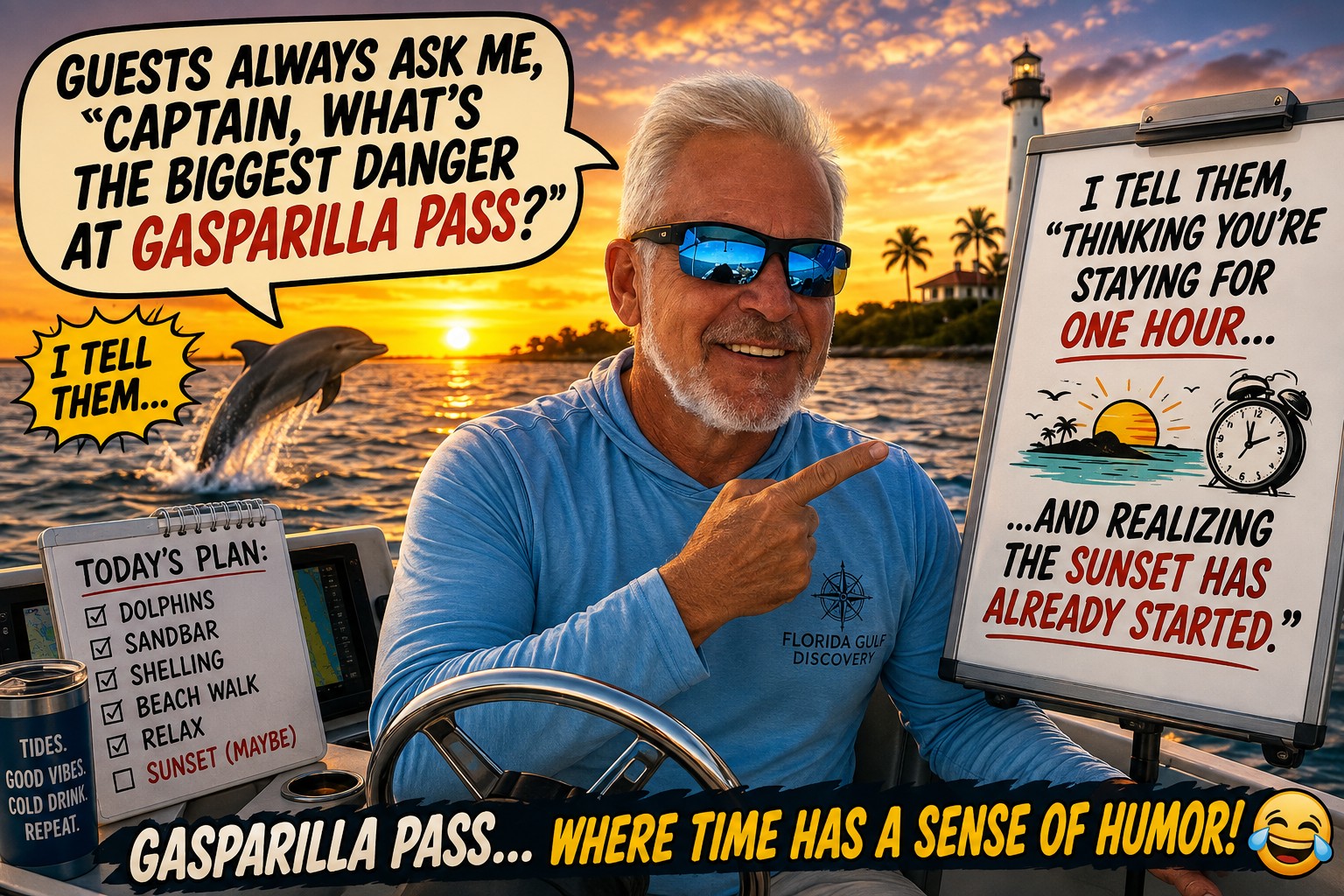
Captain Pavel's Explorer's Note: "People ask me how long we stay at Gasparilla Pass. I tell them, 'Until someone says, "Just five more minutes..." for the fifth time.'" That's the magic of Gasparilla Pass.
Gasparilla Pass is more than just another stop on the map—it's one of those special places that reveals something new every time you visit. One day it's a pod of dolphins riding the incoming tide. Another day it's a spectacular Gulf sunset, a quiet beach all to yourself, or an osprey diving for its next meal.
I've spent countless hours exploring these waters, and every trip is different. That's what keeps bringing me back.
When you join me aboard Florida Gulf Discovery LLC, you're not signing up for a scripted tour or rushing from one destination to the next. Every private boat tour is customized around your interests, the weather, the tides, and the best conditions that day. Whether you'd like to discover hidden beaches, explore nearby islands, watch dolphins, enjoy waterfront dining, or simply relax on the water, we'll create an experience that's uniquely yours.
My goal is simple—to help you discover Southwest Florida the way I have come to know and love it: one quiet beach, one hidden island, one dolphin, and one unforgettable adventure at a time. The best memories aren't made by following a schedule—they're made by slowing down and appreciating the incredible places that make this coastline so special.
Captain Pavel's Explorer's Note
"I'm not here to rush from stop to stop. I'm here to help you discover Southwest Florida the way nature intended—one island, one dolphin, one sunset, and one unforgettable moment at a time."
If you're ready to experience Gasparilla Pass from a local captain's perspective, I'd be honored to welcome you aboard and share one of my favorite places in Southwest Florida.
Ready to Explore?
Join me aboard Florida Gulf Discovery LLC, and let's create a private boating adventure you'll remember long after the day is over.
⚓ Check My Private Boat Tours