
🌿 Explore This Guide
Warm Mineral Springs, North Port, Florida | Visitor & Nature Guide
Discover the remarkable story of Florida’s naturally warm mineral spring—from its ancient geological origins and Ice Age archaeology to its mineral-rich water, scientific research, wildlife, and visitor experience.
🌿 Explore Responsibly
Warm Mineral Springs is a protected geological wonder, an internationally significant archaeological site, and a unique natural resource. Please respect wildlife, follow official park rules, and help preserve this extraordinary place for future generations.
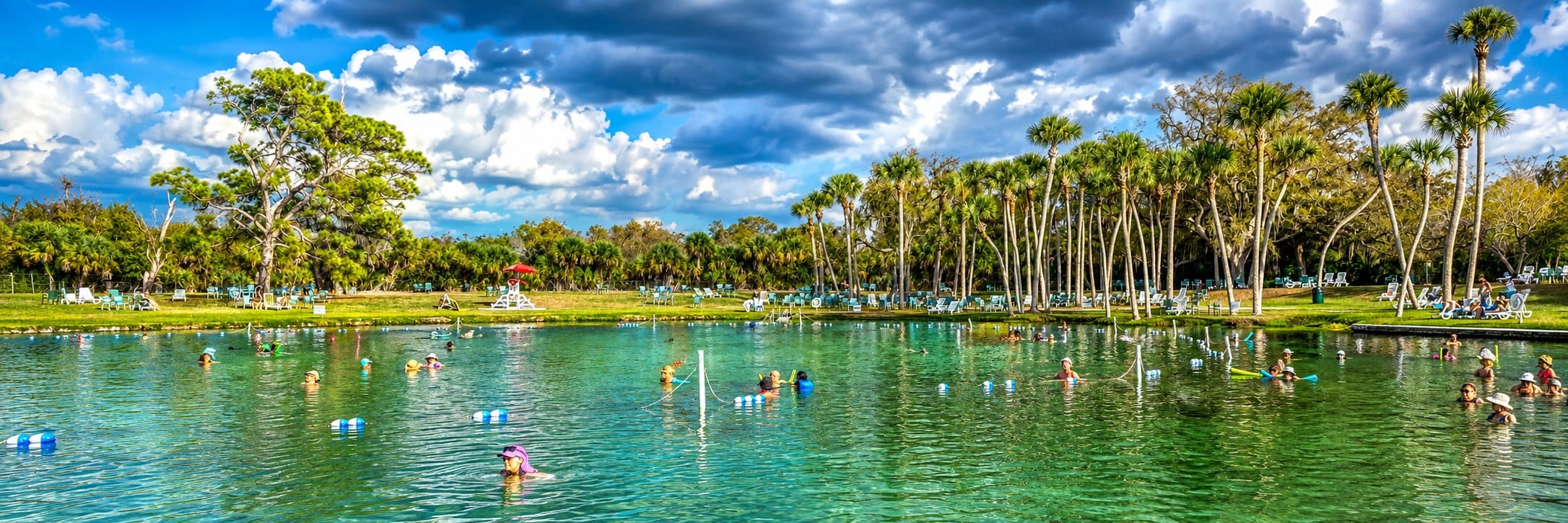
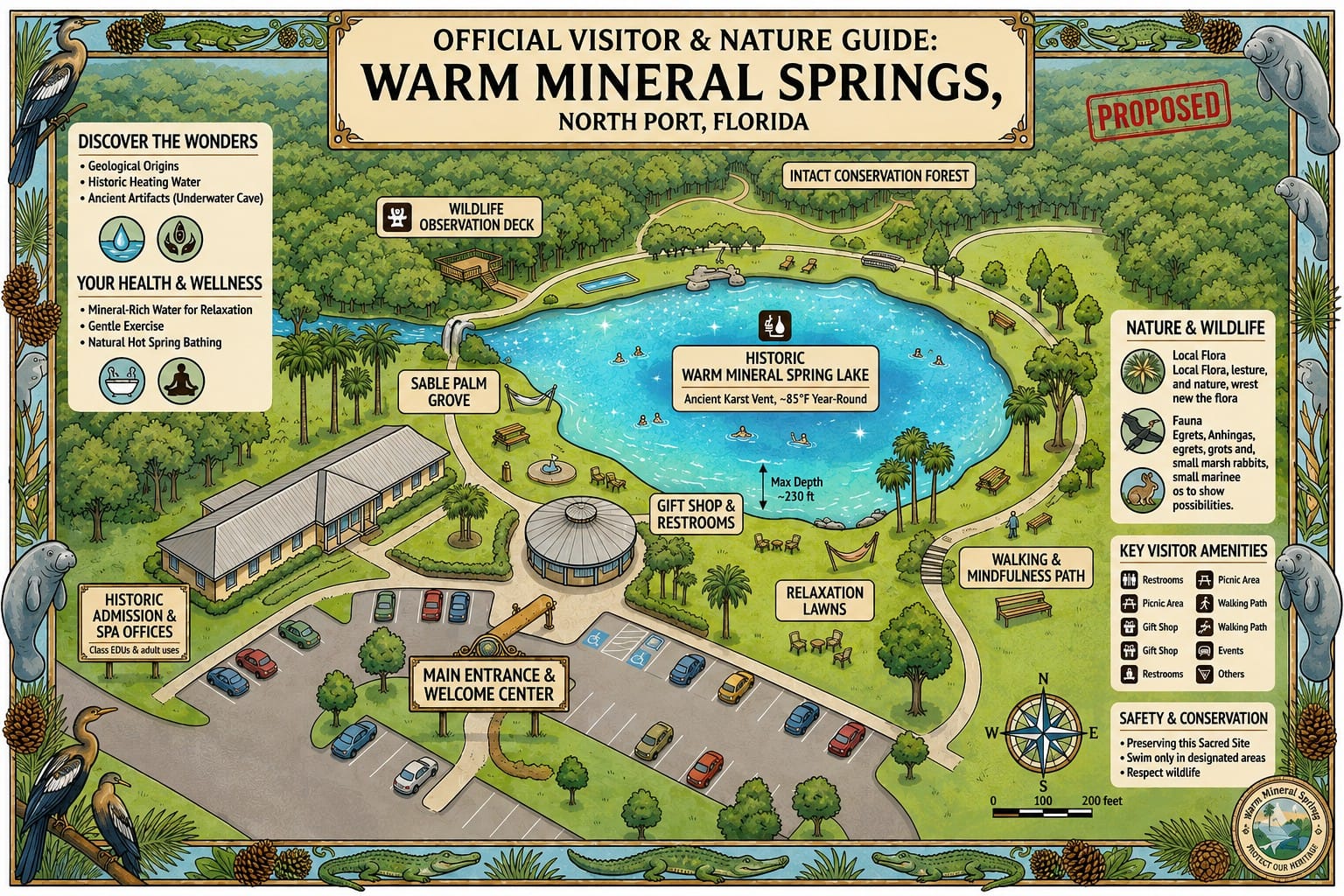
Quick Facts
Warm Mineral Springs is a naturally warm, mineral-rich spring filling an ancient limestone sinkhole in North Port, Florida. These essential facts provide a concise overview of its size, water source, geology, hydrology, and archaeological importance.
| Feature | Information |
|---|---|
| Location | North Port, Sarasota County, Florida, USA |
| Type | Naturally warm mineral spring filling an ancient limestone sinkhole |
| Spring Classification | Third-magnitude warm mineral spring |
| Elevation | Approximately 18 ft (5.5 m) above sea level |
| Surface Diameter | Approximately 240 ft (73 m) |
| Maximum Depth | Approximately 205 ft (62.5 m) |
| Water Temperature | Approximately 85°F (29–30°C) year-round |
| Water Source | Deep artesian groundwater from the Upper Floridan Aquifer |
| Estimated Groundwater Source Depth | Approximately 1,400–1,600 ft (430–490 m) below the surface |
| Historic Spring Discharge | Approximately 6–9 ft³/s (170–255 L/s), historically as high as 11–12 ft³/s |
| Water Appearance | Clear with a slight green tint caused by dissolved minerals |
| Typical Water Clarity | Best in the morning, about 30 ft (9 m), and often decreases later in the day |
| Natural Odor | Mild hydrogen sulfide (“sulfur”) aroma |
| Mineral Content | Highest total dissolved mineral content among Florida’s major natural springs |
| Estimated Age of the Sinkhole | More than 12,000 years |
| Formation | Formed by limestone dissolution, underground cave development, and sinkhole collapse |
| Surface Outflow | Warm Mineral Springs Creek → Salt Creek → Myakka River |
| Archaeological Significance | One of North America’s most important prehistoric underwater archaeological sites |
| National Register of Historic Places | Listed in 1977 |
| Visitor Access | Swimming, floating, soaking, and therapeutic bathing through Warm Mineral Springs Park |
Where Is Warm Mineral Springs?
Warm Mineral Springs is an inland natural landmark in North Port, connected hydrologically to the Myakka River watershed and the deeper Upper Floridan Aquifer beneath Southwest Florida.
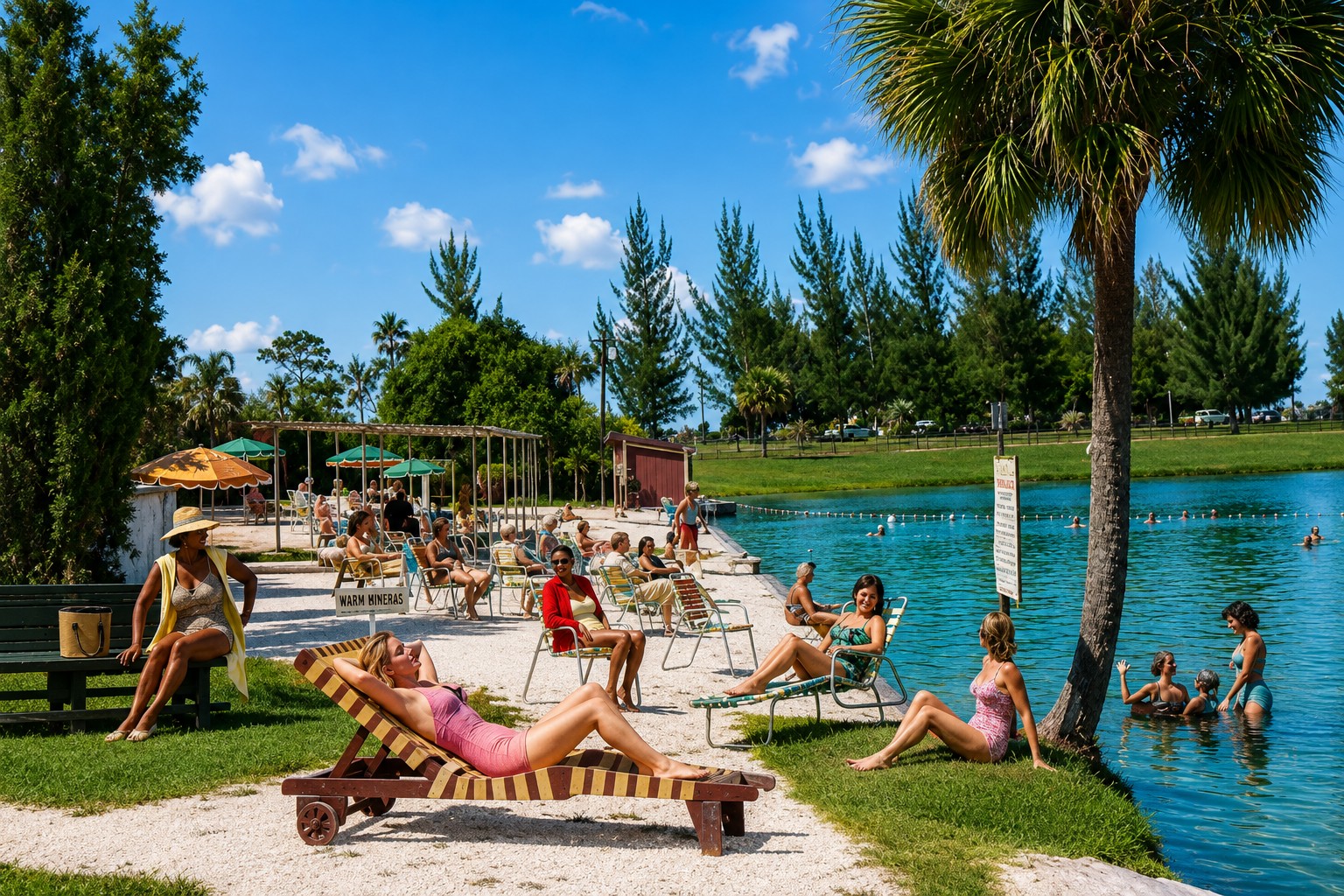
This historic 1955 postcard captures Warm Mineral Springs during the early years of its rise as one of Florida's most famous health and wellness destinations. Promoted as the "Fountain of Youth".
Warm Mineral Springs is located in the City of North Port, in southern Sarasota County, on Florida’s Gulf Coast. Although it lies only about 13 miles (21 km) from the Gulf of America, the spring is entirely inland within the Myakka River watershed, making it one of Southwest Florida’s most unusual natural landmarks.
The spring sits at an elevation of approximately 18 feet (5.5 meters) above sea level and is surrounded today by residential neighborhoods and parkland. Beneath the surface, however, it is connected to the deep Upper Floridan Aquifer, where artesian groundwater rises naturally through ancient limestone formations before filling the sinkhole.

1962 captures Warm Mineral Springs during the height of its popularity as one of Florida's premier health and wellness destinations. By the early 1960s, thousands of visitors traveled to North Port.
The spring’s overflow exits through Warm Mineral Springs Creek, flows into Salt Creek, and eventually reaches the Myakka River, which empties into Charlotte Harbor and the Gulf of America.
Warm Mineral Springs is conveniently located near several of Southwest Florida’s most popular destinations, making it an easy day trip for both residents and visitors.
Approximate Driving Distances
| Destination | Approximate Distance |
|---|---|
| Downtown North Port | 4 mi (6 km) |
| Venice | 17 mi (27 km) |
| Englewood | 22 mi (35 km) |
| Port Charlotte | 18 mi (29 km) |
| Punta Gorda | 30 mi (48 km) |
| Sarasota | 38 mi (61 km) |
Unlike Florida’s famous river-fed springs in the central and northern parts of the state, Warm Mineral Springs is a deep circular sinkhole spring rather than the source of a large spring-fed river. Its unique location within the Myakka River Basin, combined with its warm mineral-rich water and exceptional archaeological significance, makes it one of the most distinctive natural attractions in Southwest Florida.
How Was Warm Mineral Springs Created?
Warm Mineral Springs developed through a long sequence of geological events involving ancient tropical seas, limestone formation, underground cave development, sinkhole collapse, rising groundwater, and deep artesian flow.
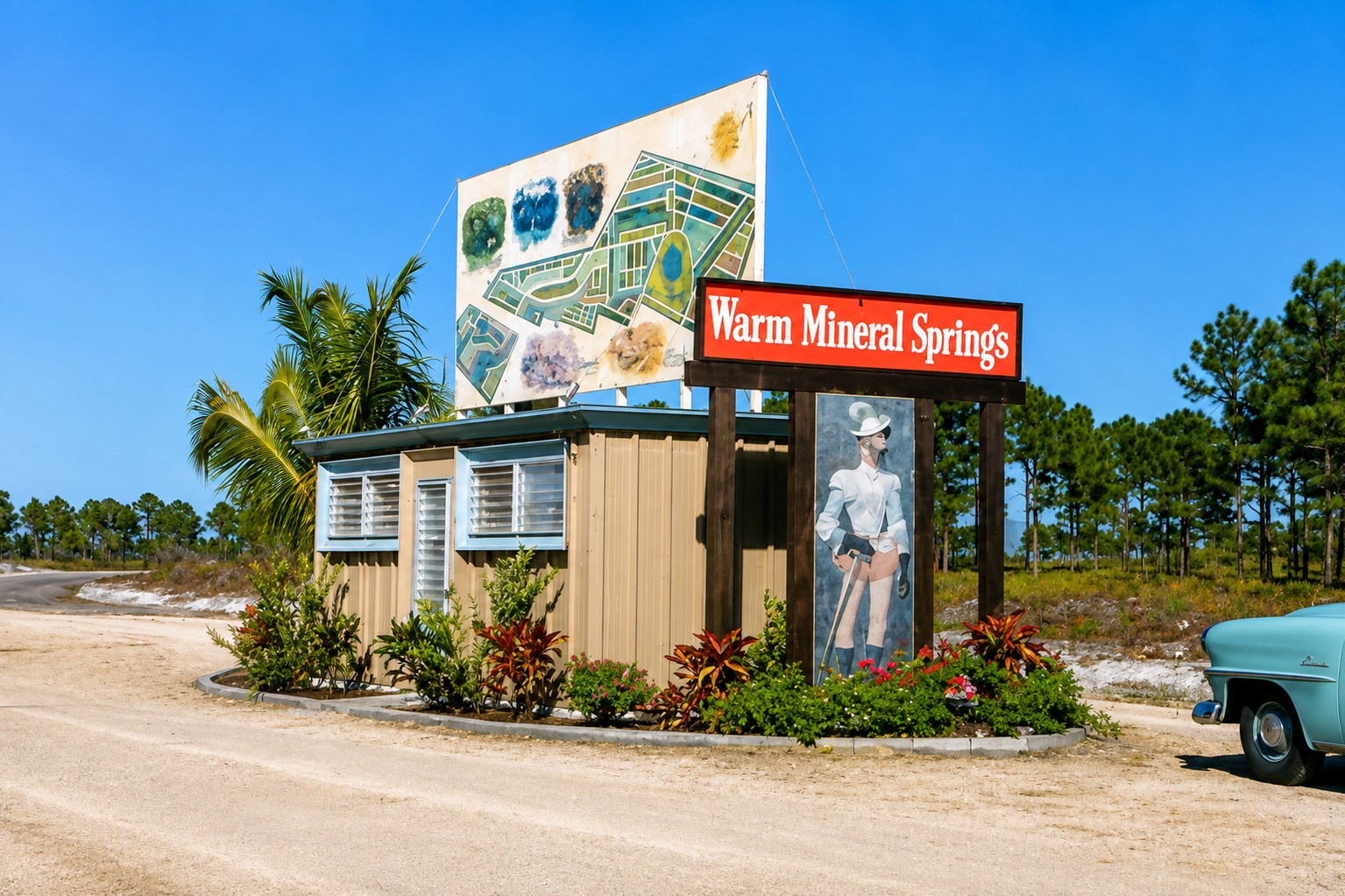
This restored image recreates the welcoming entrance to Warm Mineral Springs as it appeared in 1955, when the famous spring was promoted nationwide as "The Original Fountain of Youth."
The story of Warm Mineral Springs began millions of years before the first humans arrived in Florida. Its formation was not the result of a single event but rather a long sequence of geological processes involving ancient seas, limestone deposition, underground cave development, sinkhole collapse, and the continuous movement of deep groundwater. Today, the spring is considered one of Florida’s most remarkable examples of karst geology.
An Ancient Tropical Sea

This historic photograph, taken in 1955, shows visitors enjoying the naturally warm waters of Warm Mineral Springs during the resort's golden era. Throughout the 1950s, thousands of travelers visited North Port to float, swim, and relax in the spring's naturally mineral-rich waters, which maintain a constant temperature of approximately 87°F (31°C) year-round. Promoted as the legendary "Original Fountain of Youth," the attraction became one of Florida's best-known health resorts, drawing visitors from across the United States. Beyond its popularity as a spa, Warm Mineral Springs is now internationally recognized for its exceptional geological formation and underwater archaeological discoveries, preserving evidence of human activity dating back more than 12,000 years.
Between 25 and 35 million years ago, much of what is now Florida lay beneath a warm, shallow tropical sea. Over millions of years, the shells, corals, algae, and other marine organisms settled on the seafloor. As these calcium-rich remains accumulated, they gradually hardened into thick layers of limestone and dolostone, creating the foundation of the Florida Platform.
These rock formations—including the Avon Park Formation, Ocala Limestone, and Suwannee Limestone—still lie beneath Warm Mineral Springs today.
The Birth of an Underground Cave
Limestone is naturally dissolved by slightly acidic rainwater. As rainwater absorbed carbon dioxide from the atmosphere and soil, it slowly seeped underground, enlarging tiny cracks within the limestone over countless thousands of years.
Gradually, these cracks expanded into underground passages and large caverns, creating the classic karst landscape for which Florida is well known.
Karst is a landscape formed where slightly acidic water dissolves soluble rock—especially limestone—creating caves, underground passages, springs, and sinkholes.
When the Ground Collapsed
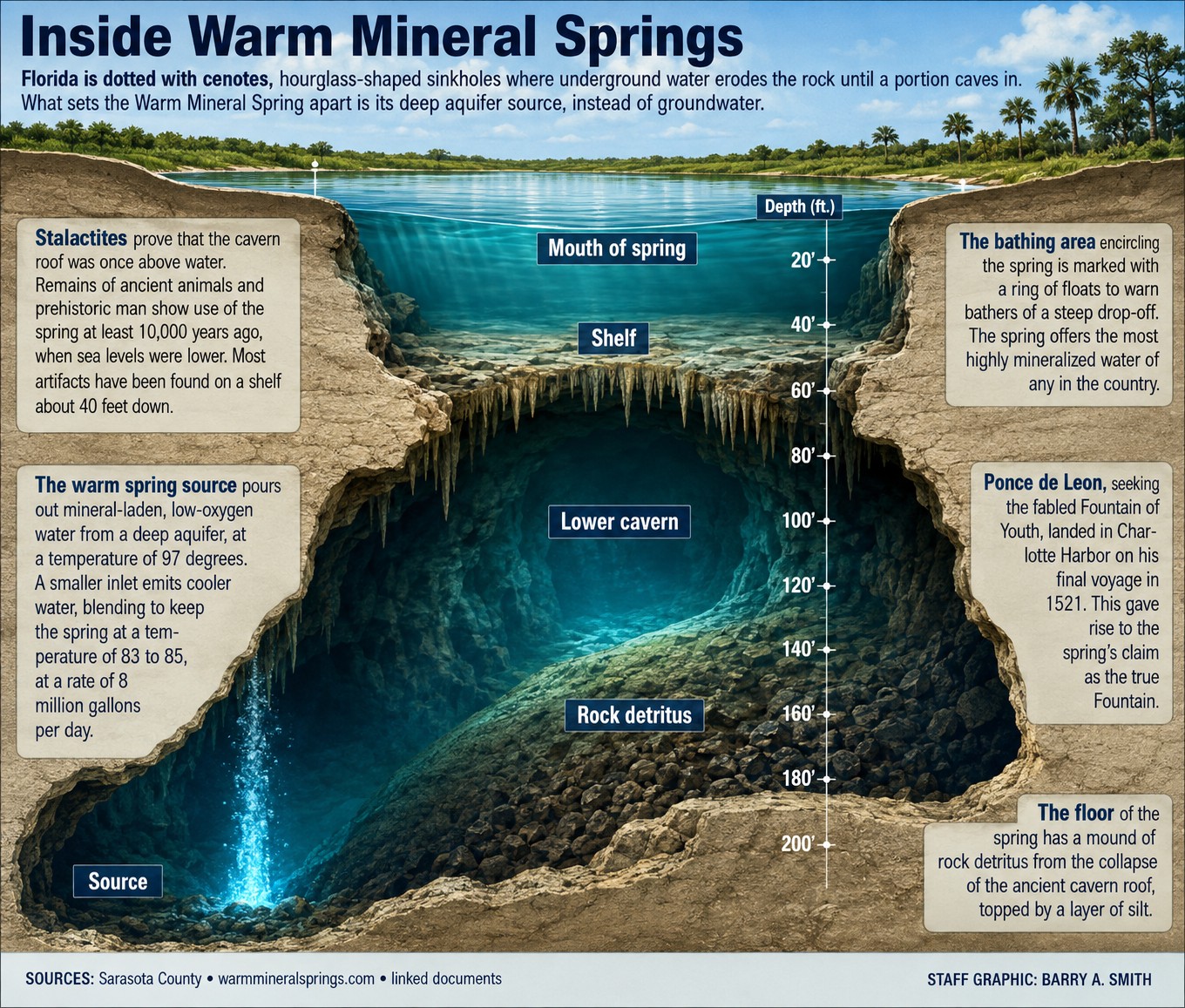
This geological cross-section reveals the hidden interior of Warm Mineral Springs, a remarkable limestone sinkhole formed more than 12,000 years ago. Beneath the surface, the spring reaches a depth of approximately 205 feet (62 meters), where warm, mineral-rich water enters through an underwater spring vent connected to the Upper Floridan Aquifer. Scientific dives have mapped the principal underwater conduit for more than 170 feet (53 meters), providing valuable insight into the spring's unique hydrogeology. The oxygen-poor waters also helped preserve prehistoric human remains, Ice Age animal fossils, and ancient artifacts, making Warm Mineral Springs one of North America's most important underwater archaeological sites as well as one of its most fascinating geological wonders.
Eventually, one of these underground caverns became too large to support the weight of the overlying rock and sediments. The cave roof collapsed, forming a nearly circular sinkhole.
Scientific evidence indicates that this collapse occurred more than 12,000 years ago, before the end of the last Ice Age. At that time, sea level was much lower than it is today, and the sinkhole was dry or contained only a small amount of water. People and Ice Age animals could walk across the landscape that now lies beneath more than 200 feet of water.
Rising Water Creates the Spring
As the Ice Age ended, glaciers melted around the world and sea levels gradually rose. At the same time, groundwater levels across Florida also increased.
Deep artesian groundwater from the Upper Floridan Aquifer began rising through the collapsed sinkhole, eventually filling it with warm, mineral-rich water. Unlike ordinary lakes that depend primarily on rainfall, Warm Mineral Springs is continuously supplied by groundwater flowing upward under natural artesian pressure. This constant flow has maintained the lake for thousands of years.
Why the Spring Is Still Active Today
The warm water reaching the surface has traveled a remarkable underground journey. Modern U.S. Geological Survey research indicates that much of it likely circulates through the Avon Park Formation, approximately 1,400 to 1,600 feet (430–490 meters) below the surface.
At these depths, groundwater is naturally warmer and contains a high concentration of dissolved minerals acquired during its long passage through ancient carbonate rocks. As this mineral-rich water rises under artesian pressure, it fills the sinkhole and eventually flows out through Warm Mineral Springs Creek, Salt Creek, and into the Myakka River.
A Living Geological System
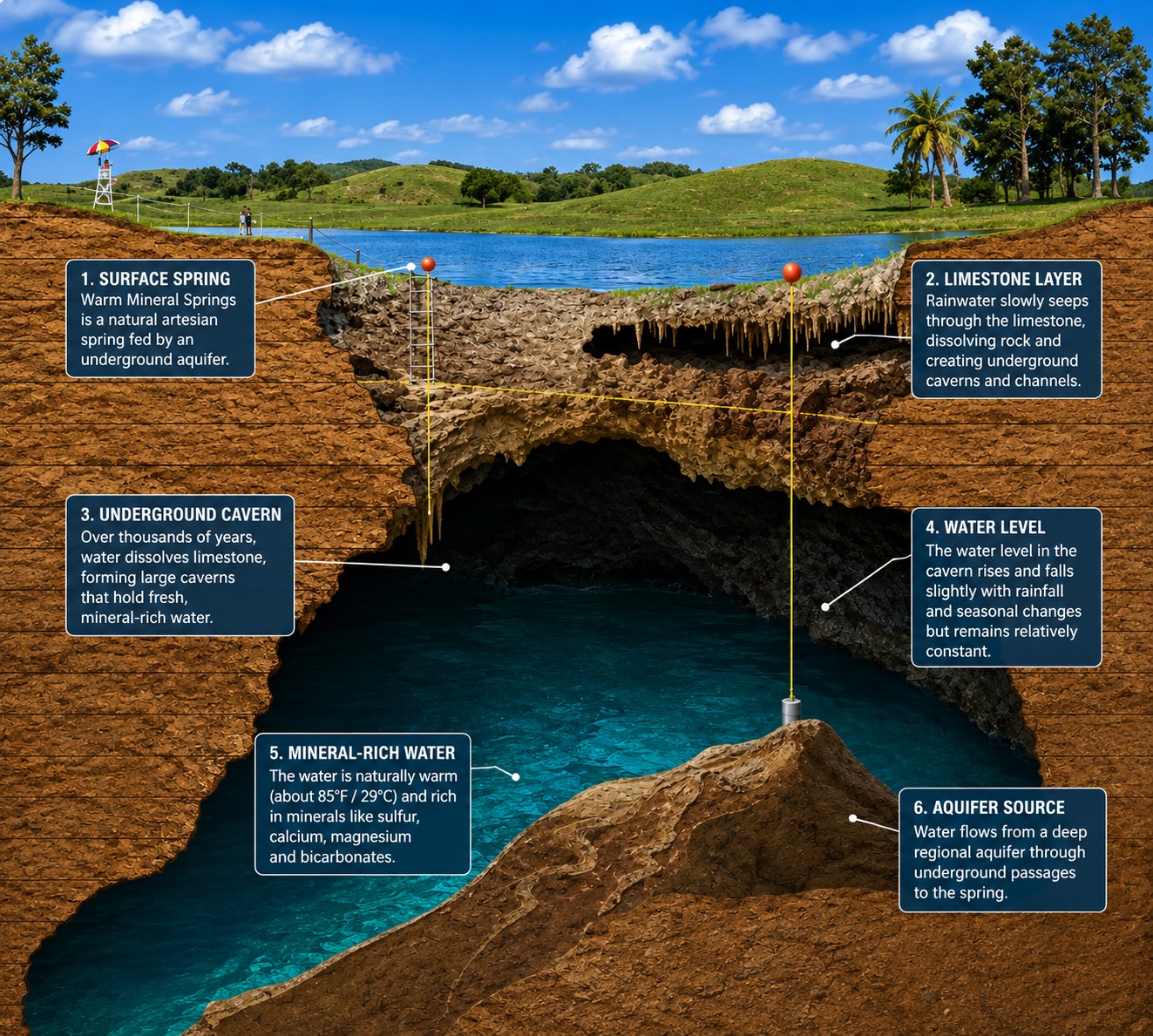
This cross-section illustrates the remarkable underground structure of Warm Mineral Springs, one of Florida's most fascinating geological features. The spring is a water-filled limestone sinkhole that extends to a depth of approximately 205 feet.
Although the sinkhole itself formed thousands of years ago, Warm Mineral Springs remains an active geological feature. Groundwater continues to move through the deep aquifer every day, delivering warm, mineral-rich water to the surface while slowly reshaping the underground limestone.
The spring’s water temperature has remained remarkably stable throughout modern scientific records, demonstrating the consistency of its deep groundwater source. This ongoing natural process makes Warm Mineral Springs not only a beautiful destination but also a living window into Florida’s geological history.
Geological Timeline
| Time | What Happened |
|---|---|
| 35–25 million years ago | Florida was covered by a warm, shallow tropical sea where limestone and dolostone began forming. |
| Millions of years | Slightly acidic groundwater dissolved the limestone, creating underground caves and passages. |
| More than 12,000 years ago | The roof of a large underground cave collapsed, forming the Warm Mineral Springs sinkhole. |
| End of the Ice Age | Rising groundwater filled the sinkhole with warm, mineral-rich artesian water. |
| Today | Deep groundwater from the Upper Floridan Aquifer continues to feed one of Florida’s most unique natural springs. |
Why Is the Water Warm and Rich in Minerals?
The spring’s warmth, mineral content, sulfur aroma, low oxygen, and natural buoyancy are all connected to the water’s long underground journey through the deep limestone formations of Southwest Florida.
One of the first things visitors notice at Warm Mineral Springs is that the water feels comfortably warm throughout the year. The second is its distinctive mineral smell and the effortless feeling of floating. These characteristics are not a coincidence—they are the result of a remarkable underground journey that began thousands of feet beneath Southwest Florida.
Warm Water from Deep Below Florida
Unlike most Florida springs, which are supplied primarily by shallower groundwater, Warm Mineral Springs receives much of its water from deep flow paths within the Upper Floridan Aquifer.
Scientific studies by the U.S. Geological Survey indicate that the spring’s warm water most likely originates from a highly permeable zone of the Avon Park Formation, approximately 1,400 to 1,600 feet (430–490 meters) below the surface.
At these depths, groundwater is naturally warmer because temperatures gradually increase with depth inside the Earth. This natural increase in underground temperature is known as the geothermal gradient.
Warm Mineral Springs is not heated by volcanic activity. Its water becomes warm naturally as groundwater circulates through deeper rock layers, where temperatures are higher than near the surface.
A Long Journey Through Limestone and Dolostone
As rainwater slowly filters through layers of limestone and dolostone, it spends thousands of years moving through underground rock formations. During this long journey, the water dissolves naturally occurring minerals from the surrounding rocks.
By the time it reaches Warm Mineral Springs, it contains an unusually high concentration of dissolved minerals compared with other major springs in Florida. The U.S. Geological Survey concluded that Warm Mineral Springs has the highest water temperature and the greatest mineralized content among Florida’s major natural springs.
What Minerals Are in the Water?
Why Is the Water Low in Oxygen?

Watch on YouTube Shorts: Meet one of most famous local residents.
Another unusual characteristic is the spring’s low dissolved oxygen. Most Florida rivers and shallow lakes are constantly mixed by wind and flowing water, allowing oxygen from the atmosphere to dissolve into the water.
Warm Mineral Springs, however, is supplied by deep groundwater that has remained isolated from the atmosphere for long periods. As a result, the water contains relatively little dissolved oxygen.
These oxygen-poor conditions helped preserve archaeological remains and organic material that might otherwise have decomposed, contributing to the spring’s exceptional underwater archaeological importance.
Why Does Floating Feel Easier?
Many visitors notice that floating feels easier than in an ordinary freshwater lake. This is because dissolved minerals slightly increase the density of the water, providing greater natural buoyancy.
While the effect is much less dramatic than in highly saline places such as the Dead Sea, it is noticeable to many swimmers and contributes to the spring’s relaxing bathing experience.
The higher density of mineral-rich water provides slightly more upward support, making it easier for the human body to float than in ordinary freshwater.
A Remarkably Stable Temperature
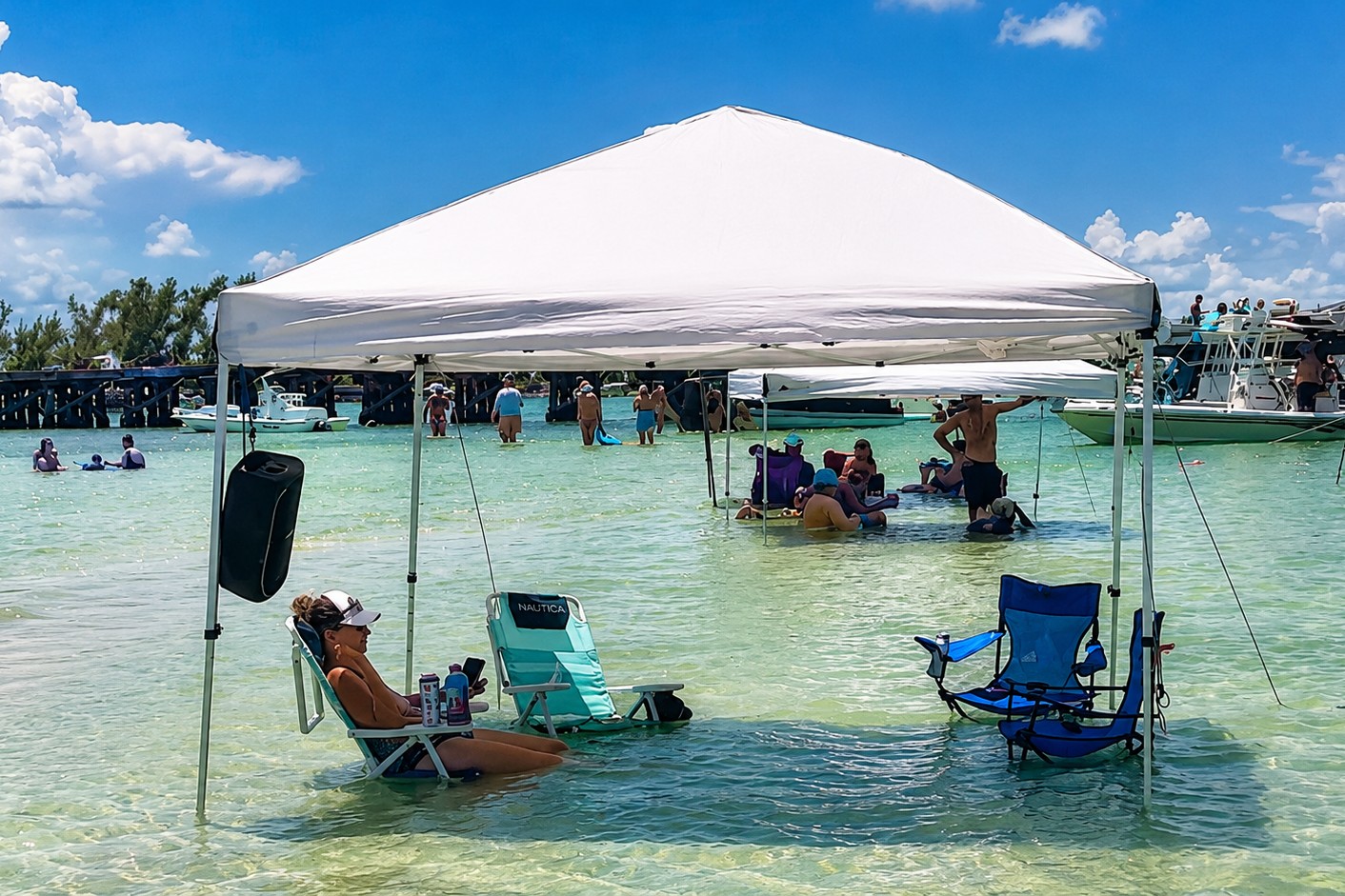
Watch on YouTube: Relax with Captain Pavel at Boca Grande Sandbar, where crystal-clear turquoise water, soft white sand, and gentle Gulf breezes create the perfect escape. Watch guests unwind beneath a floating canopy while enjoying one of Southwest Florida's most popular boating destinations. Boca Grande Sandbar is renowned for its shallow, family-friendly waters, outstanding swimming, and unforgettable days on the water.
Despite seasonal weather changes, the spring’s water temperature remains remarkably stable at about 85°F (29–30°C) throughout the year. More than seventy years of measurements show no significant long-term change in temperature.
Hurricanes, cold fronts, and summer heat may temporarily influence conditions near the surface, but they have little effect on the deep artesian groundwater continuously feeding the spring.
This constant temperature is one of the defining features that has attracted visitors from around the world for generations.
The water emerging from the deeper zones of the Avon Park Formation is estimated to be at least 95°F (35°C). As it rises and mixes with cooler groundwater before reaching the surface, it stabilizes at the spring’s familiar temperature of approximately 85°F (29–30°C).
Wellness & Balneotherapy at Warm Mineral Springs
Warm Mineral Springs has attracted visitors for generations because of its naturally warm water, mineral content, buoyancy, peaceful setting, and long association with relaxation and traditional wellness practices.
For more than a century, people have traveled to Warm Mineral Springs seeking relaxation and the unique experience of bathing in naturally warm, mineral-rich water. Long before the spring became a public attraction, local residents and early visitors believed its warm waters provided a soothing environment for tired muscles, stiff joints, and overall well-being.
Today, visitors from around the world continue this tradition, making Warm Mineral Springs one of Florida’s most recognized natural wellness destinations.
Unlike a swimming pool or an ordinary freshwater lake, Warm Mineral Springs offers a rare combination of naturally warm water, exceptional buoyancy, and one of the highest mineral concentrations found in any major Florida spring.
Together, these natural characteristics create an environment that many visitors describe as calming, comfortable, and deeply relaxing. Floating in the warm water reduces stress on joints and muscles, allowing the body to move more freely while encouraging relaxation.
What Is Balneotherapy?
The practice of bathing in naturally warm mineral water is known as balneotherapy. The word comes from the Latin balneum, meaning “bath.”
For thousands of years, civilizations including the ancient Greeks, Romans, Egyptians, and Japanese have visited natural mineral springs for relaxation, bathing, and wellness.
Today, balneotherapy remains an important part of health and wellness traditions throughout Europe, where thermal spas are often used as a complementary therapy alongside conventional medical care.
What Does Modern Research Suggest?
Modern scientific research suggests that warm mineral-water bathing may help relieve symptoms associated with certain musculoskeletal conditions. Studies have reported improvements in comfort, flexibility, and quality of life for some people experiencing:
Researchers believe these possible benefits result from a combination of warm water, natural buoyancy, gentle movement, temporary changes in circulation during immersion, and the relaxing environment rather than from any single mineral alone.
Individual experiences vary, and the strength of scientific evidence differs depending on the condition being studied.
Why Many Visitors Feel Better
Many visitors describe feeling refreshed and rejuvenated after spending time in the spring. Several natural factors may contribute to this experience:
For many people, the greatest benefit is simply taking time to slow down, disconnect from daily routines, and enjoy one of Florida’s most remarkable natural places.
Who Should Use Extra Caution?
Although Warm Mineral Springs may be enjoyed by many healthy adults in moderation, warm-water immersion may not be suitable for everyone. Visitors should consult a healthcare provider before bathing if they have:
- Serious heart disease or uncontrolled high blood pressure.
- Recently experienced a heart attack or stroke.
- Recently undergone surgery.
- Open wounds or active skin infections.
- Fever or an acute infectious illness.
- Severe kidney disease or certain electrolyte disorders.
- A history of dizziness or fainting.
- Pregnancy, particularly when advised by a healthcare provider to avoid prolonged warm-water exposure.
Young children and older adults should avoid prolonged immersion and remain well hydrated. Visitors should also avoid alcohol before entering the spring and leave the water immediately if they begin to feel light-headed, overheated, or unwell.
Many European thermal spas recommend soaking for 15 to 30 minutes, followed by a period of rest and hydration before returning to the water. While every visitor is different, shorter sessions with breaks are often more comfortable than remaining in warm water continuously.
Warm Mineral Springs is a unique natural destination for relaxation, recreation, and wellness. Although many visitors report feeling refreshed after bathing, the spring is not a medical treatment, and no scientific evidence demonstrates that it cures diseases. If you have a chronic medical condition or questions about warm-water immersion, consult your healthcare provider before visiting.
Warm Mineral Springs has earned its worldwide reputation not because of miracle cures, but because it offers something increasingly rare—a peaceful place where nature, geology, history, and relaxation come together in one extraordinary setting.
While many visitors come to Warm Mineral Springs for relaxation and wellness, the greatest treasures of this remarkable place remain hidden beneath the surface. The spring has preserved evidence of prehistoric humans and extinct Ice Age animals for thousands of years, making it one of the most important underwater archaeological sites in North America. In the next section, we explore the fascinating ancient history beneath the water.
Ancient History Beneath the Water
Beneath the calm surface of Warm Mineral Springs lies an extraordinary underwater archive preserving evidence of Ice Age animals, early people, ancient environments, and more than 10,000 years of human history.
Long before Florida’s beaches, cities, and barrier islands existed, the landscape around Warm Mineral Springs looked dramatically different. During the last Ice Age, sea levels were more than 300 feet (90 meters) lower than they are today, and much of the Gulf Coast extended far beyond its present shoreline.
What is now a deep spring was once a dry limestone sinkhole surrounded by open grasslands, freshwater ponds, and forests that supported an extraordinary variety of wildlife.
Thousands of years ago, this sinkhole became an important place for both animals and early humans. Like many natural depressions, it collected fresh water and offered shelter within the surrounding landscape. As a result, countless traces of prehistoric life accumulated on its floor.
When the climate warmed and sea levels gradually rose at the end of the Ice Age, artesian groundwater filled the sinkhole, sealing many of these remains beneath oxygen-poor water and sediment. These unusual conditions preserved organic materials that rarely survive at ordinary archaeological sites.
The spring’s low-oxygen water and accumulating sediments helped protect bones, wood, plant remains, and other fragile materials that would normally decay after thousands of years.
A Lost World of Ice Age Animals
Archaeological excavations have uncovered the remains of numerous extinct animals that once roamed prehistoric Florida, including:
These discoveries reveal that Southwest Florida once supported a rich and diverse ecosystem very different from the subtropical environment visitors see today.
Early People at Warm Mineral Springs
The spring has also yielded evidence of some of the earliest known human activity in Florida. Archaeologists have recovered human bones, stone and bone artifacts, wooden remains, and evidence of intentional burials dating back more than 10,000 years.
These discoveries demonstrate that people were living in this region near the end of the Ice Age, when the sinkhole was still dry or only partially filled with water.
One of the site’s most remarkable discoveries was a nearly complete prehistoric human skeleton intentionally buried within the sinkhole. Radiocarbon dating indicates that the burial is more than 10,000 years old, making it one of the oldest known intentional human burials in North America.
This finding transformed scientific understanding of early human occupation in the southeastern United States and established Warm Mineral Springs as a site of international archaeological importance.
In 1959, explorer William Royal and marine biologist Dr. Eugenie Clark recovered a prehistoric human skull containing naturally preserved brain tissue. The oxygen-poor environment within the sinkhole had slowed decomposition. Although the soft tissue deteriorated rapidly after exposure to air, the discovery remains one of the most unusual archaeological finds reported in North America and attracted worldwide scientific attention.
Why the Site Is So Important
Unlike most archaeological sites, where only stone tools and bones survive, Warm Mineral Springs preserved an exceptional combination of:
Together, these discoveries have helped archaeologists reconstruct what Southwest Florida looked like thousands of years ago and better understand how early people adapted to a changing climate and rising sea levels.
The spring continues to provide valuable scientific information, and researchers believe there is still much to learn from this extraordinary underwater archive.
A Protected Archaeological Treasure
Today, Warm Mineral Springs is recognized as one of North America’s most significant prehistoric underwater archaeological sites. Because many artifacts remain undisturbed beneath the spring floor, diving is prohibited to protect this irreplaceable resource. Every layer of sediment may preserve another chapter of Florida’s ancient history, making careful scientific stewardship essential for future generations.
Standing beside Warm Mineral Springs today, it is difficult to imagine that beneath the peaceful water lie traces of a world where mastodons wandered, giant sloths browsed, and some of Florida’s earliest inhabitants lived thousands of years before recorded history. Every visitor looks across the same calm surface, but few realize they are standing above one of the most remarkable prehistoric time capsules in North America.
Scientific Research & Underwater Exploration
For more than seventy years, Warm Mineral Springs has attracted archaeologists, geologists, hydrologists, paleontologists, and underwater explorers seeking to understand its geology, ancient inhabitants, preserved remains, and deep groundwater system.
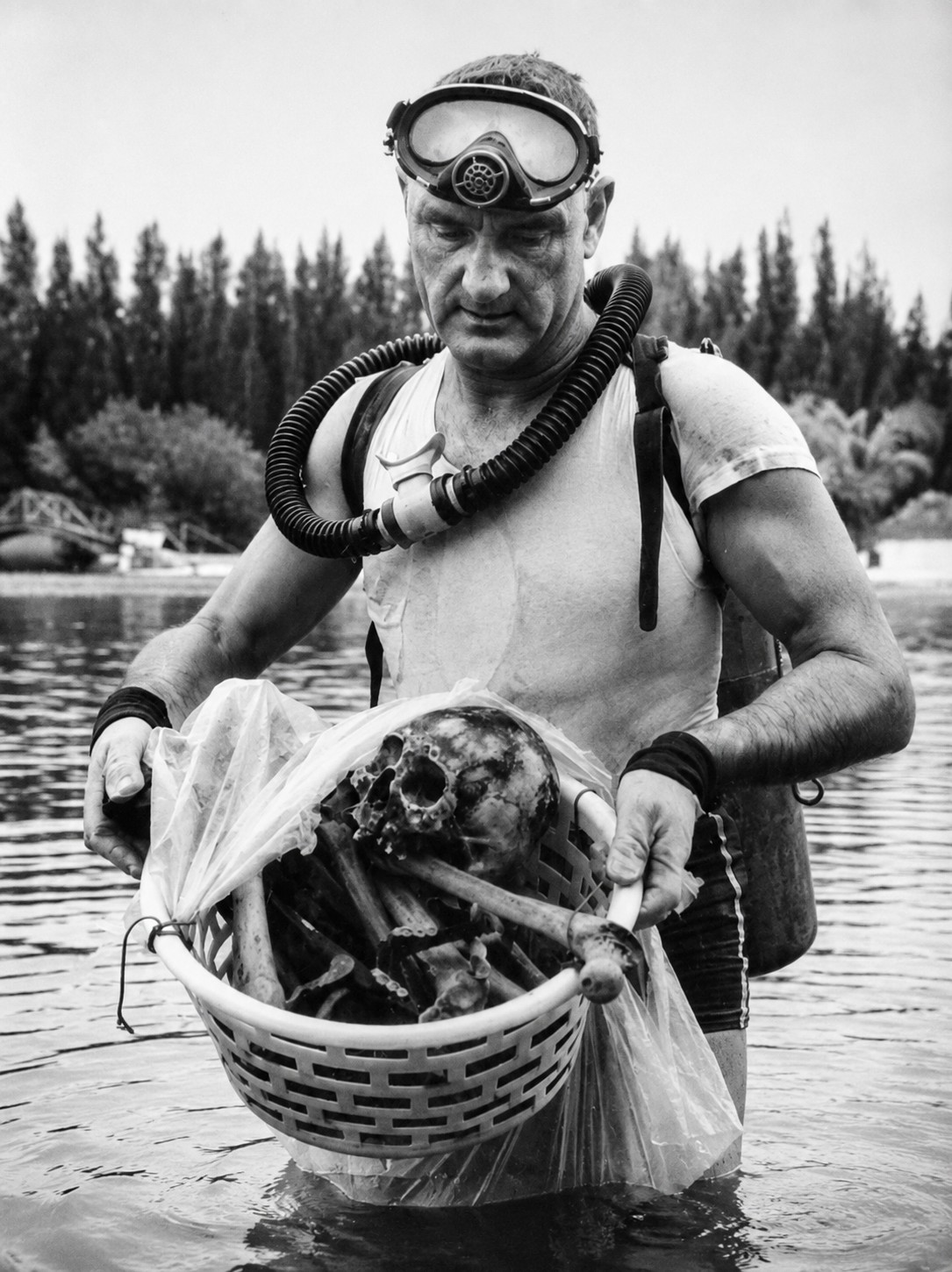
This historic photograph features Lt. Col. William R. Royal, the pioneering diver whose exploration of Warm Mineral Springs helped reveal one of North America's most important underwater archaeological sites. Beginning in 1959, Royal explored the spring's deep underwater cave system, discovering prehistoric human remains, extinct Ice Age animal fossils, and a partially burned log later radiocarbon dated to about 10,000 years old. His remarkable discoveries challenged long-held beliefs about the earliest human occupation of Florida and inspired decades of scientific investigation by archaeologists, geologists, and cave divers. Today, William Royal is widely recognized as the individual whose persistence brought worldwide attention to the extraordinary scientific importance of Warm Mineral Springs.
Warm Mineral Springs is much more than a popular swimming destination. For more than seventy years, it has attracted geologists, archaeologists, hydrologists, paleontologists, and underwater explorers from around the world. Their work transformed the spring from a local curiosity into one of Florida’s most scientifically important natural sites.
Because the spring reaches a depth of approximately 205 feet (62.5 meters) and contains a complex underwater cave system, exploring it has always been both challenging and rewarding.
Limited visibility, steep limestone walls, low dissolved oxygen, deep ledges, and submerged passages require specialized training and equipment. These same conditions, however, also helped preserve archaeological materials that would normally decay over time.
William Royal’s Remarkable Discovery
The modern scientific story of Warm Mineral Springs began in 1959, when retired U.S. Air Force Lieutenant Colonel William Royal, an experienced scuba diver and amateur archaeologist, began exploring the spring.
While diving along the limestone ledges, Royal discovered prehistoric animal bones, human skeletal remains, and evidence that the sinkhole had once been dry. These discoveries challenged existing ideas about Florida’s earliest inhabitants and immediately attracted scientific attention.

Watch on YouTube: Step back to 1959 and discover why Warm Mineral Springs attracted worldwide attention from the diving community. This historic Skin Diving magazine feature highlights the famous Florida spring, whose exceptional underwater visibility, warm mineral-rich water, and remarkable archaeological discoveries made it one of the most celebrated freshwater diving destinations in North America during the 1950s.
Recognizing the importance of the finds, Royal invited renowned marine biologist Dr. Eugenie Clark, founder of what is now Mote Marine Laboratory, to investigate the site with him.
During their dives, they recovered additional archaeological materials, including a prehistoric human skull containing naturally preserved brain tissue—one of the most extraordinary discoveries ever reported from an archaeological site in North America.
Their findings were published in the scientific journal American Antiquity in 1960 and brought international recognition to Warm Mineral Springs.
Expanding Scientific Research
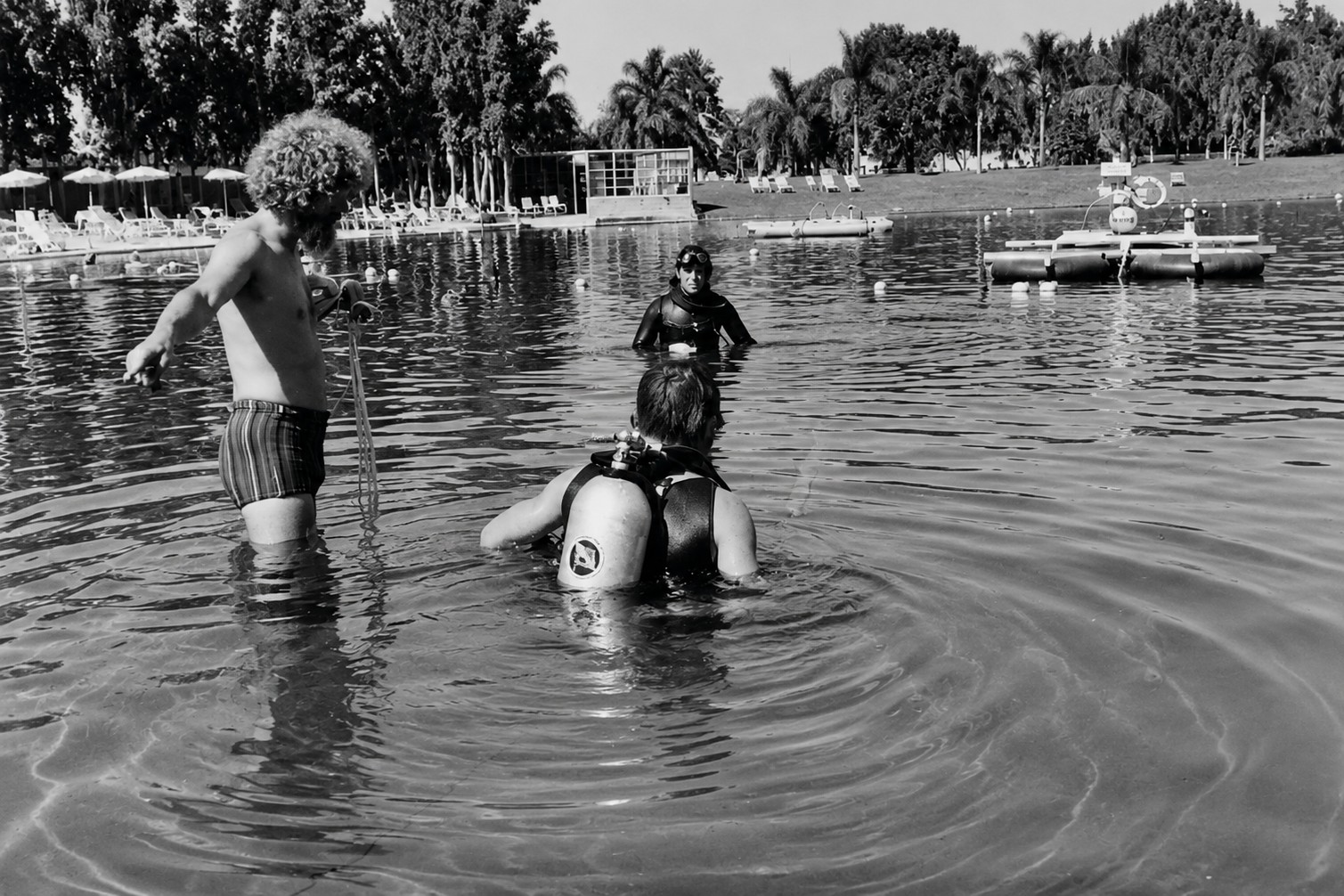
This historic photograph from 1972 captures scuba divers exploring the depths of Warm Mineral Springs, one of the world's most significant underwater archaeological sites. During this period, pioneering diver William R. Royal and professional archaeologists were investigating the spring's underwater cave system, where discoveries of prehistoric human remains, Ice Age animal fossils, ancient plant material, and submerged stalactites transformed scientific understanding of Florida's earliest inhabitants. The investigations of the early 1970s established Warm Mineral Springs as an internationally important archaeological and geological site, attracting researchers from around the world.
Royal’s discoveries inspired decades of professional archaeological investigation. During the 1970s, Dr. Carl J. Clausen, Florida’s first State Underwater Archaeologist, led systematic excavations that confirmed the great antiquity of the site.
Later investigations by Wilburn “Sonny” Cockrell and other researchers recovered additional prehistoric human remains, extinct animal fossils, wooden artifacts, burned logs, and environmental evidence dating to the end of the last Ice Age.
These discoveries significantly improved scientific understanding of Florida’s earliest inhabitants and prehistoric environments.
Modern Geological Research
While archaeologists studied the spring’s ancient past, geologists and hydrologists sought to understand its origin and modern operation.
Investigations by the U.S. Geological Survey (USGS) combined groundwater chemistry, water-temperature measurements, discharge records, and geologic mapping to determine how Warm Mineral Springs functions today.
- Warm water rises from deep within the Upper Floridan Aquifer.
- The principal warm-water source likely originates within the Avon Park Formation, approximately 1,400–1,600 feet (430–490 meters) below the surface.
- The spring’s nearly constant 85°F (29–30°C) temperature results from deep groundwater circulation rather than volcanic activity.
- Warm Mineral Springs contains the highest total dissolved mineral content measured among Florida’s major natural springs.
These studies confirmed that the spring is both a remarkable geological feature and an important natural laboratory for understanding Florida’s groundwater systems.
Exploring the Underwater Cave System
Although visitors see only the circular lake at the surface, Warm Mineral Springs extends into submerged passages, ledges, chambers, vents, and groundwater seepage zones beneath the water.
Scientific surveys and trained cave divers have documented deep chambers, multiple freshwater seepage points, and the principal warm-water vent near the bottom of the sinkhole.
These submerged features help explain the spring’s unusual circulation, constant temperature, mineral chemistry, and low dissolved oxygen. They also continue to provide opportunities for carefully controlled scientific research.
Protecting an Irreplaceable Resource
Archaeological exploration at Warm Mineral Springs is now carefully controlled. Unauthorized diving is prohibited to protect fragile geological formations, undisturbed sediments, human remains, artifacts, and other priceless archaeological resources. Every undisturbed layer may preserve additional evidence of prehistoric life.
More than six decades after William Royal’s first dives, researchers continue to study Warm Mineral Springs. Advances in underwater mapping, groundwater science, radiocarbon dating, archaeology, and environmental analysis are revealing new information while helping preserve this extraordinary site for future generations.
“William Royal entered Warm Mineral Springs searching for adventure. Instead, he helped uncover thousands of years of Florida’s hidden history. Every scientific discovery since then has reminded us that the greatest treasures beneath the water are not gold or lost artifacts—but the stories they tell about the people, animals, and landscapes that existed long before modern Florida.”
Natural Changes, Hurricanes & Human Impact
Warm Mineral Springs has endured more than 12,000 years of climatic change, rising seas, tropical storms, hurricanes, and human influence while maintaining remarkably stable warmth and mineral-rich groundwater.
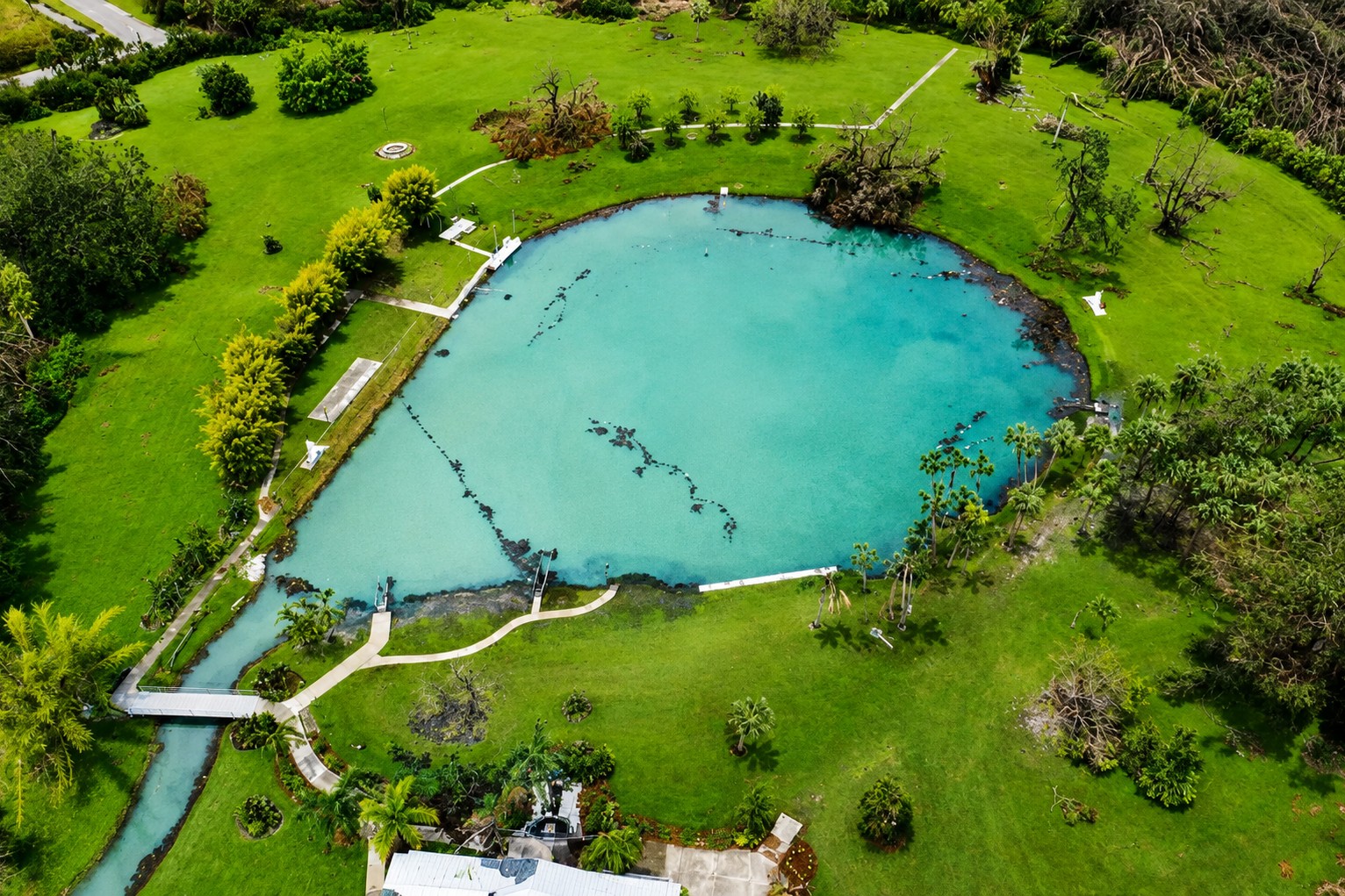
This aerial photograph documents Warm Mineral Springs Park after Hurricane Ian struck Southwest Florida in September 2022. Although the spring itself remained intact, the storm caused extensive damage to the park's historic buildings, utilities, and visitor facilities. Following professional inspections, the City of North Port kept the park closed because damaged structures, debris, water quality concerns, and utility failures created unsafe conditions for visitors. Recovery efforts focused on restoring the park while preserving one of Florida's most important geological, archaeological, and historic landmarks. Today, the spring has reopened, although some historic facilities continue to undergo repair and long-term restoration following Hurricanes Ian and Elsa.
Warm Mineral Springs has existed for more than 12,000 years, surviving dramatic changes in climate, rising sea levels, tropical storms, and countless hurricanes.
While hurricanes have repeatedly reshaped Florida’s coastlines, barrier islands, beaches, and rivers, they have had surprisingly little long-term effect on the spring itself. This remarkable stability is one of the defining characteristics of Warm Mineral Springs.
Unlike coastal lagoons or shallow lakes, Warm Mineral Springs is fed by deep artesian groundwater rising from the Upper Floridan Aquifer. Because its water originates approximately 1,400 to 1,600 feet (430–490 meters) below the surface, the spring is largely isolated from short-term weather events occurring above ground.
Even powerful hurricanes are unlikely to significantly alter the temperature or mineral composition of the deep groundwater supplying the spring.
Surface weather may change quickly, but the spring’s main water supply travels through deep rock formations. This protects its temperature and mineral character from most short-term atmospheric events.
How Hurricanes Affect the Spring
Although hurricanes have little influence on the spring’s deep groundwater system, they can temporarily affect surface conditions around the lake.
Following major storms, visitors may notice:
These effects are generally temporary and diminish as debris settles or is removed and the spring returns to its normal condition.
Remarkably Stable Water Temperature
One of the most remarkable findings of the U.S. Geological Survey is that the spring’s water temperature has shown no significant long-term trend despite decades of seasonal weather, droughts, floods, and hurricanes.
Scientific records demonstrate that the spring remains close to 85°F (29–30°C) throughout the year because its water originates deep within the regional groundwater system rather than primarily from rainfall or surface runoff.
Cold fronts, summer heat, and storms may affect only the uppermost surface layer temporarily. The continuous upward flow of deep artesian groundwater restores and maintains the spring’s characteristic warmth.
Changes Beneath the Surface
Although hurricanes rarely produce lasting changes to the spring itself, scientists have documented other natural and long-term processes.
These processes occur gradually over years or decades and are part of the spring’s continuing geological and ecological evolution.
The Greatest Human Influence
Scientific research indicates that the most significant long-term change affecting Warm Mineral Springs has not been hurricanes but regional groundwater pumping throughout Southwest Florida.
As groundwater withdrawals increased during the twentieth century, pressure within the Upper Floridan Aquifer declined. This reduction in artesian pressure was accompanied by a decrease in measured spring discharge.
Importantly, despite this reduction in flow, the spring’s temperature and distinctive mineral-rich character have remained essentially unchanged.
A Spring Built to Endure
Warm Mineral Springs has survived the end of the Ice Age, thousands of years of environmental change, and every hurricane that has crossed Southwest Florida since long before written history.
While storms may temporarily cloud the water or damage surrounding vegetation, the spring continues to emerge from deep beneath the Earth with nearly the same warmth and mineral composition that have characterized it for thousands of years.
Its resilience is one of the reasons Warm Mineral Springs remains one of Florida’s most extraordinary natural wonders.
“Southwest Florida’s beaches and barrier islands are constantly reshaped by hurricanes. Warm Mineral Springs tells a different story. While the landscape above changes, the spring continues its quiet journey from deep within the Earth, reminding us that some parts of nature measure time not in years or storms—but in thousands of years.”
Visiting Warm Mineral Springs
Warm Mineral Springs offers a quiet experience centered on floating, relaxation, natural warmth, geology, archaeology, and the unusual atmosphere of one of Florida’s most distinctive natural springs.
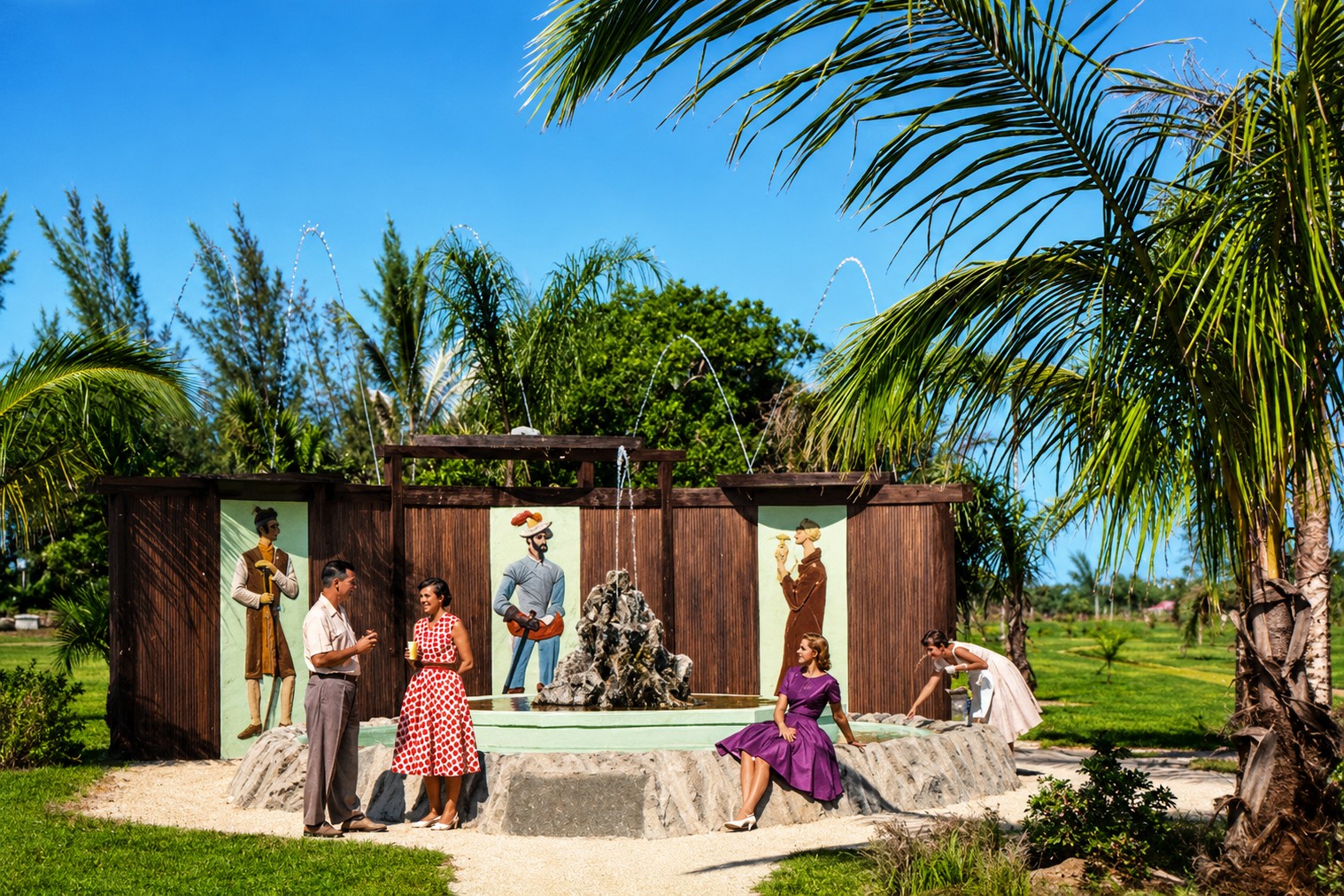
This restored view recreates the beautiful courtyard and Fountain of Youth at Warm Mineral Springs as visitors experienced it in 1955. During the 1950s, the spring was promoted as one of Florida's premier health resorts, attracting thousands of visitors seeking relaxation in its naturally warm, mineral-rich waters.
A visit to Warm Mineral Springs is unlike visiting any other natural spring in Florida. Rather than swimming through a crystal-clear spring run or kayaking along a river, visitors come here to relax, float, and experience one of the world’s most unusual natural mineral springs.
Whether you are interested in geology, archaeology, wellness, natural history, or simply enjoying a peaceful day outdoors, the spring offers a memorable experience.
What to Expect

This restored view recreates the popular swimming area at Warm Mineral Springs as it appeared in 1955, during the height of Florida's postwar tourism boom.
Warm Mineral Springs forms a nearly circular lake surrounded by tropical and subtropical vegetation. Visitors commonly enter through designated access points, then float quietly, enjoy the constant warmth, or swim leisurely within approved recreational areas.
Unlike many Florida springs, the water has a mild natural sulfur aroma caused by hydrogen sulfide, one of the naturally occurring constituents acquired during its long underground journey. Many visitors become accustomed to the aroma after spending a short time near the water.
The spring reaches a maximum depth of approximately 205 feet (62.5 meters). Diving is prohibited except when specifically authorized for scientific or official purposes, helping protect visitors and the internationally significant archaeological resources beneath the lake.
Best Time to Visit
Warm Mineral Springs can be enjoyed throughout the year because its water remains close to 85°F (29–30°C).
The spring remains popular throughout the year, particularly during Southwest Florida’s cooler winter season.
Admission, opening hours, visitor access, regulations, accessibility information, and temporary closures may change. Confirm current details through the official City of North Port website before visiting.
A Place Unlike Any Other
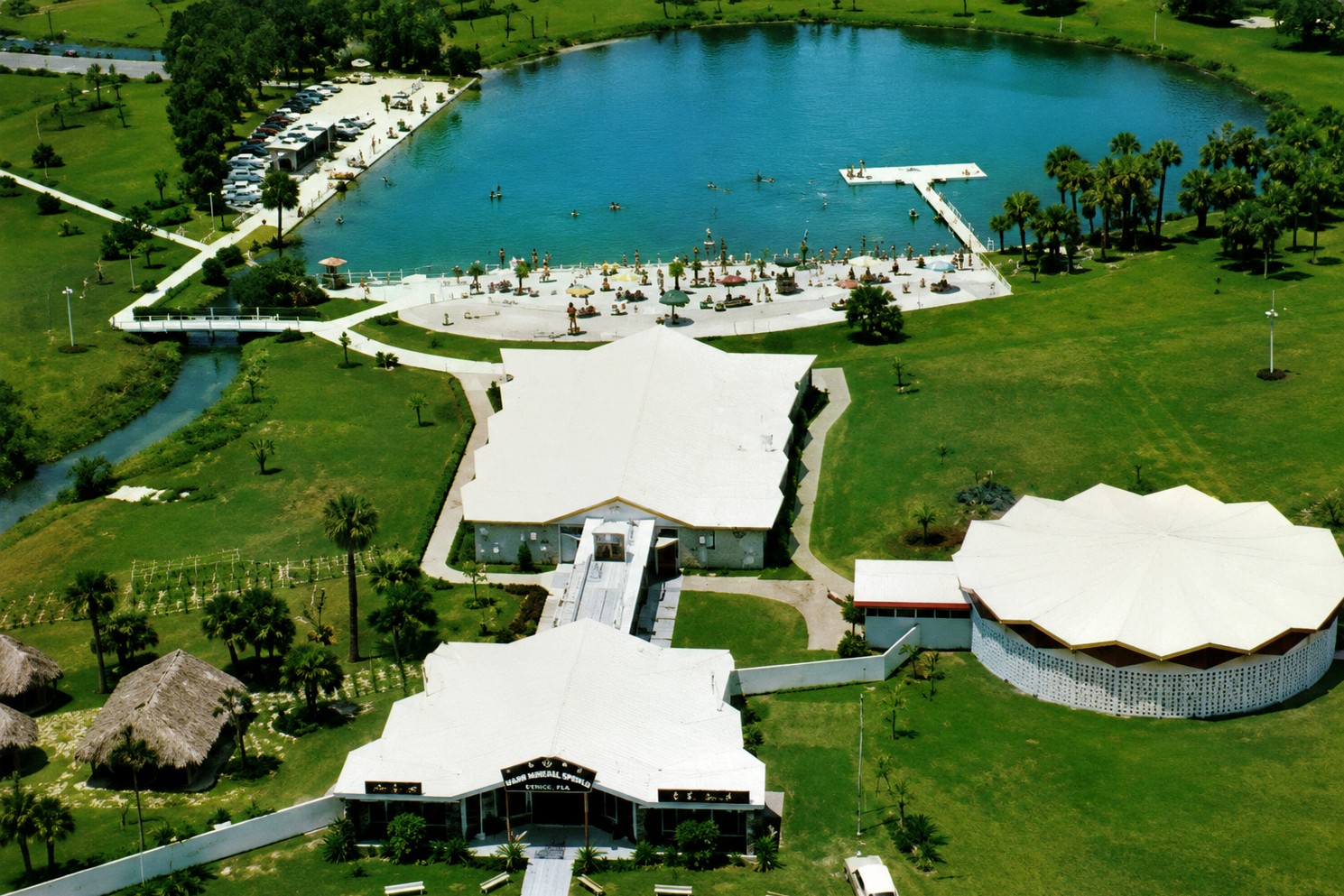
This restored aerial view captures Warm Mineral Springs Resort during its golden era in the 1950s and 1960s, when it ranked among Florida's best-known health and wellness destinations.
Warm Mineral Springs is far more than a place to swim. It is a destination where millions of years of geological history, prehistoric archaeology, scientific discovery, natural beauty, and relaxation come together in one remarkable location.
Whether you come to float in warm mineral water, discover Ice Age history, observe local wildlife, or simply enjoy a peaceful afternoon, Warm Mineral Springs offers an experience unlike anywhere else in Florida.
It is a place where geology, archaeology, nature, and human history meet above one of North America’s most remarkable prehistoric landscapes.
“Some places impress you with dramatic scenery. Others surprise you with hidden history. Warm Mineral Springs does both. Every visitor floats on the same warm water, but few realize they are also floating above thousands of years of Florida’s story. That is what makes this place unforgettable—not just what you see on the surface, but everything waiting beneath it.”
Visiting Warm Mineral Springs
Warm Mineral Springs offers a year-round experience where naturally warm mineral water, geology, archaeology, natural history, and relaxation come together in one remarkable place.
Best Time to Visit
Warm Mineral Springs can be enjoyed throughout the year thanks to its naturally constant water temperature of approximately 85°F (29–30°C). Every season offers a slightly different experience, making the spring an attractive destination year-round.
Many visitors prefer:
Because the spring maintains nearly the same temperature throughout the year, visitors can enjoy a relaxing soak even during Florida’s cooler winter months. Weather conditions, visitor numbers, and special events may vary seasonally, so it is always a good idea to check the official park website before planning your visit.
A Place Unlike Any Other

Captain Pavel's Explorer's Note: "People ask whether these waters really have healing powers. I always answer, 'I don't know about that... but I've never seen anyone in a hurry to leave.'"
Warm Mineral Springs is much more than a place to swim. It is a remarkable destination where geology, archaeology, natural history, and wellness come together in one extraordinary location.
Few places in North America offer the opportunity to float in naturally warm mineral water while standing above an ancient sinkhole that preserves evidence of Ice Age animals and some of Florida’s earliest inhabitants.
Whether you come to relax in the warm mineral-rich water, learn about the spring’s fascinating geological history, observe local wildlife, or simply experience one of Florida’s most unique natural wonders, Warm Mineral Springs offers an unforgettable experience unlike anywhere else in the Sunshine State.
More than just a visitor attraction, the spring is a living reminder that nature is constantly shaping our world. For thousands of years, warm artesian water has risen from deep beneath the Earth, creating a place that continues to inspire scientists, historians, and visitors from around the world.
“Some places impress you with beautiful scenery. Others surprise you with hidden history. Warm Mineral Springs does both. Every visitor floats on the same warm water, but few realize they are also floating above thousands of years of Florida’s story. That is what makes this place unforgettable—not just what you see on the surface, but everything waiting beneath it.”
Before You Visit
For the latest information about admission fees, operating hours, park rules, accessibility, temporary closures, and visitor policies, please visit the official City of North Port – Warm Mineral Springs Park website.
