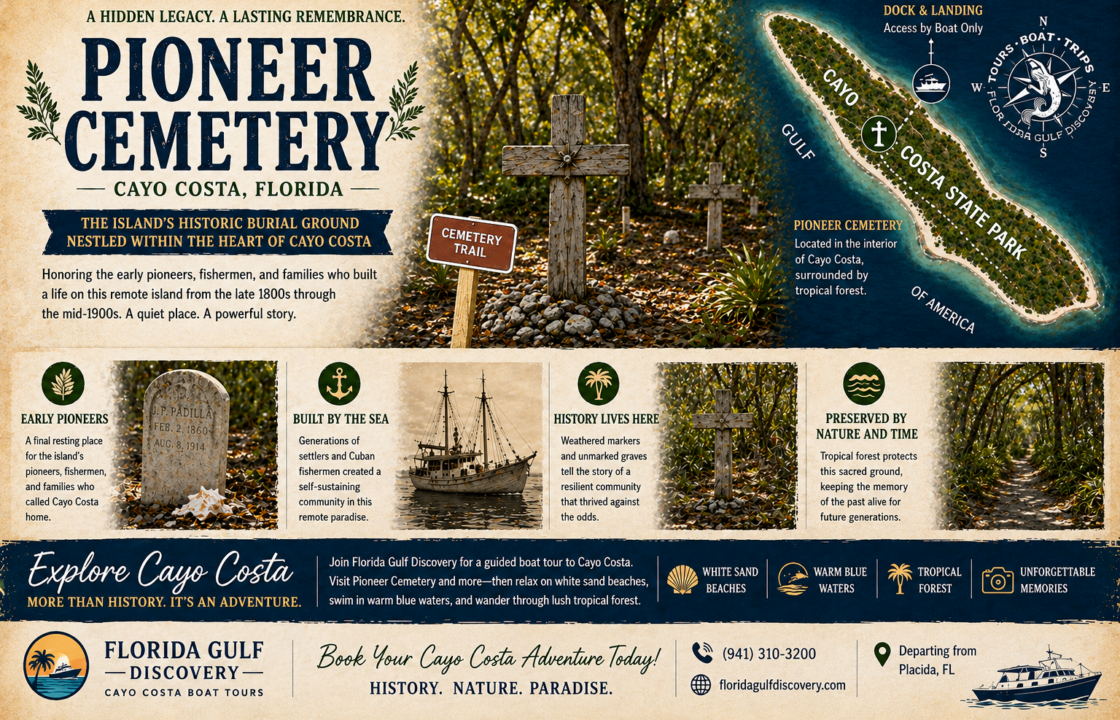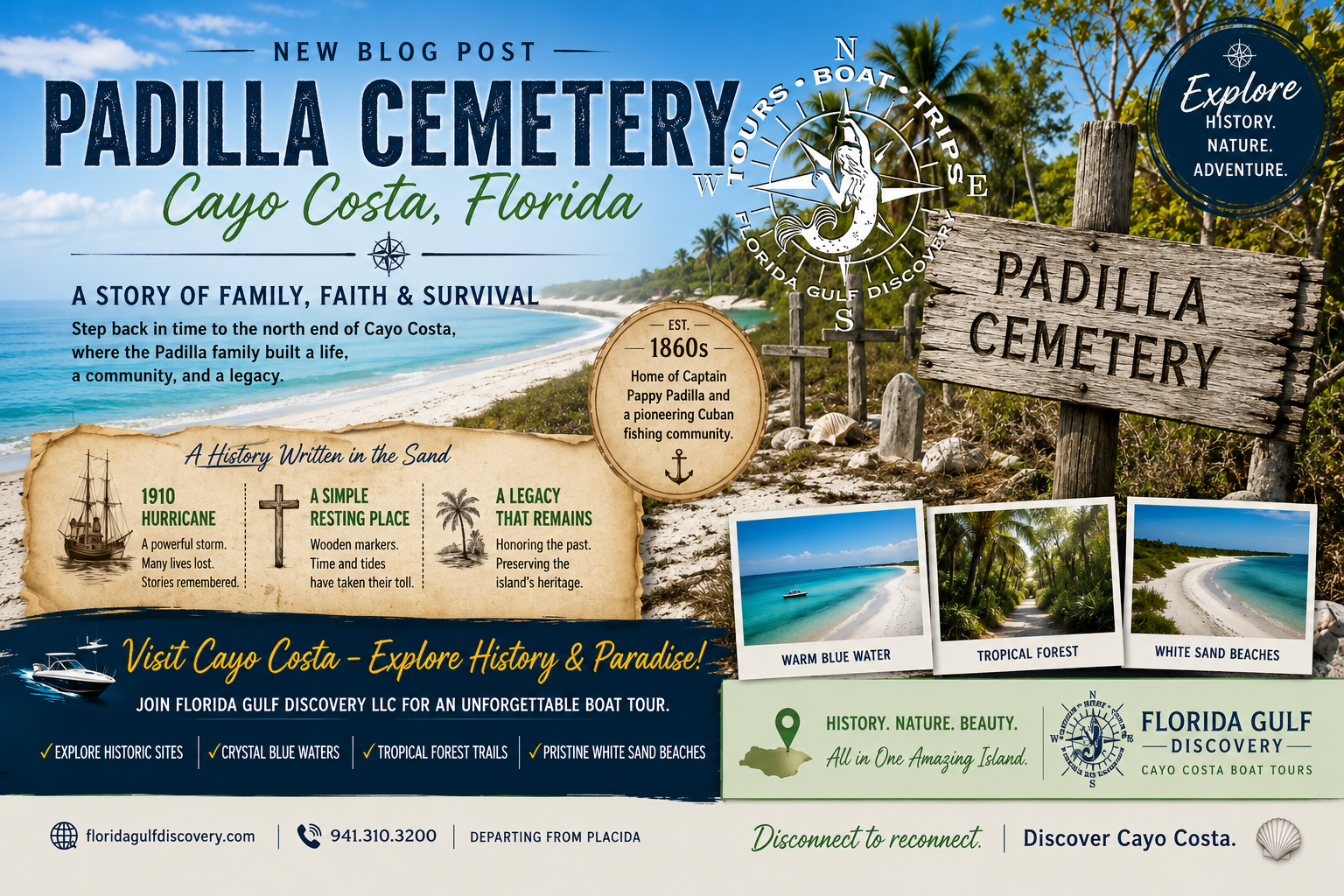
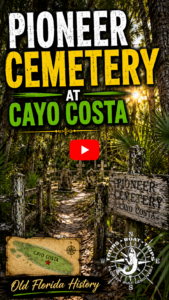
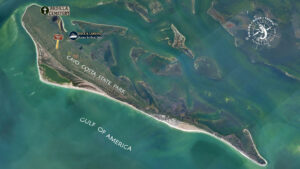
There are two cemeteries located within the grounds of Cayo Costa State Park. First, we will briefly describe them, and then we will recount the full history of the Padilla Cemetery—everything I was able to uncover during the course of my research. I have already described the Pioneer Cemetery on my blog; a link to that post can be found here:
https://floridagulfdiscovery.com/pioneer-cemetery-cayo-costa/
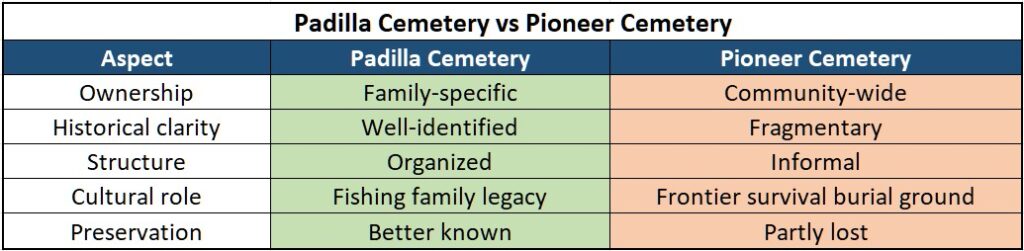
Pioneer Cemetery is generally described as the broader community burial ground tied to the old fishing village / pioneer settlement on Cayo Costa, while Padilla Cemetery is described as the specific Padilla family cemetery on the island’s northeast end.
There is a wrinkle, though: some sources blur the line. Find a Grave says Cayo Costa Pioneer Cemetery began as a resting place for members of the Padilla family, which suggests overlap in origin. But Florida State Parks separately describes the Padilla family cemetery as the place where “Pappy” Padilla and his wife were buried, and where some 1910 hurricane victims may also be buried.
So, the safest way to say it is:
-
- Pioneer Cemetery = the island’s general pioneer/fishing-settlement cemetery
- Padilla Cemetery = the Padilla family’s own cemetery, more specifically associated with Captain Pappy Padilla and possibly the 1910 storm victims
In practice, the two are often confused because erosion, lost markers, and inconsistent modern listings have blurred the original layout and naming.
Padilla Cemetery – What Seems Well Documented.
I’m doing a second pass on the people, the Padilla family connection, and the hurricane-era burial story, and I’ll separate what is well documented from what is tradition or inference.
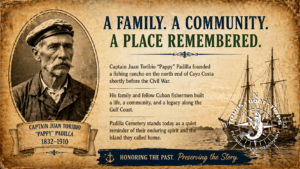
The cemetery is tied to the Padilla settlement on Cayo Costa, especially to Toribio / Tariva / Tervio Padilla, often called “Captain Pappy.” Florida State Parks says Tariva “Captain Pappy” Padilla founded a small fishing rancho on the north end of Cayo Costa shortly before the Civil War, and that the Padilla family lived there as part of a self-sustaining fishing community connected to Cuba.
A University of Florida / Randell Research Center history gives the clearest biographical detail I found: Toribio “Tariva” Padilla (1832–1910) was born in the Canary Islands, immigrated to the Florida Keys, became a U.S. citizen in 1862, and married Lainey/Juanita Perez in Key West in 1867. That source also places him firmly in the rancho economy of southwest Florida, where fish were caught and processed for the Cuban market.
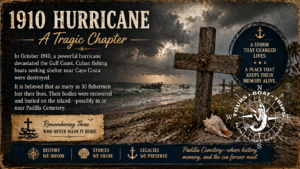
Florida State Parks also states that an estimated 30 Cuban fishermen who died in a 1910 hurricane may be buried at the cemetery site, though much of the area has since eroded into the bay. That is the most authoritative public statement I found on the “mass burial” part of the story.
The 1910 hurricane itself is real and well documented. NOAA’s hurricane archive identifies the major October 1910 storm that crossed Cuba and struck southwest Florida near Cape Romano, and regional historical accounts say Cuban fishing vessels had sheltered along the harbor side of Cayo Costa as the storm approached Charlotte Harbor.
What the burial records suggest
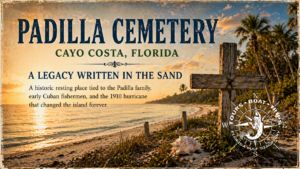
Public cemetery databases support the Padilla connection, but they also reveal a naming problem.
Find a Grave’s entry for Cayo Costa Pioneer Cemetery says it “began as a final resting place for members of the Padilla family,” and that many original wooden markers have rotted or washed away. It also says islanders buried bodies of Cuban sailors washed ashore there in the late 1800s.
A separate Find a Grave entry exists for Padilla Cemetery, described as a different place on the northeast end of Cayo Costa. That entry says it should not be confused with Cayo Costa Pioneer Cemetery, and adds that after Hurricane Charley in 2004 shoreline erosion removed most visible evidence; it also says recovered victims of the 1910 hurricane were buried there.
So the public record does not fully agree on whether there was:
-
- one cemetery later remembered by two names,
- two nearby burial grounds with overlapping stories,
- or a main cemetery plus a more isolated Padilla-family/hurricane burial area.
The safest conclusion is that the Padilla family and the hurricane victims are central to the burial history of north Cayo Costa, but the exact modern mapping of “Pioneer Cemetery” versus “Padilla Cemetery” is not fully settled in public-facing sources.
Named people tied to the site
The clearest named burial tied to the Padilla side of the story is Captain Juan Toribio “Pappy” Padilla. His Find a Grave memorial identifies him as an early settler on Cayo Costa and patriarch of the Padilla clan, and notes that his first name appears in several spellings, with Toribio appearing on birth, marriage, and citizenship documents. It also lists several children, which helps explain why the cemetery story is really a family-settlement story, not just one individual grave.
Florida State Parks, meanwhile, speaks more generally of the cemetery as a remnant of the broader pioneer and fishing-village population that remained on the island until 1958.
What is tradition, local memory, or informed inference
Some parts of the story are repeated often but are less solidly documented in official sources.
The idea that many original markers were wooden and disappeared is plausible and repeated in cemetery listings, but I did not find a state or academic source directly inventorying those vanished graves.
The tradition that bodies washed ashore at “Dead Man’s Cove” and were buried with the island’s own dead appears in Find a Grave, but I did not find an official archaeological or state report in this search naming that cove as the confirmed burial location.
Likewise, the strong claim that the 1910 victims are in Padilla Cemetery specifically appears in cemetery listings and local histories, while Florida State Parks uses more cautious wording: they “may” be buried at the site and note substantial erosion. That softer wording is probably the most responsible phrasing.
The strongest historical narrative
The most credible version of the story is this:
Cayo Costa’s cemetery grew out of the island’s Padilla-led fishing settlement, a frontier community linked to the old Cuban rancho trade. Captain Pappy Padilla and his family helped anchor that community in the late 19th century. When people died on this isolated island, burial had to happen there. Then the 1910 hurricane struck the southwest Florida coast and likely added a second layer of tragedy: the dead from wrecked Cuban fishing crews. Over time, storms and shoreline change erased many of the physical signs, leaving modern visitors with a sparse burial ground but a much larger unseen history under and beyond it.
Bottom line
What I’m confident saying is:
-
- the cemetery is deeply connected to Captain Pappy Padilla and the Padilla family,
- it is also tied to the memory of about 30 Cuban fishermen lost in the 1910 hurricane,
and the exact boundaries, names, and grave count are uncertain today because erosion and lost markers have blurred the site’s original layout.
Final Thoughts: Visit Cayo Costa by Boat
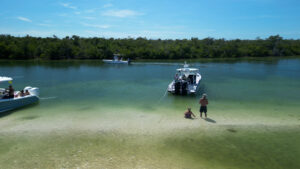
Padilla Cemetery is more than a historic site—it is part of the living story of Cayo Costa. A boat trip to this remote barrier island gives you the chance to explore places like Padilla Cemetery and Pioneer Cemetery, then experience the island’s warm blue Gulf water, tropical coastal forest, quiet trails, and white sand beaches.
Join Florida Gulf Discovery LLC for a Cayo Costa tour and discover the history, nature, and hidden beauty of one of Southwest Florida’s most remarkable islands.